But if you look into his papers, you’ll find that he also had an
intriguing way with pen and ink outside the realm of letters — or, if
you like, deep inside the realm of letters, since to see drawings by
Dostoevsky, you actually have to look within the manuscripts of his
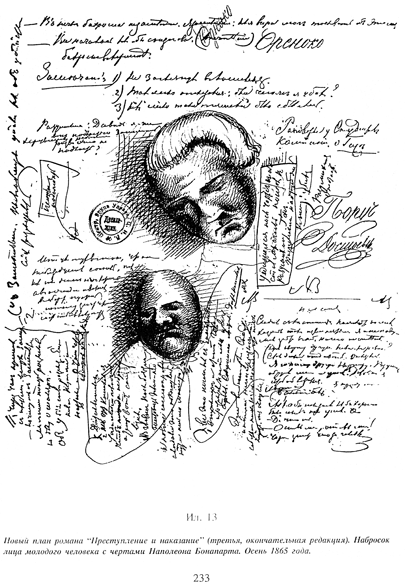
novels. Above, we have a page from Crime and Punishment
into which a pair of solemn faces (not that their mood will surprise
enthusiasts of Russian literature) found their way.
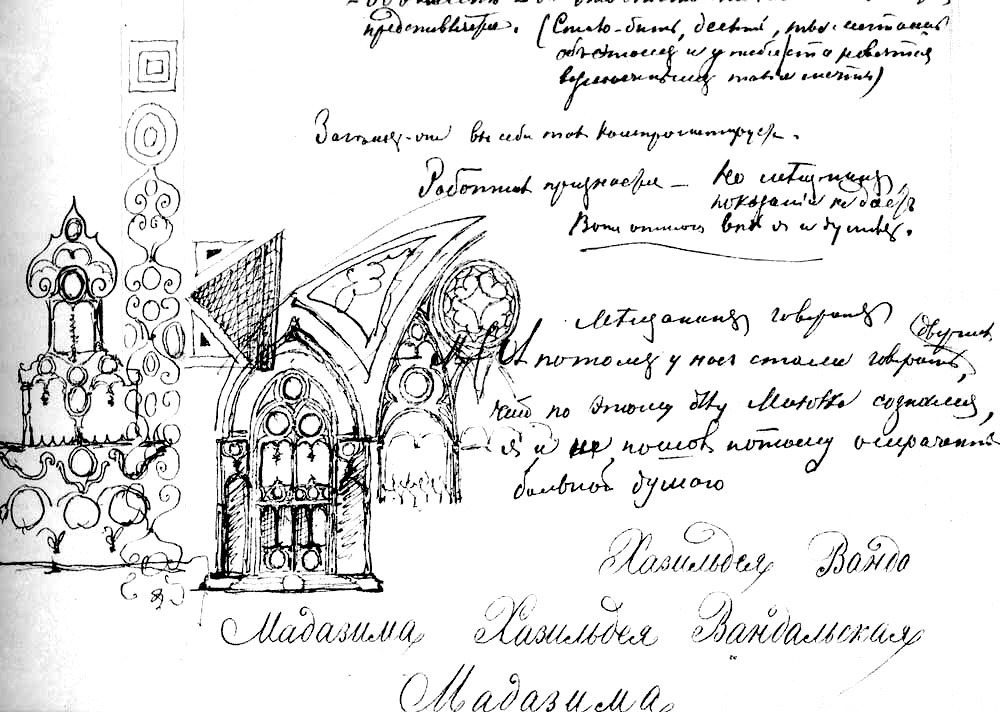
Just below, you’ll
find examples from the same manuscript
of his pen turning toward the ornamental and architectural while he
“created his fiction step by step as he lived, read, remembered,
reprocessed and wrote,” as the exhibition of “Dostoyevsky’s Doodles” at Columbia University’s Harriman Institute of Russian, Eurasian, and East European Studies put it.
According to the exhibition description, Dostoevsky’s notes to
himself “represent that key moment when the accumulated proto-novel
crystallized into a text. Like many of us, Dostoevsky doodled hardest
when the words came slowest.” Some of Dostoevsky’s character
descriptions, argues scholar Konstantin Barsht, “are actually the
descriptions of doodled portraits he kept reworking until they were
right.”
He didn’t just do so during the writing of Crime and Punishment, either; below we have a page of The Devils that
combines the human, the architectural, and the calligraphic, apparently
the three main avenues through which Dostoevsky pursued the doodler’s
art.
Even if you would personally argue against his claim to greatness
(and thus side with his countryman, colleague in literature, and fellow part-time artist Vladimir
Nabokov, who found him a “mediocre” writer given to “wastelands of
literary platitudes”), surely you can enjoy the charge of pure creation
you feel from witnessing his textual mind interact with his visual
one. Works by Dostoevsky can be found in our Free Audio Books and Free eBooks collections.



No comments:
Post a Comment