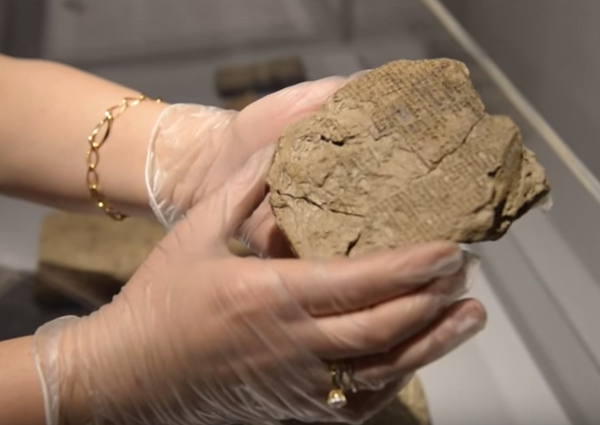
The Epic of Gilgamesh, one of the oldest narratives in the world, got a surprise update last month when the Sulaymaniyah Museum in the Kurdistan region of Iraq announced that it had discovered 20 new lines of the Babylonian-Era poem of gods, mortals, and monsters. Since the poem has existed in fragments since the 18th century BC, there has always been the possibility that more would turn up. And yet the version we’re familiar with — the one discovered in 1853 in Nineveh — hasn’t changed very much over recent decades. The text remained fairly fixed — that is, until the fall of Baghdad in 2003 and the intense looting that followed yielded something new.
the [Sulaymaniyah] museum has a matter of policy paid smugglers to keep artifacts from leaving the country, no questions asked. The tablet was acquired by the museum in late 2011 as part of a collection of 80-90 tablets sold by an unnamed shady character. Professor Farouk Al-Rawi examined the collection while the seller haggled with museum official Abdullah Hashim. When Al-Rawi saw this tablet, he told Hashim to pay whatever the seller wanted: $800.
That’s a pretty good deal for these extra lines that not only add to the poem’s length, but have now cleared up some of the mysteries in the other chapters. These lines come from Chapter Five of the epic and cast the main characters in a new light. Gilgamesh and his companion Enkidu are shown to feel guilt over killing Humbaba, the guardian of the cedar forest, who is now seen as less a monster and more a king. Just like a good director’s cut, these extra scenes clear up some muddy character motivation, and add an environmental moral to the tale.
In the video above, Hazha Jalal, manager of the tablet’s section of the Sulaymaniyah Museum talks (in Kurdish) about the new discovery, saying (in translation): “The tablet dates back to the Neo-Bablyonian period, 2000-1500 BCE. It is a part of tablet V of the epic. It was acquired by the Museum in the year 2011 and [then] Dr. Farouk Al-Raw transliterated it. It was written as a poem and many new things this version has added, for example Gilgamesh and his friend met a monkey. We are honored to house this tablet and anyone can visit the Museum during its opening hours from 8:30 morning to noon. The entry is free for you and your guests. Thank you.”
Ted Mills is a freelance writer on the arts who currently hosts the FunkZone Podcast. You can also follow him on Twitter at @tedmills, read his other arts writing at tedmills.com and/or watch his films here.
A recent study has shown that a group of hunter-gatherers had survived the last Ice Age while living in the modern location of Europe, only to unexpectedly disappear about 14,500 years ago.
As the Newspaper El País reports, when scientists began to study the genetic material of humanity’s ancient ancestors about 30 years ago, they commenced on a quest for knowledge about a time in our collective past that was generally believed to have been lost forever. Several studies that have arisen since then have shown that all of the hard work has not been in vain.
Now, research including Johannes Krause, director of the Max Planck Institute for the Science of Human History and published in the journal Current Biology , has analyzed the genes of 35 individuals who lived between 35,000-7,000 years ago in modern France, Germany, Belgium, Italy, Czech. Republic, and Romania. The results of their study are surprising.
About 25,000 years ago, the last Ice Age began and froze about half of the world, causing many prehistoric humans to seek shelter in the south of Europe. The chilling temperatures and the consequences of this greatly reduced the human population in the area and subsequently decreased diversity in the groups that survived.
About 25,000 years ago the last Ice Age began, which froze about half of the world and caused many prehistoric humans to seek shelter in the south of Europe. Artistic representation of the last Ice Age. (Ittiz/CC BY – SA 3.0 )
The current study found that the mitochondrial DNA of three of the individuals, who correspond to modern France and Belgium and lived before the Last Glacial Maximum (the coldest period in the last Ice Age), were from haplogroup M.
This was a shock to the researchers, as Cosimo Posth of Tübingen University, the lead author of the study reported:
“I couldn’t believe it. The first time I got this result I thought it must be a mistake, because in contemporary Europeans haplogroup M is effectively absent, but is found at high frequency in modern Asians, Australians and Native American populations.”
These results suggest that haplogroup M existed in Europe relatively recently and provide evidence for the hypothesis that “all non-Africans quickly dispersed from a single group at a specific time, which scientists believe occurred around 50,000 years ago.” [Via The Independent ]
However, the questions arise: What happened to make this group of hunter-gatherers disappear from the region of Europe 14,500 years ago? How is it that they survived the chilling Ice Age only to fail to survive the subsequent warming?
“Regarding what happened to them, we can only speculate, and think that perhaps these people had adapted to the cold climate or to hunt mammoths, and that people better adapted to the warmer climates came in later from the near East or from the southeast of Europe. We don’t know who replaced them or where they came from for sure, however, their DNA can help us better pinpoint where they may have come from.”
Map of human migration based on mitochondrial haplogroups. Pink corresponds to areas dominated by haplogroup M and their offspring in indigenous populations. (Maulucioni/ CC BY SA 3.0 )
Carles Lalueza Fox , researcher with CSIC in the Institute of Evolutionary Biology of Barcelona, agrees with the results of the study, saying that they can be linked to some of his own research. “When we studied La Braña (a site located in León, Spain) we saw evidence for low genetic diversity and a diminished population in mitochondrial DNA of the Mesolithic.”
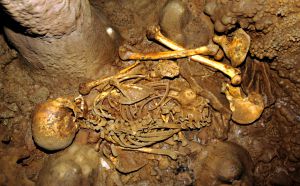
Skeleton of a hunter-gatherer from about 7,000 years ago. Found in the La Braña site. ( El País/ J.M. Vidal Encina )
Lalueza Fox explained that normally there is some amount of continuity between different cultures, however the change in Europe 14,500 years ago was very brisk. The disappearance of the hunter-gatherer group also coincides with the rise of the Magdalenian culture . This too may suggest that the hunter-gatherer group was weakened for some reason and overtaken by newcomers who were better suited to the climate.
Featured Image: ‘The Stone Age’ (1882-1885), detail of a painting by Viktor M. Vasnetsov. Source: Public Domain
According to conventional archaeology, writing wasn’t invented until 3000 to 4000 BC in Sumeria. However, an artifact was found over a decade ago which contradicts this belief – and perhaps this is the reason why few people know about the discovery.
The Dispilio tablet was discovered by a professor of prehistoric archaeology, George Xourmouziadis, in 1993 in a Neolithic lake settlement in Northern Greece near the city of Kastoria.
A group of people used to occupy the settlement 7,000 to 8,000 years ago. The Dispilio tablet was one of many artifacts that were found in the area, however the importance of the table lies in the fact that it has an unknown written text on it that goes back further than 5,000 BC. The wooden tablet was dated using the C12 method to have been made in 5260 BC, making it significantly older than the writing system used by the Sumerians.
The text on the tablet includes a type of engraved writing which probably consists of a form of writing that pre-existed Linear B writing used by the Mycenaean Greeks. As well as the tablet, many other ceramic pieces were found that also have the same type of writing on them. Professor Xourmouziadis has suggested that this type of writing, which has not yet been deciphered, could be any form of communication including symbols representing the counting of possessions.
More artifacts were discovered that show the economic and agricultural activities of the settlement, proof of animal breeding and their diet preferences as well as tools and pottery, figurines and other personal ornaments.
Decoding the writing is going to be difficult if not impossible, unless a new Rosetta stone is found. Unfortunately, by the moment the tablet was removed out of its original environment, contact with oxygen started the deterioration process and it is now under preservation. It is impressive to think that the wooden tablet had remained at the bottom of the lake for 7,500 years.
While this artifact predates the Sumerian writing system, I am sure in the future more will be found in other areas of the world that will go even further back in time, until the true history of humanity will be unraveled and completely change what we know about our history.
Excavations at Dispilio constitute a landmark for archaeological investigations in Greece because of the special character of the site and because it permits the study of habitation structures during the Neolithic Period.
The houses of the settlement, circular and rectangular, were built of timber, reed, and clay upon timber-post framed platforms. The modern reconstruction of the lakeside settlement provides a wonderful insight into the habitation norms of that period.
Among the fauna and flora remains, as well as the mobiliary finds from the excavations (pottery, tools, etc.), the whole range of economic activities of the prehistoric inhabitants of Dispilio are represented: farming, animal husbandry, hunting and fishing.
Numerous bone hooks and traces of a boat, identical to those used to this day by the fishermen of Kastoria, is clear evidence that fishing was practised. Finds, such as leaf-shaped and triangular arrowheads of Melian obsidian, pottery similar to that of the neighboring Balkan areas, and a stone ring idol pendant, place the settlement of Dispiliowithin the exchange networks developed in Greece in particular during the Late Neolithic period.
Grey pottery of the Tsangli type, black burnished ware of the Larisa type, and polychrome-painted vessels date to the phases of the Late Neolithic I. In the late phases of the settlement, black and blacktopped ware predominated, as well as red burnished and painted designs (brown on a light background). Characteristic types of vases were bowls, fruit stands, closed vases with a neck, and clay tables.
The community at Dispilio must have been a culturally evolved one, as is indicated by the three bone flutes, along with a wooden tablet with incised linear symbols that archaeologists were happy to unearth (please see our album). This tablet dates with certainty from 5260 BC, and is probable to be an early form of written speech, as has been assumed about similar symbols on clay, discovered at settlements in the southern Balkans (Vinca culture).
The signs (letters) on the tablet transcribed. They really look like writing.
I also think they bear some resemblance to these symbols..
This inscription was made about 6,500 years ago on the wall of a cave near Sitovo (next to Plovdiv, Bulgaria). The written signs are in two lines and each row is 3,4 meters long. The signs are 40 cm tall.
There’s a legend from Europe that the birch goddess taught people to write, and there is evidence from medieval finds that birch bark has been used as a form of parchment in Europe. Only time will tell if it’s really writing.
It was a few years ago that a Greek-American archaeological team made a startling discovery – they found the oldest indications of seafaring and navigation in the world, in an area called Plakia on Crete Island in Greece. It is an incredibly important discovery that is given little attention, despite the fact that it reached the top ten discoveries of 2010. Their research is forcing scholars to rethink the maritime capabilities of early human and pre-human cultures.
The team of archaeologists were carrying out excavations in a gorge on the island of Crete when they discovered a Palaeolithic site in the canyon of Preveli, where more than 30 hand axes and hundreds of other stone tools, such as cleavers and scrapers, made from quartz were found scattered across more than 20 different locations. Until this discovery, it was believed that ancient humans reached Crete, Cyprus, a few other Greek islands, and possibly Sardinia, no earlier than 12,000 years ago. However, remarkably, the stone tools found at Parkia were dated to at least 130,000 years old.
The tools were dated through stratigraphic analysis, a branch of geology which studies rock layers. The cliffs and caves above the shore were uplifted in the ancient past by tectonic forces. The exposed uplifted layers represent the sequence of geologic periods that have been well studied and dated. The team analyzed the layer bearing the tools and determined that the soil had been on the surface 130,000 to 190,000 years ago.
Rocky bluffs around the village of Plakia were actually the shoreline zone in prehistoric times. This is where the team began excavations. Image source .
Considering Crete has been an island for five million years, the tools could have only arrived in that location if ancient humans or pre-human species travelled there by boat. This means that sea traveling existed in the Mediterranean Sea tens of thousands of years before what archaeologists initially believed, and that early Homo sapiens or their ancestors used boats capable of open-sea navigation. Prior to this discovery, the oldest established marine travel was the sea-crossing migration of anatomically modern Homo sapiens to Australia, where they had to cross between islands with the maximum open water distance of 71 km, beginning about 60,000 years ago, although this time line is debatable.
What is particularly interesting, is that the style of the tools closely resembles artifacts from the stone technology known as Acheulean, which originated with pre-human populations in Africa. For decades, the standard hypothesis has been that Acheulean toolmakers reached Europe and Asia via the Middle East, passing mainly through what is now Turkey into the Balkans. The findings in Crete raise the possibility that human migration was not confined to land routes and may have included expansion from Africa across the Strait of Gibraltar to Spain, or from Libya to Crete – a stretch of approximately 200 miles (320 km).
It was initially believed that the earliest boats were log rafts with sails made of animal skins sewn together and lashed to a tree limb to catch the wind. However, experts on early nautical history have said that the ancient mariners would have required something much sturdier to make the distance between North Africa and Crete.
One theory is that the boats of Stone Age migrants were log rafts with sails made of animal skins sewn together and lashed to a tree limb to catch the wind. Image source .
Archaeologists cannot be certain about whether the tools found on Crete were made by Homo sapiens or another pre-human ancestor. One hundred and thirty thousand years ago, modern humans shared the world with other hominids, like Neanderthals and Homo heidelbergensis. It has long been believed that early humans, and certainly pre-human species, were incapable of creating boats or navigating across open water. But this discovery challenges that assertion and suggests that they were capable of much more sophisticated behavior than their relatively simple stone tools would suggest.
“The results of the survey not only provide evidence of sea voyages in the Mediterranean tens of thousands of years earlier than we were aware of so far, but also change our understanding of early hominids’ cognitive abilities,” said the Greek Culture Ministry in a statement about the discovery.
The research, if confirmed by further study, will turn the timetable of technological development on its head and offer new perspectives on how ancient humans migrated and expanded throughout the world.
Could the prehistoric Stonehenge megaliths once have been the support for a wooden, two-storey roundhouse, a venue for feasting, speakers and musicians? That’s the theory of an English landscape architect who designed a small model of what she has in mind and is looking for money to build a 1:10 scale model of the structure.
Sarah Ewbank says the fact she is not an archaeologist has freed her from preconceived notions and allowed her to approach the matter in a fresh way.
Ms Ewbank told Ancient Origins via email about her vision of Stonehenge:
“I believe Stonehenge was a Bronze-age venue, a large oval hall encircled and overlooked by galleries. Interestingly the upper level was tiered, the height of different sections reflecting the different height trilithons. Consider both hall and galleries filled, listening to a speaker, or maybe there was feasting on the galleries with dancing below, perhaps crowds gathered to listen to singing or musicians playing, or maybe ceremonies took place to welcome in the solstices. It all sounds rather splendid and certainly needed – there were no electronic gadgets then!
My view – such a splendid building deserved to be used often – so, much as the Albert Hall in London serves to accommodate every type of gathering, so I believe our Bronze-age ancestors used Stonehenge whenever such a venue was required. Our bronze-age ancestors were intelligent people with needs similar to ours today. Forget the furry loin cloth and ritual sacrifice stuff - it's wrong.”
She said she’s discussed her theories with other experts. Some of them agree with her interpretation of the building’s use, but others strongly disagree and argue for the traditional view.
The way the monument looks today . Howard Ignatius/ Flickr
Ms. Ewbank speculates that the sides of the house were made of oak and the roof of thatching. Of course, it is highly unlikely wood or straw would survive the thousands of years of Stonehenge’s existence, so finding physical evidence for her theory—other than the layout of the stones themselves—is next to impossible.
In fact, she says on her website people have asked her if there is evidence of a roof. She points out that 500-year-old abbeys have roofs missing. “So don’t expect to find the timber structure lying around after 4,000 years,” she said.
“When you look at it the whole thing it fits absolutely perfectly,” she’s quoted as saying in SalisburyJournal. “I haven’t had to push one stone out of place. I have just taken all the standing stones and it all fits.”
She lists several reasons on her website for theorizing the monument was a roundhouse, including: One of the stones is called the “lintel stone,” apparently for an important reason. The blue-stones have grooves in them for structural purpose. The trilithons are spaced just right to support four large trusses. The height difference between the trilithons allowed raising of the trusses.
Ms. Ewbanks writes on her blog:
To form the large trusses, only eight 15-baunt (16-metre) oak timbers with angled profile are required. Bronze-age oaks were very likely bigger and better than those available today. Apparently ship-building in past-times robbed the UK of the good-sized oaks! Before discounting this idea ask yourself, ‘If Bronze-age people are capable of quarrying, moving and shaping stones that weigh 20 to 50 tonnes, can they fell and oak and shape the timber to form a roof?’ The answer can only be yes.
She told SalisburyJournal:
“Archaeologists are very obsessed with dating and the meaning of it. I looked at it and thought it was a ruin, and that with my design skills I could work out what was there. In our climate back in the Bronze Age it still rained, and why would you move 75 large stones just so you could dance around twice a year? If you put a roof on it you can use it all year.”
And those ancient people apparently moved those stones quite a distance. Archaeologists announced in December 2015 that they found the exact holes in a rocky outcrop in Wales from where the bluestones found at Stonehenge originated, revealing that they were quarried 500 years before they were assembled into the famous stone circle that still stands today in Wiltshire, England. The dramatic discovery suggests that some of the stones making up the ancient monument was first erected as a structure in Wales and later dismantled, transported, and reassembled over 140 miles away in Salisbury Plain.
Computer rendering of the overall site of Stonehenge and surrounds
The Guardian reports that the finding was made during a project run by the University College London (UCL), in cooperation with the universities of Manchester, Bournemouth and Southampton, among others, to investigate quarries in the Preseli Hills in Pembrokeshire, Wales.
It has long been known that the bluestones – a term used in a loose sense to cover all of the ‘foreign’ stones which are not native to Salisbury Plain – originated in southwest Wales. Their name actually refers to the spotted dolerite, an igneous rock that looks blue when broken and is spotted with small pellets of feldspar and other minerals that got into the molten matrix when the rocks were forming geological ages ago. Nearly a century ago, in 1923, the eminent petrographer, Herbert Thomas, was able to identify their source as the Preseli hills .
Another scholar, Julian Spalding, theorized recently that the Stonehenge we know today may have been merely the support for a series of elevated wooden platforms. These platforms could have been used for spiritual ceremonies, elevating religious leaders off the ground - bringing humans closer to the heavens and the gods.
Art critic, historian and former curator Spalding said to The Guardian : “In early times, no spiritual ceremonies would have been performed on the ground. The Pharaoh of Egypt and the Emperor of China were always carried – as the Pope used to be. The feet of holy people were not allowed to touch the ground. We’ve been looking at Stonehenge from a modern, earth-bound perspective.”
No physical evidence has been found to back up the historian’s claim.
The exact purpose of Stonehenge is not known, but some researchers believe it was built as an ancient calendar to mark seasons and the movements of the sun and moon. Others say it was a place of healing, or dying, or perhaps a place of worship.
Featured Image: The famous Stonehenge monument in Wiltshire, England, as imagined in a 1:50 scale model made by landscape architect Sarah Ewbanks. ( Image copyrighted by Sarah Ewbanks )
Herodotus describes the Scythians living in the area north of the Black Sea about three thousand years ago.
According to him they traced their ancestry directly from Zeus and the river nymph Borysthenis, daughter of the river god Borysthenes, the union of which produced a son named Tagitaos and he in turn had three sons with a human woman, demigods, who were the progenitors of the three Scythian tribes. It is said that in the time of the sons of Tagitaos there came down from heaven four items made of gold. These items were a plow, a yoke, a cup and a battle axe. Each brother attempted to use the items but they were met with a blazing fire or great heat but when the youngest approached the items the fire was gone and they worked only for him and from him the tribe of the Royal Scythians was formed. If one looks at such a tale with modern eyes we could imagine that the items were technology coded to only function for one individual and possibly dangerous as it was also said that anyone who slept while guarding these items in the open would die within a year
Now while Herodotus, the historian and teller of this tale doubted that the Scythians were indeed the descendants of Zeus, he nonetheless recorded their accounts. He also tells a different account where they are the descendants of another of Zeus’ sons, Heracles and the half serpent half goddess Echidna, but that story seems like a more fanciful telling of the first story and involves many of the same events. He goes on to say that he favours a third version of their origin which tells of wandering Asiatic tribes that migrated into the lands of the Cimmerians.
The longer you look, the origin of the Scythians becomes more and more cloudy and some scholars contend that the Scythians referred to by Herodotus are really only the remnants of a much earlier people who were once widespread and very advanced with great cities, ships, farming and herding. If we remember the story of the golden plow, yoke, cup and battle axe we would infer that farming must have been important to the early Scythians if their gods saw fit to gift them with a magical plow and yoke, not a very practical gift for nomadic horsemen. This possibility seems very likely since the Scythians of Herodotus’ time were known to be nomadic and the earlier Scythians are credited with developing the smelting of iron and bronze, the invention of the battle axe (actually credited to the Amazons among the Scythians), the pottery wheel, the bellows, the anchor and the science of horse breeding. One has to wonder why nomads would invent the anchor.
Fred Hamoriwrote that Justinius II referred to the Scythians as one of the oldest civilizations in the world; even older than the Egyptians and that they were most likely a northern Mesopotamian culture, not the later immigrant tribes who adapted many of their customs.
The Scythians described by the Greeks were apparently an amalgamation of many peoples overlaying a very ancient culture that existed in the area around the Black Sea.
Whatever their origins, the Scythians were a remarkable people with a very ancient origin that remains a mystery.
However, two more tales of the Scythians are even stranger.
One is the story of the bald people who were once part of the royal Scythians but separated themselves and went to live isolated at the foot of a mountain. Herodotus described them thus; Passing over a great extent of this rough country, you come to a people dwelling at the foot of lofty mountains, who are said to be all- both men and women- bald from their birth, to have flat noses, and very long chins. These people speak a language of their own; the dress which they wear is the same as the Scythian. They live on the fruit of a certain tree, the name of which is Ponticum; in size it is about equal to our fig-tree, and it bears a fruit like a bean, with a stone inside. … No one harms these people, for they are looked upon as sacred- they do not even possess any warlike weapons. When their neighbors fall out, they make up the quarrel; and when one flies to them for refuge, he is safe from all hurt. They are called the Argippaeans .
Now we have a race of people who believe they were descended from the three sons of a god, they are so early that even in the time of Herodotus their origins were ancient history, they believed they had received technology directly from their gods and a small number of them, described as not normal humans lived apart and served as judges and protectors and the strange story gets even stranger…now we bring in the Amazons.
It seems that in all the histories of the Scythians one point is either marginalized or simply mentioned as if it is not important, but I contend that it is of upmost importance if we are to truly understand the psyche of the Scythians, the existence of the Amazons and in fact the history of all humanity.
The ancient Scythians, the ones who predate the nomads, worshiped as
their main deity not a god but a goddess,the half snake half woman
deity known as Tabiti, who coincidentally fits the description of
Tagitaos’ mother in the Scythian origin story . She was the Earth
Goddess who was said to be the witness of all things, often depicted as a
woman with child she traveled with a raven and a wolf.
The Goddess is the most ancient of all deities with depictions dating
back over 29000 years BC and her worship held sway until only about
four thousand years ago when mankind spiraled into never ending
warfare. Her names are almost endless, Anu, Eki, Hathor, Isis, Danu,
Cali; the list would go on for pages but they all represented the same
thing, the sacred feminine, the great mother.
The fact that matriarchal
or egalitarian societies might have existed and in fact may have been
the norm prior to the ‘historical’ period is now dismissed by most
mainstream historians but I contend that they were the norm and they did
not die out suddenly. There was a time of transition during which women
and men still existed as equals in society and the Amazons are a
compelling example of one of these transitions.
Herodotus, with his usual flare, tells a remarkable story of how the
Amazons came to be with the Scythians which makes a great deal more
sense when one understands that the nomadic Scythians were later
arrivals and the Amazons were part of an earlier civilization still
existing to the south of the Black Sea but in constant threat from the
Greeks as the accounts of many battles suggest. He recounts that after
the Battle of Thermodon, several galleys carrying Amazon prisoners were
retaken by the captives and the women came ashore in the land of Scythia
on the north shore of the Black Sea They engaged some of the Scythians
in combat who upon discovering that the dead were actually women decided
not to try to kill the newcomers but woo them instead. They eventually
approached them unarmed and the two groups decided to merge but not
without negotiations.
The Amazons refused to live as Scythian women,
they would not give up their place in society so their new Scythian
husbands agreed and asked for their inheritance to be given them and
they left for lands to the northeast. This story seems to tell of a
merging of the nomadic Scythians with the earlier matriarchal society
and their migration away from the patriarchal societies rising to power
to the south and eventually the entire world.
Of course most mainstream historians call the Amazons creatures of
myth not because there are not ample records of their battles and
individuals but for the reason Strabo the Greek historianput it 2000
years ago,
“For who can believe that an army of women, or a city, or a
nation, could ever subsist without men? and not only subsist, but make
inroads upon the territories of other people, and obtain possession not
only of the places near them, and advance as far as the present Ionia,
but even dispatch an expedition across the sea to Attica?”
Who indeed
could believe such a thing? Certainly not the men who have written
history but now we have their bodies, women buried with the respect once
though only reserved for men and these tattooed women warriors are much
harder to call a myth.
The origin of the word Amazon may have come from the Iranian language. The work ha-mazan (phonetic pronunciation) meant warrior and the nomadic Scythians that migrated into the eastern European region are believed to have been Indo-Iranian tribes so the etymology of the word seems right. As the Scythian nomads moved across the area, described in Herodotus’ third story of their origin, a stratified society developed in which the farmers and herders (the earlier inhabitants) were lower status and the newer Scythian warrior class became the royal or ruling class.
However, unlike most societies that are absorbed by a warrior based culture, this one did not immediately or exclusively denigrate women to the lowest status. It seems that in their world there was a place for the warrior woman, a practice perhaps influenced by their female deities. Herodotus believed that the Samatians were the result of the merging of the Scythian and Amazon cultures. Whether this acceptance came from the merging of a society, such as the Amazonians that already had such practices, or it was inherent in the customs of the early nomads is not clear, but archaeological evidence shows that women both as warriors and as high status individuals existed in the Scythian society and similar cultures in the region of Pazyryk.
The Scythians buried their high status dead in mounds called kurgans or tumuli. The dead were laid out often as if asleep in a hollowed out log, facing the east. Grave goods included fine clothes, jewellery, food, cannabis, hand mirrors (also carried by the followers of Hathor), horse tack, bows, swords, shields, entire chariots and often other humans and horses. The horses were sacrificed by axe blow and then buried with the deceased. A later excavation, such as the one of the Pazyryk mummy known as the Ice Maiden excavated by Natalia Polosmak, has shown that at least in this instance the horses were older rather than younger stock suggesting a hint of practicality when killing the livestock. The bodies were mummified in a complex process involving the removal of internal organs, packing the body cavity with aromatic herbs and spices and then embalming the flesh with oils and resin. Some of the kurgans also filled with ground water and subsequently sealed the mummies in ice which further preserved all of the burial goods. The craftsmanship of the gold work, textiles, leather items and wood carving is exceptional and equally so for both male and female burials.
Royal Scythians were also tattooed and apparently those tattoos attested to their elite status. Their tattoos are almost modern in appearance and were created not by the most common ancient method of sewing dye soaked thread under the skin but instead by the puncture method. This technique allowed the artists to create stylized designs in the shapes of goats, horses, deer and leopards. A tattoo stencil (pattern used for creating the design) was actually found in one of the burials. The males and females wore the same designs and there is also evidence of more medicinal tattoos that as usual were only lines. Among the Scythians it is relatively easy to separate the therapeutic tattoos from the decorative because they had such advanced tattooing skills.
There are many very interesting Scythians and Pazyryk burials and it would take a book to describe them all, but some contained women, or men and women together, who were buried as warriors with bows, shields and swords as well as their horses. It is apparent that this society accepted the participation of women in warfare and allowed them the honors afforded to such a status and perhaps it is this very custom that earned these people the title of barbarian because the cultures that surrounded them found the very thought of women in such roles as unthinkable, even mythical. It has long been an accepted practice in anthropology to draw inferences about people and gender role within a society based on the way they are treated in death and there must have been some degree of equality within this society.
Just as the Pazyryk culture greatly resembled the Scythian culture to their west, I think we can also see cultural similarities in the Norse and Celtic peoples to the east of Scythia who, whether from intermingling in trade or migration, exhibited the same treatment of women until the spread of Rome and Christianity across Europe destroyed the native culture and purposefully erased any pagan history especially Goddess worship. I will also go as far to say that Rome and the church at the time began the systematic persecution of women taking away any power they had in society including, medicine, religion, brewing and warfare.
The Sarmatians, the people Herodotus believed were the mix of Amazons and Scythians, are known to have invaded Gaul and pushed out the Picts and there are many Roman accounts of the women warriors among the Gauls. The Norse shield maidens are not myth and accounts of their participation in known battles is generally not disputed unlike those of the Amazons. Queen Boudicca, trained as a warrior when she was a child went on to led an army of over 10,0000 many of them women against the Romans in Briton. Of course the Romans described her as a woman who was smarter than most of her gender which explained her successes but they still considered her a person not to be dealt with lightly.
Of her own part Boudicca said
“ We British are used to women commanders in war; I am descended from mighty men! But I am not fighting for my kingdom and my wealth now. I am fighting as an ordinary citizen for my lost freedom, my bruised body and my outraged daughters…Consider how many of you are fighting and why! Then you will win this battle or perish. That is what I, a woman, plan to do, let the men live in slavery if they will. ”(Boudicca according to Tacitus)
In 61 AD Boudicca died when she took her own life instead of being captured and with her died the hope of women all over Europe for social equality in the face of the Roman invasion and the subsequent spread of Christianity. Perhaps Boudicca represents the last great stand of the descendants of the Amazons and the tattooed warriors of the steppes who rode into battle together, man and woman side by side, against the new societies where woman were seen as weak and inferior and their great deeds in history were turned into myths.
J.Harmatta: "Scythians" in UNESCO Collection of History of Humanity – Volume III: From the Seventh Century BC to the Seventh Century AD. Routledge/ UNESCO. 1996.
.wikipedia.org/wiki/Scythians
The Real Scythians of Messopotamia, Fred Hamori, based on a work by Gyula Mszros
The History of Herodotus, George Rawlinson, ed. and tr., vol. 3, Book 4, Chapters 2-36, 46-82. New York: D. Appleton and Company, 1885]
The Real Scythians of Messopotamia, Fred Hamori, based on a work by Gyula M�sz�ros
The History of Herodotus, George Rawlinson, ed. and tr., vol. 3, Book 4, Chapters 2-36, 46-82. New York: D. Appleton and Company, 1885]
Scythians in the Ancient World by Gill, Education About.com Ancient / Classical History Herodotus History Book IV
The Real Scythians of Messopotamia, Fred Hamori, based on a work by Gyula Meszaros
The History of Herodotus, George Rawlinson, ed. and tr., vol. 3, Book 4, Chapters 2-36, 46-82. New York: D. Appleton and Company, 1885]
Scythians in the Ancient World by Gill, Education About.com Ancient / Classical History Herodotus History Book IV
Scythian tumuli : Bouzek Jan (2/22/2008) "Scythian tumuli", 2008, Encyclopaedia of the Hellenic World, Black Sea
Origins of the Picts and Scots, Hal MacGregor, Origins of the Clan Gregor
The Boudicca Chapters, Isha Bassi, Heroines of History. Wikispaces
Until recently, majority opinion designated men responsible
for the masterful early paintings adorning cavernous walls around the
world. There wasn't much science behind the assumption, just that
general air of androcentrism that presumes men play a central role in
just about everything.
Things changed a little, however, in the 1970s and '80s, when male
and female archaeologists began challenging the many male-centric
inferences throughout science and history.
"The point that was made was quite simple," archaeologist Dave Whitley
of ASM Affiliates explained to The Huffington Post. "How do we know
that the cave artists were males? Frankly, we don’t! The presumption
that somehow they must be was just that -- it was speculation, and there
was no real data one way or the other that told us which gender was
responsible."
Whitley is a California-based archaeologist specializing in
prehistoric rock art and cave art, working primarily with North American
caves as well as caves in South Africa, France and Spain. While Whitley
isn't sure that women are responsible for the first cave paintings, he
certainly won't rule out the possibility. "The main point is: we have no
clear point of knowing for sure," he said.
.
The most convincing evidence
positing women as the first cave artists, Whitley believes, are the
shapes of the hands imprinted onto the cave walls -- the shapes of
women's hands. According to National Geographic, archaeologist Dean Snow
of Pennsylvania State University analyzed hand samples from eight cave
sites in France and Spain, three-quarters of which were deemed female.
Snow's study incorporated the findings of British biologist John
Manning, who found that while women often have ring fingers and index
fingers that are the same length, men primarily have longer ring
fingers. And while the ratio isn't completely consistent when looking at
contemporary hands, prehistoric hands are far more sexually dimorphic.
After reading Manning's study, Snow pulled a book from his shelf with a cover featuring a hand stencil in France's Pech Merle cave. "I looked at that thing and I thought, man, if Manning knows what he's talking about, then this is almost certainly a female hand," Snow told National Geographic.
In Whitley's perspective, the hand stencil argument presents the
strongest evidence that women could be the artists responsible for the
cave paintings. However, he isn't convinced that the women leaving their
handprints are the same women creating the artworks. "We don’t know for
sure, but it’s certainly possible."
Patrick Aventurier via Getty Images
Snow hypothesized the handprints were an artist signature of sorts, a way of saying "This is mine, I did this."
Whitley, however, isn't so sure. "Another explanation might be that
these were women coming in to see these great works of art and leaving
the signs of their visits. They were touching the cave walls and, by
that fact, touching essentially the sacred realm."
In Whitley's opinion, there is strong data suggesting that much cave
art was created by shamans who entered an altered state of consciousness
when inside the caves, serving as proto-sensory deprivation chambers.
"What we know ethnographically is that most shamanistic societies -- at
least in the more recent past -- had male shamans. And I say most carefully because not all did. Some certainly had female shamans."
It's also possible, Whitley explains, that the handprints were left
during initiation rituals led by formal shamans -- male or female. "We
certainly have ethnographic examples of shamanistic rituals which
involve young women," he said. "Puberty rites, essentially."
Patrick Aventurier via Getty Images
While Whitley is hesitant to deem men or women
as primarily responsible for cave art, he's well aware of the
overwhelming feminine symbolism that populates so much cave
imagery. "When we look at paintings and engravings, there are images and
compositions that point straight at female symbolism of some kind.
Chauvet Cave, which has our oldest art at 36,000 years old, is a great
example. There we have, in two places, two paintings of horses in these
niches in the cave wall that can only be described -- it’s pretty
obvious and simply can’t be denied -- as vaginally shaped. Also, in that
same cave, there’s a painting of what’s obviously a woman’s pubic
area."
Yes, lady parts are all over prehistoric caves. But are these
artworks empowering self-portraits, odes to female beauty, or something
else entirely?
"The relationship between what art portrays and what it symbolizes
can be very complex," Whitley explains, channeling his inner art critic.
"This is getting into fairly complex issues, but it recalls what we
call symbolic inversions -- examples where males use female symbolism.
This tends to occur because of the ideological structure of the society.
For example, an androcentric view of society where men are controlling
women’s reproductive rights, if you will. This is the Republican party
today. They don’t do it symbolically, like perhaps the cave artists did,
but they’re still trying to do it."
So, prehistoric cave artists could have been early feminist art
makers, painting their vulvas in vaginal cave niches and slapping their
handprint proudly aside them. Or they could have been cavemen
predecessors of Richard Prince, appropriating the female body for their own artistic purposes.
Either way, a giant looming question mark remains: We may never know
what shamanistic rituals or artistic rites went down in those caves some
36,000 years ago. But just because men dominate the art world narrative
now, let's not presume prehistoric people were so predictable.
About 2,500 to 3,000 years ago some early North Americans walked in Arizona and left their footprints in the clay and mud. The prints are still there, petrified now, and viewable at a modern construction site in Tucson.
Archaeologists working at the site of a new bridge and highway connection say the prehistoric footprints belonged to people who lived and farmed in the area part of the time and moved around at other times.
“It’s incredible, and we’re so excited,” Ian Milliken, an archaeologist with Pima County who is working on the project, told Ancient Origins. “There’s been an incredible outpouring of support from the public.”
Members of the Tohono O’odham Nation, whose reservation is in Arizona, have been some of the visitors to the site. A group of high-schoolers from the tribe also plans to make the trip to see the footprints next week. Other tribes have been invited to view the ancient prints as well.
Mr. Milliken said that there are 13 tribes with ancestral ties in the area, but whether the modern people are related to the people who left the footprints can’t be known because there is no DNA evidence from the prehistoric period.
Another one of the footprints (ArchaeologySouthwest.org photo)
Workers on the project have extracted two of the footprints in blocks and have taken castings of others so they can be replicated in a pedestrian showcase near the roadway for posterity, he said.
Doug Gann of Archaeology Southwest wrote a report about the find on the company’s website, saying:
“Archaeologists from SWCA (Suzanne Griset, Principal Investigator) and Pima County observed the footprints of women, men, kids, and dogs, as well as three-dimensional remains of irrigation canals, field boundaries—even planting pits. All marked in a single muddy surface that dried out and hardened into solid adobe, which was then, some days later, buried in a flash flood so intense the entire area was blanketed in clean sand before the previously dried mud record could melt.”
Mr. Gann also said that it must have been a wet day on the farm when the people left the prints.
Dan Arnit of Innovative Excavating discovered the ancient footprints, possibly the oldest north of Mexico in the American Southwest, while working at the site. He saw a heel and scratched away dirt and sand to reveal toes and an entire set of footprints. More excavation in the vicinity turned up 20 to 30 sets of footprints.
The people who made the footprints were of the early agricultural period and hadn’t developed ceramics yet. They were of the Stone Age and yet had marks of civilization. Discoveries at the site are evidence that the people had a technological sophistication that researchers did not know people of that time and region had developed yet.
This aerial shot shows the construction site where the prehistoric footprints were discovered. (Photo by ArchaeologySouth.org)
“It’s a transition era from a lifestyle defined by hunter-gatherers to a settling down,” Jerome Hesse of SWCA Environmental Consultants told Tucson.com
Excavations at the site have revealed two field cells and two parallel channels that fed water to the fields. Archaeologists have also found an earthen barrier that may have redirected water flow from the river. Mr. Milliken told Ancient Origins that the field cells are in the construction area, but the site is much bigger than the project area, so some of the site’s features can be preserved for future study.
Research in past years has shown that the course of the Rillito River has shifted as much as a mile over the intervening years. So it’s possible the river bank, now about a kilometer (half mile) away, was a lot closer to the crop field when the footprints and irrigation works were made.
“This is a perfect place for irrigation agriculture ,” Mr. Milliken told Tucson.com. “They were brilliant engineers.”
Researchers are unsure how the people lived or organized their society, but Jerome Hesse said they likely lived near the irrigated fields and other places in the region.
What crops the people grew there?
“As for your question related to crops and pollen, we have taken a large amount of samples from the field, and hope to be able to answer these questions when we begin analysis. We are currently wrapping up fieldwork (next week or two), following which we will begin our analysis, which will involve running a set of the samples,” he wrote in e-mail.
The Arizona footprints are impressive, and more information will likely arise from their discovery, however they are not the oldest in North America. In 2014, researchers discovered fossilized footprints far north of Arizona, on Calvert Island, off the coast of British Columbia in Canada, that could be more than 13,000 years old. If they are that old, it would make them the oldest footprints discovered in North America.
This is the oldest known footprint in North America, discovered on Calvert Island in British Columbia and dating back more than 13,000 years ago. (Photo credit: Joanne McSporran)
The footprints were discovered below the shoreline on Calvert Island, a remote island off the coast of central British Columbia. The island can only be visited by boat or a seaplane. The first footprint on the site was discovered in April 2014. It was found pressed into grey clay beneath other layers of sediment. This discovery prompted the team of archaeologists, drawn from a number of locations including the University of Victoria, Hakai Institute and Heiltsuk and Wuikinuxv First Nations, to return to the site in May 2015 to conduct a longer and more extensive excavation. On this occasion, 12 other footprints were discovered, believed to be those of a man, woman, and child.
The British Columbia footprints are estimated to be at least 13,000 years old, making them 800 years older than others found nearby in a cave on Haida Gwaii.
Evidence of an ancient campfire was also found nearby, within a hearth of rocks, consisting of a pile of ash and soot. Radiocarbon dating indicates these remains could be around 13,200 years old. A stone tool was also found near the fire.
Featured image: Hohokam people working in gardens with irrigation canals. ( Duke Manor ) Detail: Outline showing one of the footprints found at the site in Tucson, Arizona. ( Daily Mail )
Over the past 25 years, scientists have supported the view that modern humans left Africa around 50,000 years ago, spreading to different parts of the world by replacing resident human species like the Neanderthals. However, rapid advances in genetic sequencing have opened up a whole new window into the past, suggesting that human history is much more complicated.
In fact, genetic studies in the last few years have revealed that since our African exodus, humans have moved and mixed a lot more than previously thought – particularly over the last 10,000 years. The Technology
Our ability to sequence DNA has increased dramatically since the human genome was first sequenced 15 years ago . In its most basic form, genetic analysis involves comparing DNA from different sets of people, whether between people with or without a particular type of cancer, or individuals from different regions of the world.
The human genome is 3 billion letters long, but as people differ at just one letter in every thousand, on average, we don’t have to look at them all. Instead, we can compare people where we know there are these differences, known as genetic markers. Millions of these markers have been discovered and, together with a genetic sequencing technology that allows us to cheaply look at these markers in lots of people, there has been an explosion in the data available to geneticists.
But while these analyses have shed light on different genetic associations , they have been unable to fully explain the genetic architecture of disease. It is becoming increasingly clear that rare genetic variants with small effects are likely to play a key role in genetic susceptibility to disease. And, because they are rare, finding these variants requires a whole-genome’s worth of sequence.
For that reason, the last ten years has also seen huge innovation in the technology available to read every letter of a genome. Today’s genome sequencing technologies typically work by breaking up DNA into billions of little pieces and then sequencing each of them separately but simultaneously in order to combine them into a full genome. Out of Africa … and Back
In addition to their use in medical genetics, these data are providing us with an increasingly sophisticated view of human history. When living things die, their DNA doesn’t disappear immediately; it slowly degrades over time. This means that the DNA of long dead people can still be found in fossils and skeletons, but it will be have been broken down into small pieces, perfect for modern sequencing technologies.
Map of early human migrations. Homo sapiens (red), Neanderthals (yellow-green), early hominids (yellow). ( Public Domain )
Take the “out of Africa” theory as an example. Based on archaeology and limited genetics , the established view was that humans left Africa at some point within the last 100,000 years, spreading out to eventually inhabit the rest of the world, replacing older resident species of humans. While more advanced genetics has confirmed this to be roughly the case, it has also shown that it is not the full story.
Ancient DNA sequenced from fossils has taught us that, following the initial expansion out of Africa, the ancestors of non-Africans lived side-by-side and interbred with Neanderthals some 37,000 to 42,000 years ago, rather than just pushing them out . We also know that the ancestors of some Asian groups interbred with a different group of archaic human – known only from their DNA – called the Denisovans.
Comparison of Neanderthal and Modern human skulls from the Cleveland Museum of Natural History ( CC BY-SA 2.0 )
Ancient DNA also allows us to directly view the genomes of past populations. For example, we now know that in Europe, the farming revolution some 8,000 years ago was accompanied by the movement of people and was not just the spread of a clever idea. There was a subsequent mass migration of people into central Europe from the Russian Steppe which potentially brought Indo-European languages into the continent. A recent genetic study found that the ability of modern Europeans to digest the lactose in milk into adulthood may be traced to these migrants from Russia. It also traced blue eyes in modern Europeans back to European hunter gatherers of the Mesolithic period (10,000-5,000BC), while light skin may have come from migrants from the Middle East.
Further ancient population mixing happened in Africa when a significant movement of Eurasian people spread back into the continent within the last 3,000 years. In fact, one study estimated that between 4-7% of most African genomes may have come from this gene flow.
Analyses of modern-day human populations have shown that a lot of mixing has happened within the last 2,000 years , with populations moving both within and between continents. For example, during their expansions in the 13th century, the Mongols left a trail of DNA across Asia and into Eastern Europe , and towards the end of the first millennium AD, Arabs brought North and West African DNA into southern Europe . In effect, this means that populations did not extend to the far reaches of the world and remained in isolation. Once settled, these groups continued to share their DNA.
What this tells us is that our history is messy: we are all the product of a tangled bush of genetic relationships between different ancient and modern human groups. Our genes demonstrate that none of us can claim to have ancestry from just a single region or place, as people have been on the move throughout history. Food for thought indeed when migration is so high on the political agenda.
Featured image: A family migrating to western US in 1886. ( CC BY-SA 2.0 )
Evidence of an epic battle between a woolly mammoth and some hunters in the Arctic Circle about 45,000 years ago suggests that people lived there 10,000 years earlier than previously thought.
The hunt took place in Russia on a bluff overlooking the Arctic Ocean. A young boy discovered the carcass of the huge animal in 2012, and scientists have done scientific dating to determine its age. “Scientists excavating the well-preserved creature determined that it had been killed by humans: Its eye sockets, ribs, and jaw had been battered, apparently by spears, and one spear-point had left a dent in its cheekbone—perhaps a missed blow aimed at the base of its trunk,” says an article on ScienceMag.org.
Vladimir Pitulko, who is part of the team that studied the great beast, told the BBC that everything about the way the mammoth was killed demonstrates that the hunters were "very skilled and organized hunters and tool makers".
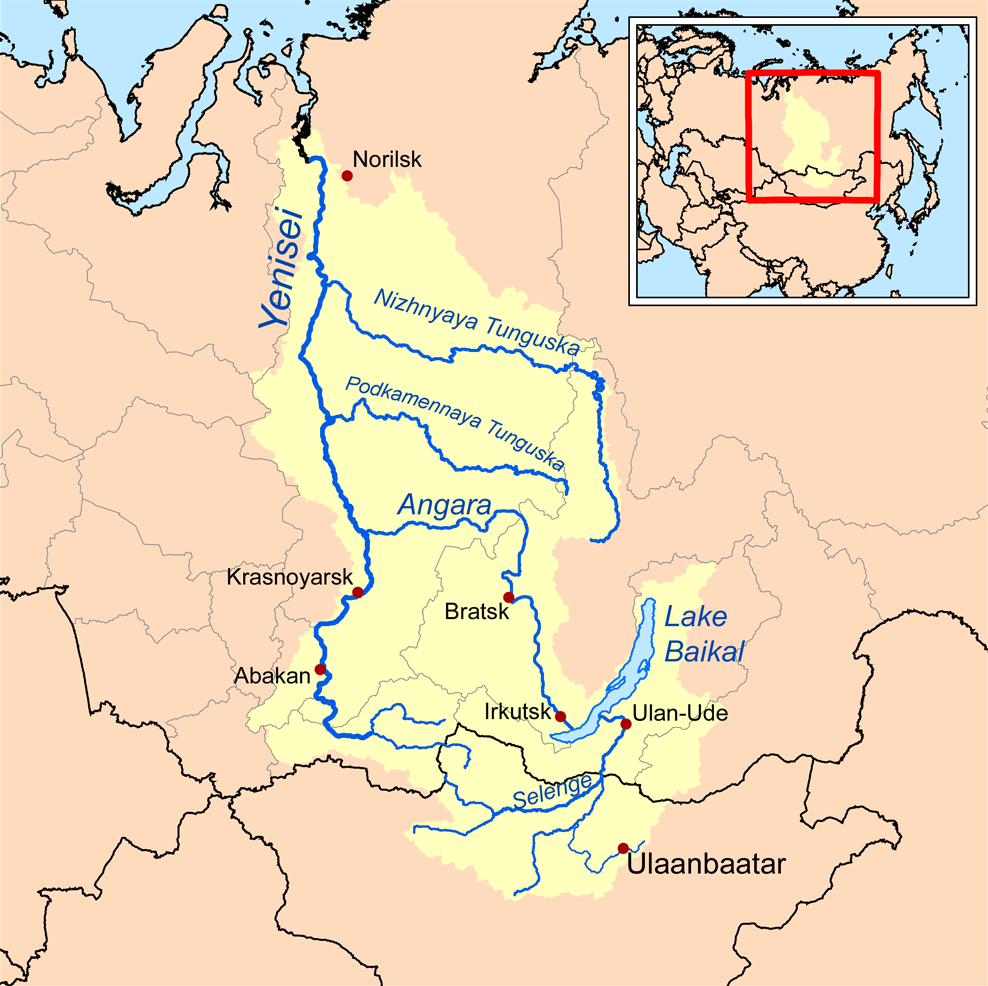
In 2012, 11-year-old Evgeniy Solinder was exploring the coast of Yenisei Bay on the Arctic Ocean and found the mammoth. ScienceMag calls it the best-preserved woolly mammoth discovered in a century. The shores where Solinder was exploring lie about 2,000 kilometers (1,243 miles) south of the North Pole.
Sergey Gorbunov on site excavating Zhenya, the Siberian mammoth carcass. ( Pitulko et al., Science )
The team that excavated the mammoth carcass, dubbed Zhenya for the nickname of the boy who found it, was led by Alexei Tikhonov of the Russian Academy of Sciences in St. Petersburg. The team flew the block of ice in which the carcass was encased by cargo plane back to St. Petersburg and began to study it and to do scientific dating.
Another researcher from the Russian Academy of Sciences told ScienceMag that hunting for large game may have been the reason that people migrated so far north. “Mammoth hunting was an important part of survival strategy, not only in terms of food, but in terms of important raw materials—tusks, ivory that they desperately needed to manufacture hunting equipment,” Pitulko explained.
The fact that humans were in the Arctic says something significant about their ability to survive the brutal cold, though the Arctic was warmer at the time. It means they were making tools, warm clothing and shelters—technology they must have brought with them when they crossed the Bering land bridge to settle in the Americas.
A Wikipedia map showing the Yenisei Bay and river basin in the Siberian Arctic
The distance from the site of the mammoth carcass to the Bering area is about 2,500 kilometers or 4,000 miles—close enough to make archaeologists wonder if people used the land bridge that existed between Russia and Alaska that long ago. Pitulko told Smithsonian.com that is quite a distance, but people had thousands of years to make the journey.
Pitulko clarified that there is no archaeological evidence people crossed into the New World 45,000 years ago, but now scientists know people were in the general vicinity. “Now we know that the eastern Siberia up to its arctic limits was populated starting at roughly 50,000 years ago,” Pitulko explained. “Until 15,000 years ago, sea-level (though changing) still remained low, which is clear from appropriate dates on terrestrial animals in the New Siberian islands. This presumes that the Bering land Bridge existed probably most or part of this time, so the New World gate remained open.”
Many scholars used to think people hunting big game first reached the Arctic Circle around 12,500 years ago. Prehistoric people left many stone tools there around that time. Researchers say they apparently traveled from Siberia to the Americas via the Bering Straits at least 15,000 years ago, but new research puts the human presence in the New World as long ago as 18,500 years.
Then, in 2004, researchers found stone and bone tools that dated back 35,000 years in Siberia and the Ural Mountains of northeast Europe. Along with those tools they found butchered remains of reindeer, woolly rhinoceroses, mammoths and other animals.
An exhibit titled ‘Woolly rhinoceros hunt’ in the Walk with Beasts exhibition - Horniman Museum, London. ( Jim Linwood /CC BY 2.0 )
But if the dating of the woolly mammoth carcass holds up, it means humans were way far north long before previously believed, and that may mean humanity left Africa longer ago than 50,000 or 60,000 years ago, Paleolithic archaeologist Leonid Vishnyatsky told Smithsonian. “Before getting so far north, they would have had to learn to survive in many different types of environments, and that doesn’t happen overnight,” he said.
Featured image: A woolly mammoth reproduction; the animal the hunters faced 45,000 years ago must have been awesome. ( Juan Velasco/CC BY SA 4.0 )


.
The most convincing evidence positing women as the first cave artists, Whitley believes, are the shapes of the hands imprinted onto the cave walls -- the shapes of women's hands. According to National Geographic, archaeologist Dean Snow of Pennsylvania State University analyzed hand samples from eight cave sites in France and Spain, three-quarters of which were deemed female.Patrick Aventurier via Getty Images
Snow hypothesized the handprints were an artist signature of sorts, a way of saying "This is mine, I did this." Whitley, however, isn't so sure. "Another explanation might be that these were women coming in to see these great works of art and leaving the signs of their visits. They were touching the cave walls and, by that fact, touching essentially the sacred realm."Patrick Aventurier via Getty Images
While Whitley is hesitant to deem men or women as primarily responsible for cave art, he's well aware of the overwhelming feminine symbolism that populates so much cave imagery. "When we look at paintings and engravings, there are images and compositions that point straight at female symbolism of some kind. Chauvet Cave, which has our oldest art at 36,000 years old, is a great example. There we have, in two places, two paintings of horses in these niches in the cave wall that can only be described -- it’s pretty obvious and simply can’t be denied -- as vaginally shaped. Also, in that same cave, there’s a painting of what’s obviously a woman’s pubic area."