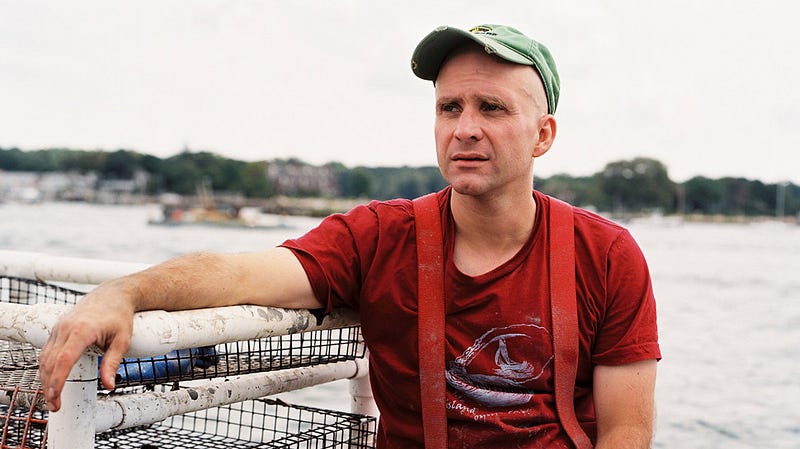
I’m a fisherman who dropped out of high school in 1986 at the age of 14. Over my lifetime, I’ve spent many nights in jail. I’m an epileptic. I’m asthmatic. I don’t even know how to swim. This is my story. It’s a story of ecological redemption.
I was born and raised in Petty Harbour, Newfoundland, a little fishing village with 14 salt-box houses painted in greens, blues, and reds so that fishermen could find their way home in the fog. At age 14 I left school and headed out to sea. I fished the Georges Banks and the Grand Banks for tuna and lobster, then headed to the Bering Sea, where I fished cod and crab. The trouble was I was working at the height of the industrialization of food. We were tearing up entire ecosystems with our trawls, chasing fish further and further out to sea into illegal waters. I personally have thrown tens of thousands of pounds of by-catch back into the sea.
It wasn’t just that we were pillaging. Most of my fish was going to McDonald’s for their fish sandwiches. There I was, still a kid, working one of the most unsustainable forms of food production on the planet, producing some of the most unhealthy food on the planet. But God how I loved that job! The humility of being in 40-foot seas, the sense of solidarity that comes with being in the belly of a boat with 13 other people working 30-hour shifts, and a sense of meaning and pride in helping to feed my country. I miss those days so, so much.
But then in the early 1990s the cod stocks crashed back home: thousands of fishermen thrown out of work, boats beached, canneries shuttered. This situation created a split in the industry: the captains of industry, who wanted to fish the last fish, were thinking 10 years down the road, but there was a younger generation of us thinking 50 years out. We wanted to make our living on the ocean. I want to die on my boat one day — that’s my measure of success.
I grew up shooting moose out of my kitchen window. I never thought climate change had anything to do with my life. But it does. From my vantage point, climate change is not an environmental issue at all — it’s an economic issue.
So we all went on a search for sustainability. I ended up in Northern Canada on an aquaculture farm. At that point aquaculture was supposed to be the great solution to overfishing, but when I got there I found more of the same, only using new technologies to pollute local waterways with pesticides and pumping fish full of antibiotics. We used to say that what we were growing was neither fish nor food. We were running the equivalent of Iowa pig farms at sea.
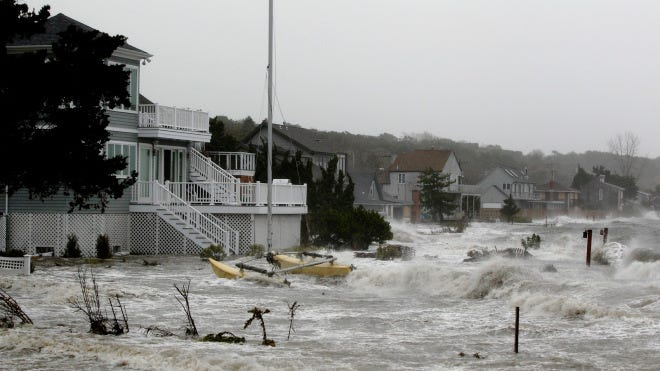
So I kept searching and ended up on Long Island Sound, where there was a program to attract young fishermen back into the industry by opening up shell-fishing grounds for the first time in 150 years. I signed up, leased some grounds from the state of New York, and re-made myself as an oysterman. I did this for seven years. Then the storms hit. Hurricane Irene and Hurricane Sandy thrashed the East Coast. Two years in a row the storms buried 90 percent of my crops in three feet of mud, and 40 percent of my gear was washed away in a sea of death. At the same time, lobster were being driven northward by warming waters, and acidification was increasing faster than at any other time in 300 million years, killing billions of oyster seed up and down the American coast.
Suddenly I found myself on the front lines of a climate crisis that had arrived 100 years earlier than expected. For a long time I’d seen climate change only as an environmental issue because environmentalists were always framing it in terms of birds, bears, and bees, but I’m a fisherman. I kill things for a living. I grew up shooting moose out of my kitchen window. I never thought climate change had anything to do with my life. But it does. From my vantage point, climate change is not an environmental issue at all — it’s an economic issue.
The same years my farm was wiped out by hurricanes, 83,000 people lost their jobs in New York City because of flooding, many of those in manufacturing. Unemployment claims doubled in Vermont along the storm’s path, and 80 percent of U.S. farmland was shriveled by drought, driving up food prices for middle and working class families. It turns out there will be no jobs on a dead planet.
Vertical underwater farming
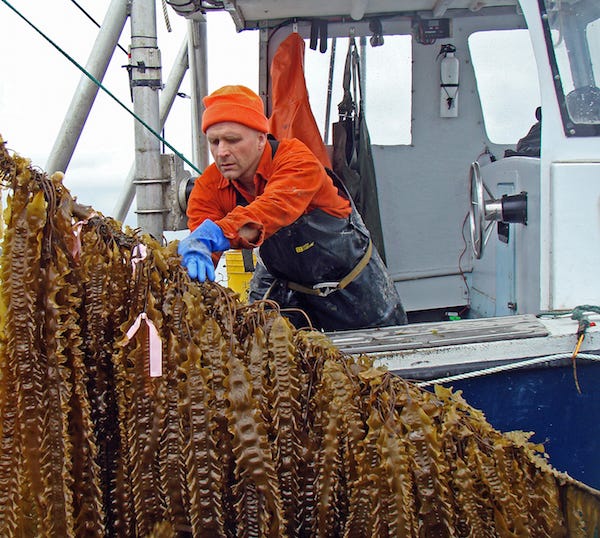
After my farm was destroyed, it was clear to me that I had to adapt because I was facing a serious threat to my livelihood. I began to re-imagine my occupation and oyster farm. I began experimenting and exploring new designs and new species. I lifted my farm off the sea bottom to avoid the impact of storm surges created by hurricanes and started to grow new mixes of restorative species. Now, after 29 years of working on the oceans, I’ve remade myself as a 3D ocean farmer, growing a mix of seaweeds and shellfish for food, fuel, fertilizer, and feed.
My job has never been to save the seas; it’s to figure out how the seas can save us.
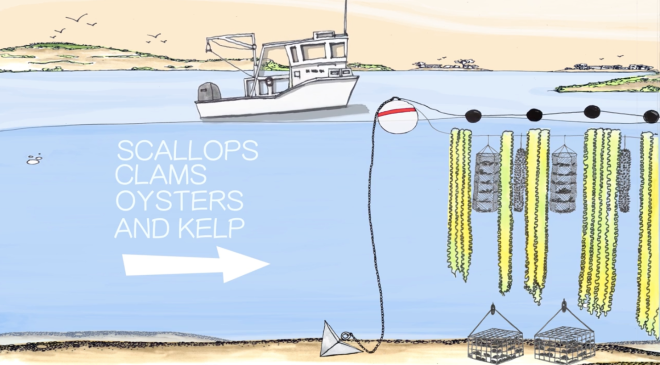
That’s how I got to where I am today. Now let’s dive in and take a look at the farm and deconstruct why it’s designed the way it is. Imagine a vertical underwater garden with hurricane-proof anchors on the edges connected by floating horizontal ropes across the surface. From these lines kelp and Gracilaria and other kinds of seaweeds grow vertically downward next to scallops in hanging nets that look like Japanese lanterns and mussels held in suspension in mesh socks. Staked below the vertical garden are oysters in cages and then clams buried in the sea floor.
If you look for my farm from ashore, there’s almost nothing to see, which is a good thing. Our underwater farms have a low aesthetic impact. That’s important because our oceans are beautiful pristine places, and we want to keep them that way. Because the farm is vertical, it has a small footprint. My farm used to be 100 acres; now it’s down to 20 acres, but it produces much more food than before. If you want “small is beautiful,” here it is. We want ocean agriculture to tread lightly.
Our 3D farms are designed to address three major challenges: First, to bring to the table a delicious new seafood plate in this era of overfishing and food insecurity; second, to transform fishermen into restorative ocean farmers; and third, to build the foundation for a new blue-green economy that doesn’t recreate the injustices of the old industrial economy.
Eating like fish and transforming an entire workforce
First: food production. As ocean farmers, we reject aquaculture’s obsession with monoculture, an obsession similar to that of modern land farming. Our goal is diversity. It’s a sea-basket approach:We grow two types of seaweeds, four kinds of shellfish, and we harvest salt. But with over 10,000 edible plants in the ocean, we’ve barely scratched the surface. We eat only a few species, and we grow basically none in the United States. We intend to de-sushify seaweed and invent a new native cuisine, not around our industrial palate of salmon and tuna but around the thousands of undiscovered ocean vegetables that are right outside our backdoor.
Native seaweeds contain more vitamin C than orange juice, more calcium than milk, and more protein than soybeans. It might surprise those of you on the hunt for Omega-3s to learn that many fish do not create these heart-healthy nutrients by themselves — they consume them. By eating the plants fish eat, we get the same benefits while reducing pressure on fish stocks. So it’s time that we eat like fish.
We’re working with chefs to cook up kelp noodles with parsnips and bread crumbs in barbeque sauce; green sea butters and cheeses; kelp-based umami-filled bouillons. Our new ocean dinners are fun, they’re creative, and they’re delicious. This is our opportunity to rearrange the seafood plate by moving ocean plants and bivalves to the center and wild fish to the edges. Imagine being a chef in 2015 and discovering that there are thousands of vegetable species you’ve never cooked with. It’s like discovering corn, arugula, tomatoes, and lettuce for the first time. As one of my partner chefs — and the former punk-rock drummer — Brooks Headley says, “As a chef it feels frightening, daunting, and exciting all at once.” Ocean greens such as kelp are not small boutique crops. We can grow incredible amounts of food in small areas: 25 tons of greens and 250,000 shellfish per acre in five months. If you were to create a network of our ocean farms totaling the size of Washington state, you could feed the planet.
This is zero-input food that requires no fresh water, no fertilizer, no feed, no arid land. It is hands down the most sustainable food on the planet.
And as the price of fertilizer, water, and feed goes up, zero-input food is going to be the most affordable food on the planet. The economics of it will drive us to eat ocean greens. The question is, will it be delicious food or will it be like being force-fed cod liver oil? As farmers, it’s our job to grow this new cuisine, and for chefs it’s their job to make it tasty.
Ocean farming isn’t just about food. It’s about transforming an entire workforce, transforming fishers into restorative ocean farmers. My job has never been to save the seas; it’s to figure out how the seas can save us. I say that because millions of years ago Mother Nature created two technologies designed to mitigate our harm: shellfish and seaweeds. Oysters filter up to 50 gallons of water a day, pulling nitrogen — the cause of our oceans’ spreading dead zones — from the water column. Our farmed kelp, called the Sequoia of the sea, soaks up five times more carbon than land based plants. Seaweeds could be a powerful source of zero-input biofuel; feasibility studies suggest we might produce 2,000 gallons of ethanol per acre — that’s a 30 times higher yield than soybeans and five times more than corn. According to the Department of Energy, if you were to take a network of our farms equaling half the size of the state of Maine, you could replace all the oil in the United States.
Our farms function as storm-surge protectors, breaking up wave action to reduce the impact of hurricanes and rising tides. And they serve as artificial reefs, attracting more than 150 species of aquatic life. Sea horses, striped bass and grey seals come to eat, hide, and thrive on our farms. My farm used to be a barren patch of ocean, now it’s a flourishing ecosystem. As fishermen, we’re no longer pillagers, hunting the last fish. We are a new generation of climate farmers who have joined the fight to restore our planet. We’re trying to break down the seawalls that separate our land-based and ocean-based food systems. Even the best land-based farms pollute, sending nitrogen into our waterways, so we use our kelp to capture that nitrogen, turn it into liquid fertilizers, and send it back to organic farmers to grow their wonderful vegetables. When the nitrogen then runs back into Long Island Sound, we capture it again.
We are also working on new forms of livestock feeds. For example, there’s exciting — though still preliminary — research that suggests adding algae to diets could reduce methane output in cattle by up to 90 percent. The idea is to build a bridge between land and sea in order to close the loop between our food systems. Too often our thinking stops at the water’s edge. A bridge is needed.
The blue-green economy
Our goal is to build a just foundation for the blue-green economy. Saving the seas is not enough. There is 40 percent unemployment in my hometown. I wouldn’t be doing this work unless it created jobs for my people, unless it opened up new opportunities for the 3 billion folks who depend on our oceans to make a living.
For the first time in generations, we have an opportunity to grow food the right way, provide good middle-class jobs, restore ecosystem, and feed the planet.
Our old economy is crumbling. I can’t get cell service in half of the country, let alone decent health care or a healthy meal. The old economy is built on the arrogance of growth at all costs, profiting from pollution, and the refusal to share economic gains with 99 percent of Americans. But out of the ashes of the old economy, together we are building something new based on new-economy principles of collaboration, community-driven innovation, shared profits, and meeting social needs. Because ocean agriculture is still in its infancy, we have the unprecedented opportunity to build a model from scratch, to build from the bottom up an economy that works for everyone, not just a few. We have the opportunity to learn from the mistakes of industrial agriculture and aquaculture. This is our chance to do food right.
We addressed the first question of farm replication and scale, not by patenting or franchising — those are tools of the old economy — but by open-sourcing our farming model so that anybody with 20 acres and a boat and $30,000 can start his or her own farm. One of our new farmers is a third-generation lobsterman who was unemployed because climate change had pushed lobsters northward. We got him up and running, growing and selling the first year. Among our other farmers are former Alaskan salmon fishermen, an Iraq war veteran, and a Latino family whose ancestors were driven off their farmlands in Mexico. We replicate and scale by specifically designing our farms to require low capital costs and minimal skills. We seek simplicity not complexity. We believe that replication is driven by setting low barriers to entry so that people from all walks of life can grow and prosper with us. At the same time our farmers receive startup grants, access to free seed, gear donated by Patagonia, and two years of free consulting from GreenWave. What is most important, we guarantee to purchase 80 percent of their crops for the first five years at triple the market rate.
We intend to create stable and secure markets that give our beginning farmers time to learn the trade and to scale up their farms. They keep farming because they know they’ll get paid well for what they grow. Our vision is hundreds of small-scale ocean farms dotting our coastlines, surrounded by conservation zones. Imagine a Napa valley of ocean merroirs dotting out coastlines.
We envision 3D farms embedded in wind farms, harvesting not only wind but also food, fuel and fertilizers. We envision using shuttered coal plants — like the one closing in Bridgeport, Conn. — for processing animal feed and salt. We want to repurpose the fossil-fuel and fishing industries so that they will protect rather than destroy our oceans.
Getting out of the boutique food economy and recreating an industry
The second question is how to build the infrastructure needed to ensure that ocean farmers and communities will reap the rewards of the blue-green economy. For too long, farmers and fishermen have been caught in the beggar’s game of selling raw commodities while others soak up the profits; too many of us are locked in the boutique food economy, selling as CSAs and at farmers markets, with the majority of us not making an adequate living and having to hold down multiple jobs to make ends meet. But now, in our unexplored oceans we have a chance to plan ahead and to build an infrastructure in the right way. One of our new farmers, a 65-year-old fisherman, whose family has fished in Rhode Island for 300 years, put it this way: “The last thing we want to do with 3D farming is re-create the fishing industry.”
We can invent new occupations, shift entire workforces out of the old economy into the new restorative economy.
Instead of repeating history we’re building infrastructure from seed-to-harvest-to-market. We’re starting nonprofit hatcheries so that our farmers can access low-cost seed. We’re creating ocean seed banks so that the Monsantos of the world can’t privatize the source of our food and livelihoods. We cap the price of a sublease at $50 an acre per year so that low-income ocean farmers can access property. But by “property” we do not mean privatization. Our farmers don’t own their patch of ocean; they own only the right to grow shellfish and seaweeds there, which means that anyone can boat, fish, or swim on their farms. I own the process of farming but not the property, and this keeps my farm as shared community space. We’re also building in levers of community control. Leases are up for review every five years so that if I’m farming unsustainably, my rights can be revoked.
At the same time, we’re building the country’s first farmer-owned seafood hub, which is not only a place to process, package and ship the raw commodities we raise but also a space to leverage the unique qualities of our seaweeds. The power of kelp is that it’s not just food; there is a whole range of products we can produce that meet environmental and social needs: organic fertilizers, new livestock feeds, kelp biofuels, and even medicine. With thousands of yet undiscovered ocean plants, farmers and scientists can join together to discover and grow new forms of medicine.
Pushing injustice off the table
If we provide our communities with the right mix of low-cost, open-source infrastructure, our hub will become an engine for job creation and the basis for inventing new industries. It will also be an engine for food justice, a place where we embed good jobs, food access, and nutrition into the structure of ocean agriculture. This means, for example, working with local grassroots groups like CitySeed in New Haven, Conn., to ensure that low-income folks can use food stamps to carry double the value at our Community Supported Fisheries (CSFs) and our Beyond Fish retail store. It also means using our hub as a hiring hall where local workers can find jobs on our farms, in our startups, and in our kitchens. If you come to the hub for a job, don’t bring your resumé. We don’t care if you are a former felon or an undocumented immigrant; we’re going to put you to work.
The final challenge is how to re-arrange the relationships between those of us who produce food and those of us who buy it. Failure would be to recreate the power dynamics of the old economy. Just as we need to re-arrange what’s on our dinner plates by moving ocean greens to the center, we need to move farmers, food workers, communities, and protection of the planet to the center of our plate, and push the destructive, unjust old economy off the table. We’re putting farmers and buyers on equal footing by negotiating with institutions to guarantee forward contracts so that we get paid before we grow, and if our crops fail, then both the farmer and the buyer share the loss. It’s time for everyone to share the risk in the risky business of growing food in the era of climate change and globalization.
The relationship between farmer and buyer has to go even deeper. Reformatting the food system is going to be costly. It’s going to be complex. Simply using purchasing power will not be enough. Anchor institutions such as hospitals, universities, wholesalers, and retailers have a new role, a new set of responsibilities in the new economy. They have a duty to invest aggressively in our farmers, our infrastructure and our communities. This involves donating a portion of their profits and their endowment to building hatcheries, seafood hubs, logistical and transport systems, incubation, and R&D. This will mean less profit for the private sector and a lower rate of return for universities. But it will also mean more value in terms of social and environmental good. All around us we can see that “business as usual” will not save this planet. It’s time to divest from the old economy and invest in the new.
The new economy: Rethinking “the politics of no”
Finally, we are insisting that markets reward the positive externalities of our farms. We’re working in places like Connecticut to include ocean farmers in existing nitrogen trading programs. New farms are being built in polluted areas like Bridgeport and the Bronx River in order to soak up the nitrogen and carbon, pull out heavy metals, and re-build reefs. Instead of harvesting food, these farms harvest ecosystem services. While others pollute, we restore — and as farmers we should be paid for the positive externalities of our work. In the new economy, markets have to reflect the environmental benefits we provide.
We could set aside the entire world’s oceans, and our ocean ecosystems would still die. Conservation alone is no longer environmentalism.
In 1979, Jacques Cousteau, the father of ocean conservation, wrote: “We must plant the sea and herd its animals using the ocean as farmers instead of hunters. That is what civilization is all about — farming replacing hunting.” This dream of Cousteau’s and of Green Wave’s is frightening to some environmentalists. The idea of hundreds of ocean farms dotting our coastlines and the idea of 3D farms embedded in wind farms are unsettling to many because of the scale. As a result, the instinct of environmentalists is to do everything they can to protect the oceans from any and all forms of economic development. They shield themselves with a “politics of no.” I’m sympathetic to these fears, especially given the history of industrial aquaculture in the 1980s; yet in the era of climate change, it’s an illusion for environmentalists to think they can save our seas by relying on a conservation strategy alone while continuing to ask the oceans to feed our hunger for wild seafood.
Conservation represents its own form of climate-change denial. We all know it’s real, but the true significance, the implications, the urgency, haven’t sunk in. Just look at what’s happening on land and sea: rising water temperatures and acidification threatening one out of four marine species with extinction; drought and extreme weather expected to make U.S. corn prices go up by 140 percent in the next 15 years alone, while agriculture is responsible for one-third to one-half of all carbon emissions and uses 80 percent of the fresh water in some areas, making it the primary cause of droughts, rising food prices, and food insecurity.
If there is one lesson we should learn from the 2015 water wars in California, it’s that our food system is going to be driven out to sea. Yes, we need marine parks, but we could set aside the entire world’s oceans, and our ocean ecosystems would still die. Conservation alone is no longer environmentalism.
The climate crisis demands that we use our fears as a catalyst for change. For the first time in generations, we have an opportunity to grow food the right way, provide good middle-class jobs, restore ecosystem, and feed the planet.
This is the new face of environmentalism. As our food system gets pushed out to sea, we can come together to block privatization, to protect our commons and to spread the seeds of justice. We can invent new occupations, shift entire workforces out of the old economy into the new restorative economy. This is our chance to recruit an army of ocean farmers to grow a new climate cuisine that is both beautiful and hopeful so that all of us can make a living on a living planet.
Some 30,000 years ago, our ancestors adorned the walls of Chauvet Cave in France with images of the beasts of their world- some familiar today, others impossibly exotic. These portraits of horses and cattle, of panthers and bears and hyenas were preserved by a cave-in and were left for millennia until by chance they were rediscovered, and later filmed by Werner Herzog in an extraordinary documentary.
This secret bestiary of the ancient world contained a curious anomaly that has puzzled scientists for almost 2 decades- in all the dozens of portraits on the walls of the cave, there was not a single depiction of any canine- no dogs, no wolves, nothing at all to suggest that man and his best friend had met. Yet the muddy ground of the cave told a different story- preserved for millennia, the tracks of a young boy of 10 or so years and the paws of a dog ran side by side the length of the cave.
We’re not sure when we first domesticated dogs, but the muddy evidence of this cave floor (coupled with the facts the tracks do not cross, and the lack of bones and slow gait do not imply the child was prey) suggest an idea I will use to frame the history of domestication- we did not paint the portraits of dogs in this cave because even then, this species was considered part of the human realm and not the wild one.
The animals on this cave wall can be roughly divided into two camps- those herbivores we domesticated, and the carnivores we hunted to irrelevance or extinction. The animals that are today clearly part of the human family- dogs, horses, cows, bison, represent some of the most populous species on our planet today- cave sloths? not so lucky.
The last 30,000 years of human history have slowly removed more and more animals from the walls of this cave and into the human family- and in all the time we have been domesticating animals, the family has only grown. Even animals who’s first role in the human family is no longer necessary (most of us don’t keep cats to prevent grain contamination by rodents, for instance, or horses for ploughing fields) have found a role as companions, and moved even deeper into the core human family. Today, a healthy chunk of the planet are lucky enough to have companion animals; an even bigger chunk of humanity enjoy meat, eggs and dairy produced by mutualistic relationships with other animals that sustain our species.
The portraits on the walls of this cave depict very different versions of the animals in the human family- somewhat like an old family photo, we have trouble identifying certain relatives who have grown in strange directions. The cattle of the cave have horns and ferocious glares- the horses look nervous and flighty. These animals have been changed by their departure from the cave wall- I’m keen to explore how.
Anyone who tells you that genetic engineering is a new pastime for humanity must be reminded of the history of herd animals. The cow, the chicken, and even the humble dog have passed through an incredible millennia of gradual manipulation to yield a species that conforms to our needs as humans. Our species optimized each one of these genetic codes with the patience of generations to perform the function we most desired of them- this is the reason why there are “egg chickens” and “meat chickens”, why there are “guard dogs” and “hunting dogs”, why horses can either run like the wind of haul several tons of cargo.
Sometime in the middle of the 20th century, we started to run into the limits of genetic manipulation by breeding, and began to look for even more clever ways to render the animals in the human family more efficient in what we desire of them.
Even these new ‘pharmaceuticals’ were not enough to keep up with the insatiable demand for meat that arose during the 50’s and 60’s, and so we took a step further into industrialization. The modern meat production system further abstracted the animals role in the production of the meat we wanted- we removed the idea of their central role in the process and began to see the role of these animals not as a mutualized, give-and-take with our species, but as simply a catalyst- input grain, antibiotics and time, output meat, eggs, and dairy.
The journey from the cave wall into the human family benefitted enormously the animals who made the journey, and until the latter half of the last century, we as a species maintained a mutualistic relationship with those species included in our family.
Anyone who has ever toured a modern CAFO will tell you that the degree by which our relationship with these animals benefits them is now called into question.
I will not dwell on the horrors of industrial meat- the subject has been covered extensively, and frankly, it depresses me. The important consideration is not the sin, but the evolution of the relationship- down from the cave wall, into our family, into our industrial system, into our medicine cabinet, and now, into new systems of control and manipulation.
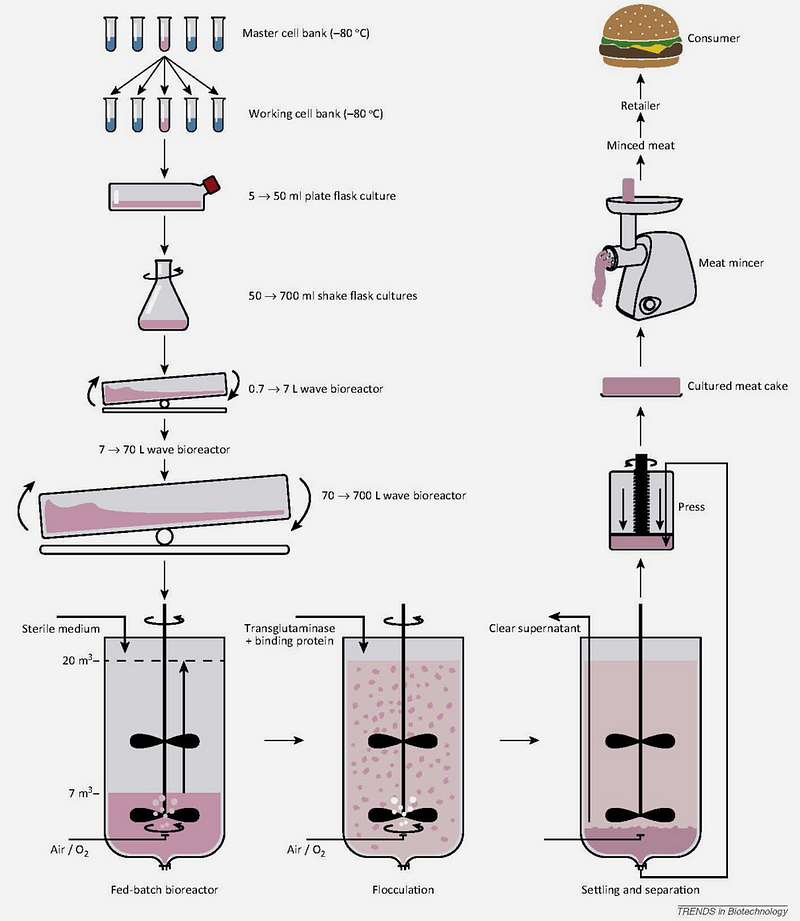
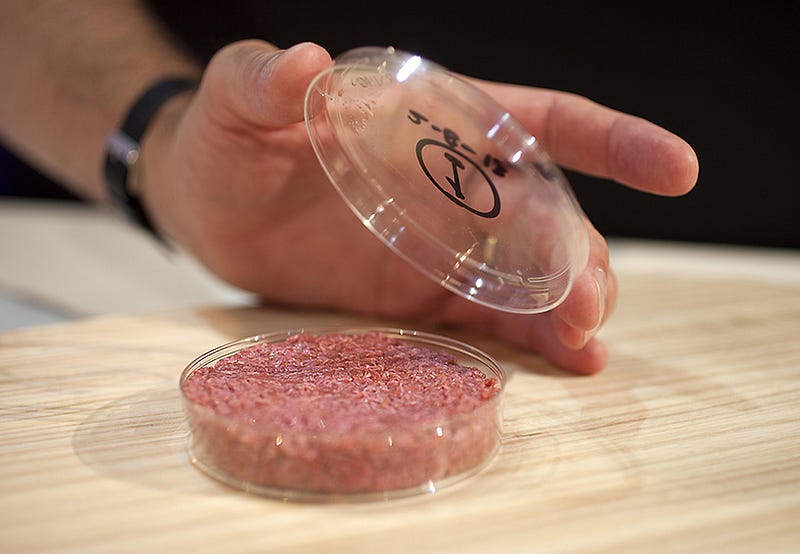
In 2016, there exist today methods of creating meat that do not involve animals. This evolution is inevitable- the logical conclusion of our relationship with these animals we domesticated so long ago is to let go of the parts of the animals we do not need, and embrace a perfect industrial method of obtaining the outputs we desire.
source- Trends in Biotechnology, van der Weele et al.
Breeding was not enough. Pharmacological manipulation was not enough. Industrialization was not enough. Our desire for meat, eggs, dairy, and all the delicious and ritualized foods of our various cultures that developed alongside these animals for millennia will lead us to a oh-so-logical conclusion- a block of animal protein, a perfect cube of manipulated tissue, fed by saline solution and exercised by electric shock.
source- Reuters
The feeling of discomfort and dread that seizes me when I consider The Flesh Cube is the thing that most interests me in the future of food.
My two questions are this-
Why would I be scared of this process when the morality of The Flesh Cube is so obviously superior to the industrialized misery that is the lives of a good portion of the animals we once painted on the walls of caves?
Do we as a species owe anything to these animals?
When I weigh the pros and cons of The Flesh Cube, I think about the negative externalities of the modern meat production system. I’ve written extensively about the coming explosion of demand for meat across the globe, so I will not re-tread that ground- suffice to say that we’ll need to evolve the relationship between humans and the animals that sustain us in order to avoid cataclysmic problems in climate, human nutrition, and animal welfare. The optimization to date will not be enough- The Flesh Cube is coming, and if 30,000 years of human history speak to anything, it is the inevitability of this next step.
Many folks I speak to who consider themselves enlightened foodies recoil at the thought of The Flesh Cube. The question we must ask ourselves is this- if we allowed our modern relationship with animals we eat devolve to the state that it is today, how can we stand on any moral high ground and hate on The Flesh Cube? It has no brain! No feelings! It does not yearn for grassy pasture, it does not seek companionship, it doesn’t run around and frolic in the spring time, it does not care for its young. The Flesh Cube is blissfully unaware of the industrial system it belongs to.
We took those animals off the cave wall, and into our family. Incrementally, year by year, we betrayed that mutualization by forgetting that those animals even existed in our thirst for delicious calories. We deserve The Flesh Cube, and so do the animals we have domesticated.
I want to propose a radical outcome to the coming age of artificial meat- we may have the opportunity to care for the animals we moved into the human family in a redefined role. We took the time, somewhere in the middle of the 17th century, to breed dogs to give and receive love and affection. We bred cats to belong in our hearts and homes. We bred horses to give us sport, friendship, even therapy. We have no concrete use for chickens other than meat and eggs- no Bison will end up as house pets, no off-leash cow parks will form in our cities. It is our moral imperative, eventually, to start to think up new places for these animals to thrive in the human context, when we no longer require their bodies as a catalyst for protein.
We need to start thinking about breeding pigs who eat invasive species. We may need cows who can revitalize degraded landscapes by creating uphill nutrient cycling. We need to start thinking about chickens as vehicles for teaching our kids about the natural world. We need goats who sequester carbon. In other words, the incredible efficiency we have found in these animals when we needed them for protein is not the end of the story- we must keep considering the role of these animals in solving human problems, so that the bonds of mutualization are not forgotten.
Our human family is going to need each and every species we domesticate to move our mutual future forward. We are arriving at the limits of industrialization, and will soon separate the animal and the output. This gives us an opportunity to see the animal anew, to redefine the mutual contract, and to transfer the animals we once needed for food into new roles that are truly mutualized.
We must not fear whatever final step protein production will take this generation; we must instead decide to create new bonds of trust with the animals in the human family by repurposing them, just like dogs and cats, into securing a better future.
Far in the future, archeologists will dig up the ruins of a modern industrial feedlot, or a modern industrial pig farm, and marvel at how far away from the cave wall we took things. By fulfilling the potential of these animals to help assist humans in solving new problems, we can honour the journey these species took with us while gently separating them from the inevitabilities inherent in 6 billion humans eating their body weight of animal protein per year. My final point- don’t fear The Flesh Cube, and embrace a new era of symbiosis with the cave wall.
Today’s
industrialized food system, designed to put food on everyone’s table at
any expense, is failing us. While the developing world is challenged
with the basics of reliable and safe food supply, the industrialized
countries have all the food they need, just not the rightfood.
Let’s
start with what we know. Humanity’s focus on short-term,
easy-to-understand concepts in agriculture, like yield per acre and
price per product, has resulted in a monolithic agricultural system.
Here, the idea of scarcity led the architects of today’s system to seek
out maximum efficiency through high crop yields. But we now know this
came at a price: food with low nutritional value that promotes
environmental degradation. This system is not designed for the long
haul.
It’s
time to move on and reimagine our food systems in both the
industrialized and developing world. We can transition to precision,
data-driven farming that helps us understand why a crop is not growing
and address the problem with a targeted solution like spraying one row
rather than an entire field. We can empower farmers with actionable,
data-driven insights that come straight from the fields and not from
hunches. Food waste can be minimized as food delivery companies work to
create kits that include healthy ingredients in exact proportions. And
consumers can take control of how they prepare their foods, personalized
to their micro-biome, as new kitchen appliances with integrated
technologies like 3D printing and robotics get more sophisticated to
make fresh food for us with fresh ingredients. Anyone wishing to cook a
healthy, delicious and fresh meal will not have to think twice.
Such
examples of reimagination are being complemented by innovations in
technology. No longer do we need to rely on a cow for milk and
meat — instead we can use custom designed microbes to produce milk
proteins and literally “grow” meat. No longer do we need to poison our
soil with fertilizer that runs off farmland and pollutes nearby
waterways — instead we can use our understanding of soil composition to
introduce bugs that create a healthy soil environment. And why should
our crops be grown the same way they have been for millennia? We now
have the technology to grow vertical crops and even crops without soil,
increasing the per acre yields radically by moving in the vertical axis.
We
have to reimagine our current food system and create one where clean
and nutritious food is delivered to savvy consumers who are demanding
more than just a meal — they want to know the story behind how something
got on their plate. And many are willing to pay a bit more to support
new entrants working to reimagine today’s food systems.
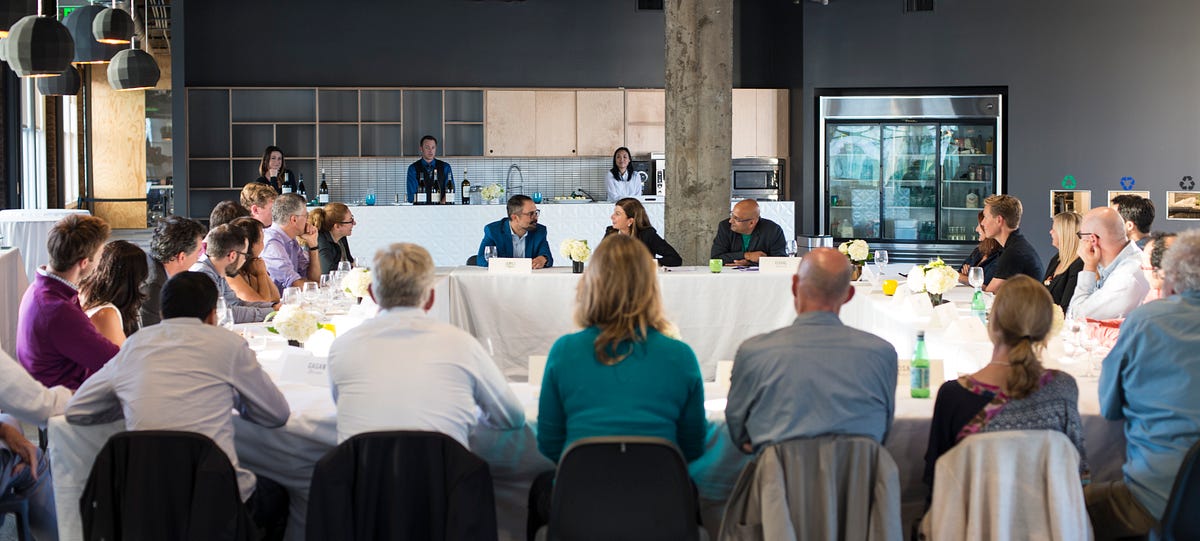
Innovators in Silicon Valley are used to addressing such challenges, so late last year we invited a diverse set of leaders with a collective “doer mindset” to discuss how we could disrupt today’s unsustainable and unhealthy food ecosystem.
Here is what we are up against: five years ago, Chinese officials sounded the alarm that they
would be hard pressed to meet rising food demands thanks to their
overworked, polluted and artificially fertilized soil. Meanwhile,
agriculture’s thirst for water at any cost has resulted in dwindling
water tables that risk our ability to increase food production precisely
when it is most needed. In India, McKinsey predicts the country’s national water supply will fall 50% below demand by 2030 in a country where 54% of the population already faces high to extremely high water stress.
Despite
all these challenges, today’s food monoculture does manage to provide
plenty of food, but much of it is processed with dangerous levels of
salt, sugar, and chemicals. Researchers at the University of California
San Francisco have performed so much research on the role of sugar in
the modern Western diet that they were able to say conclusively in 2012
that sugar is the “primary culprit” behind a worldwide health crisis.
Beyond sugar, some food is downright toxic: the Food and Drug
Administration came under fire when it was blamed for allowing
carcinogenic arsenic to make its way into roughly 70% of chicken in U.S. supermarkets.
Consumers
for years have been voicing their opinions through their wallets for a
transition away from today’s food system. According to The Organic Trade Association,
consumer demand for organic food in the United States has grown by
double-digits every year since the 1990s, with organic sales increasing
tenfold from $3.6 billion in 1997 to over $39 billion in 2014. People
are so willing to pay higher prices for pesticide and antibiotic-free
products that supply of organic foods continues to fall short of demand.
Organic food sales currently make up 4% of total food sales, but
acreage devoted to organic agriculture is less than 1% of total U.S.
cropland. This is a system out of touch with producing the right food.
Clearly,
our narrow mindset around food has led us into a crisis. Companies and
even whole civilizations have failed as a result of their inability to
divert attention when and where necessary. We recognize the challenges
we face are complex and systemic in nature but we know the time is right
for a wholesale re-imagining of how food gets from the farm to the
fork.
Bringing
about this change will require shifts across the supply chain of our
food ecosystem, including farming and inputs, food processing and
product development, logistics and delivery, retail and consumers. But
players like Obvious Ventures
will be there along the way to incentivize large scale reimagining of
how food is made and delivered to meet consumer needs and wants in a
long-term sustainable way.
This
is not an impossible task. Already we are seeing players move away from
models based on scarcity and dirty and toward those based on abundance
and clean, toward providing people with food that is grown responsibly,
distributed affordably, and consumed excitedly.
Our
era of abundance is allowing us to transform the science of farming,
making it more precise. Farms are becoming data-rich thanks to a network
of sensors that collect and exchange real-time information on
everything from water use to harvesting. Companies like FarmLogs
have created multiple tools such as to track not only aggregate
rainfall amounts but also contextualize this data against prior years’
rainfall totals and how such water affected crops. Blue River Technology
is making “smart machines for digital agriculture” which can visually
characterize each plant and decide which ones are viable and which ones
are not. Such a process drastically reduces the amount of chemical
inputs needed to generate healthy crop yields.
And
once the food is ready to leave the farm there are now plenty of ways
to get it to you and your table. Demand for services like UberEATS, Postmates, Blue Apron and Caviar
has spurred local food processing, allowing for speedy, real-time
delivery so food remains nutritious. Urban Remedy, an organic food
company (and one of our portfolio companies), has a goal to make healthy
eating easy by processing local, healthy ingredients that are then
distributed across multiple channels, including micro retail outlets and
online.
Another portfolio company of ours, Beyond Meat, aims to replace animal protein with plant protein. One of Beyond Meat’s latest innovations was to partner with Chef’d,
a meal delivery service, to offer plant-based meals to make at home.
Such a service not only guarantees consumers a healthy meal, but also
cuts down on food waste since only the right amount of ingredients is
included.
The
best part of all of these innovations is that consumers can now do at
home what had previously only been done in large facilities or retail
outlets. Nespresso and SodaStream
were the first step on a process that will only grow further as 3D
printing of food and robot cooks proliferate to help us make healthy
food with fresh ingredients. For example, Momentum Machines
is bringing precision robotics into the Quick Service Restaurant (QSR)
space to create cleaner, faster restaurant environments where workers
will not need to directly handle food. Consumer demand for organic,
local or paleo meals will continue to influence the food production
system, as innovators create more tools to make such diets easier.
Technology
and innovative thinking will also be key in moving to a more
sustainable and healthy agricultural system. Innovations are already
occurring and laying the groundwork for how and what we eat in the
future.
Aerofarms
is pioneering the indoor growing of crops independent of soil and the
sun. The company instead employs vertical farming to save space and uses
a cloth medium on which the seeds grow. Such a system has promise to
deliver higher crop yields, year round. Additionally, it will eliminate
pesticide use, decrease water use by 95%, and allow for the recycling of
crop nutrients that otherwise would harm the environment.
Similarly, Venkatesan Sundaresan,
a professor of plant biology and plant sciences at University of
California, Davis, is looking at rice to better understand how the
nearly quarter-million bacterial species in the rice microbiome affect
how the crop grows. Soil microbes in close proximity to plant roots have
been shown to promote plant disease suppression and nutrient
acquisition, according to Sundaresan. He is looking at both how the
microbial community responds when plants face stress and also at the
functions of individual bacteria.
Meanwhile,
synthetic biology is transforming how we create and input proteins,
leveraging a far more efficient metabolic reaction than an entire
animal: a single-cell organism. Clara Foods
utilizes this technology to make egg alternatives, incorporating yeast
fermentation and iterating on techniques that are paralleled in the
beer-making process. The result is a product that can replace eggs both
as an ingredient in other foods, or potentially as a main dish itself.
Hampton Creek
is seeking to make the largest plant database in the world so it can
transform how we make everything from cookies to mayonnaise. Its success
making and marketing Just Mayo, a vegan mayonnaise, included a legal victory against rival Unilever, the maker of Hellmann’s mayonnaise. The result: Unilever is now making its own vegan mayonnaise to compete.
In order to make all of this the rule and not the exception, we will need, as Michael Pollan put it,
a “National Food Policy.” Pollan suggests the next president put
forward a call to arms to elevate the discussion about how we get our
food. Everyone must understand that they have a choice in determining
what gets on their dinner table, and how. Pollan sees a breakdown in
government policy, one that has failed to unite all interests around
food production.
This
will certainly have to change. We need policies that encourage current
players to adjust their business models to accommodate the fight against
climate change and environmental degradation.
But we also must ensure
any future regulatory environment welcomes new entrants and startups
who, even from a smaller pedestal, can influence food policy. And no
doubt consumers will need to play a role, collaborating with business
and government to ensure the food they eat is safe and nutritious.
We
all eat food and so we all have a stake in the future of food
production. Whether you are a farmer, entrepreneur, or foodie, you play a
role in the systems governing food policy. We at Obvious Ventures
support #worldpositive companies, firms that are profitable, impactful
and make the world a better place. We are excited to play a role in this
debate and look forward to hearing about your ideas on the future of
food.
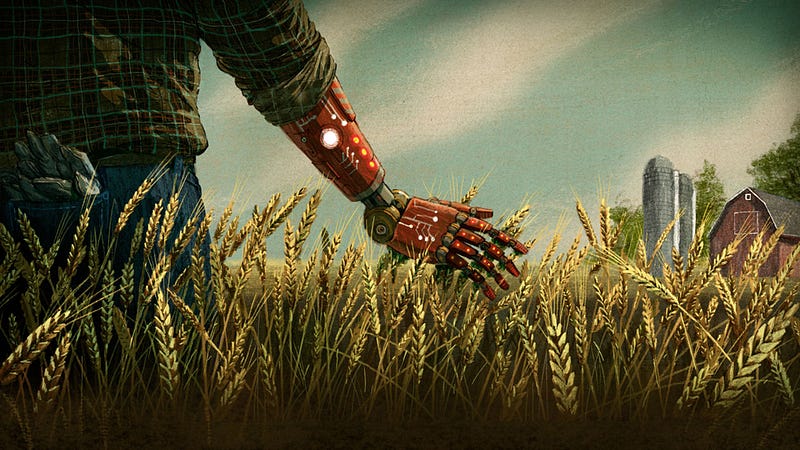
2015 has been a year of tremendous growth in AgTech, both in terms of the technology and the companies that create them. We (the AgTech nerds of the world) are right to be proud of the advances made in our little corner of the world, but our success isn’t achieved in a vacuum. As this year draws to a close, I’ve tried to place the work we do every day into its global context, the context of conflicts, victories, humanity and inhumanity we see everyday on the nightly news and our Twitter feeds. I love what I do, but I’ve been forced to ask, does AgTech really matter?
My search for answers led me to the internet. AgTechnologists turn perpetually towards the “70% more food by 2050” statistic, and set for ourselves the goal of feeding 9 billion people in the world by mid-century. But what about today? What goals might we set for ourselves in 2016? The attention of the world was captured in 2015 by terrorism, the refugee crisis in Europe, severe weather and climate change, and the ongoing struggles against racial and economic inequality. At first blush, AgTech has no answers for these problems. But for posterity, let’s take a closer look.
From Charlie Hebdo and Paris to San Bernardino, ISIS is the boogey man of the Western conscious. Though this latest incarnation of anti-Western extremism in the Middle East has turned our social technologies against us, their rise was not so different from that of their predecessors. We know that famine and starvation contribute to the instability that leads to the rise of terrorism. Food instability in the Middle East arises because water, healthy soils, meaningful information about weather and markets, and other vital resources are scarce. As AgTechnologist Norman Borlaug said, “You can’t build a peaceful world on empty stomachs.”
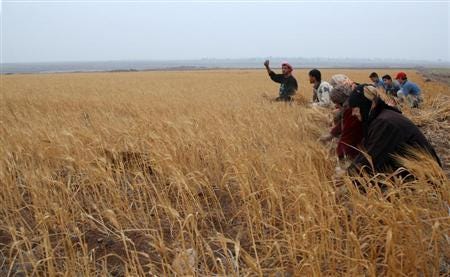
The refugee crisis in Europe shares many of the root issues of terror in the Middle East, but the link to agriculture is even stronger. According to research done by the Carnegie Endowment for International Peace, the Syrian Civil War was driven by “severe social crisis” that came to a head after mass migrations out of rural areas due to four long years of drought led to a general collapse of Syrian agriculture.
Syrian Agriculture
Now, AgTech doesn’t have a magic wand that will make these resources abundant, but we do have the ingenuity to make the existing resources more meaningful. Take, for example, our friends at SWIIM and CropX, who are pioneering technologies to use and allocate water effectively so that rural and urban populations are well served. Companies like TerViva are commercializing crops that grow effectively even in poor soils. The teams at aWhere and Descartes Labs are making serious strides in weather prediction, and companies like OnFarm and Farmers Business Network are helping make farm data meaningful to growers. We’re not soldiers, diplomats, aid workers, but the work we do everyday goes towards addressing the root cause of extremism. It makes sense really. Like our growers, when something’s wrong, we intuitively look to the roots.
As the Paris Climate Conference drew to a close this month and much of the US and the world is either drowning beneath extreme floods or parched by extreme drought, climate change is fresh on our minds. Agriculture is often fingered as a climate culprit, so we, as lovers of farmer and field, have made protecting the environment our overt strategy.
I don’t know of a single AgTech company that does not think of itself as climate-minded (like our growers, we care about the wellbeing of the Earth and environment more than most), but there are a few technologies that stand out for their innovativeness and futurosity. Companies like Impossible Foods and Beyond Meat are looking to make a dent in the carbon emission produced by livestock by making synthetic meat (and Modern Meadow does the same for leather!). As 40% of all food produced in the US goes to waste, companies like California Safe Soils and FiberStar Bio are saving this organic material from clogging landfills and turning it into nourishment for deteriorating soils. We are uniquely positioned to address climate issues that have been created or perpetuated by the current agricultural system, and it is our responsibility both to the growers we serve and the ordinary humans who co-habit our planet to leverage our technology.
Racial and economic inequality in America is, unfortunately, not a recent phenomenon, but 2015 was a year when these issues could no longer be overlooked. What role could AgTech possibly have in addressing these systemic injustices? For one, poor communities tend to be characterized by food deserts (lack of restaurants, groceries stores, etc.), which means poor families tend to have limited access to whole foods and good nutrition. So companies like Edenworks and Freight Farms are bringing sustainable agriculture to urban centers. Even when healthy food is available, it’s expensive, so companies like Kuli Kuli and Exo are revolutionizing our use of alternative nutrient sources (in this case, Moringa and cricket flour, respectively). This issue might be the hardest for AgTech to address, but it hasn’t stopped us from trying to do what we do best; level the field, cultivate change, and create the best possible conditions for growth.
2015 was a big yera for urban agriculture
The short of it is, yes, AgTech matters. Will we, as AgTechnologists, single-handedly save the world anytime soon? Probably not. But we are the pioneers at the frontier of an industry that has defined human civilization for 8,000 years. In that way, redefining agriculture is redefining something fundamental about ourselves. Changing the way we grow our food to make it, as Michael Pollan says, “Good to eat and good to think,” feels like a meaningful goal to strive for, not in 5 years or 30 years, but today. All of this makes me even more proud of our growth this year, we’ve come a long way, and though we still have many rivers yet to cross before we can put hunger behind us, I’m ready to show up to my AgTech job on Monday morning, and be part of making 2016 even better.
On how hard we work and what we expect from others?
It’s a foregone conclusion amongst food and ag writers that there is something wrong with the way we grow food in America. Paging through the best-selling volumes by Michael Pollan, Mark Bittman, Dan Barber, and others will lead you to one conclusion; there’s a better way to farm out there, and they’ve found it.
After you close the book/put down your NYTimes, you’re inevitably left to wonder, if these journalists and chefs found these solutions, farmers must be willfully ignoring them. Sure, these authors tell the farmers’ sad tale about the inheritance of industrial agriculture and the industries and policies that entrench it. But, we wonder, if farmers were smart enough, hard-working enough, and truly the environmentalists they claim to be, they should be putting away their John Deere tractors and their Monsanto seeds en masse to plant heirloom tomatoes alongside their grass-fed beef.
Right?
But what if we lived in a world where everyone, or maybe even most people, aren’t the smartest, most hardworking, and most ethical at their job? What if we live in a world of (duh duh DUN) real people? On Farmers
First off, do farmers tend to be smart, innovative, scientifically-minded individuals with incredible work ethics, a uniquely confident humility, and a passion for their job that only comes with carrying on a family legacy? Yes.
But, it turns out, farmers are also people. People like us. People who like spending time with their families, watching the game on Sunday, seeing (or artfully avoiding) their kid’s school play, grabbing a beer or a cup of coffee with friends, or reading the newspaper. You know, living.
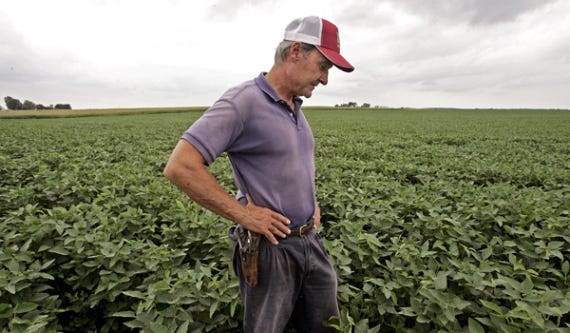
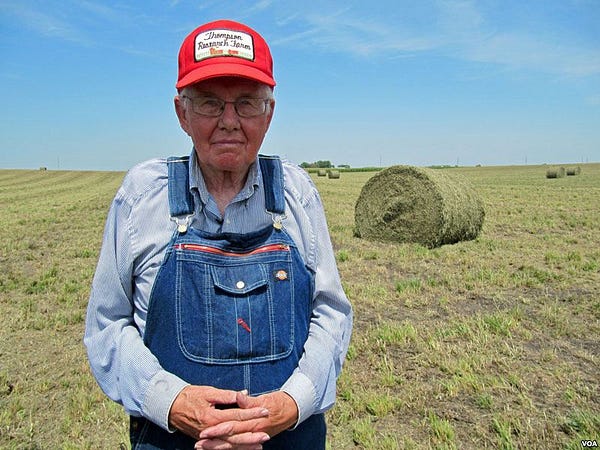
The average American farmer works more than 10 hours a day (much if it physically demanding), 6–7 days a week. Even for us workaholic types, that’s an impressive amount of hours for a group that’s on average 57 years old. Is it still so shocking that farmers aren’t spending their rare free hours reading books and articles about farming by journalists and chefs and vetting the solutions they present?
What’s more, population loss in middle America has increased tremendously over the past several decades. More than 6,000 communities have completely vanished over recent decades, and farmers are struggling just to keep their neighbors. A lot of farmers have very close, personal relationships with their chemical, seed, and equipment dealers, not to mention that a high percentage of rural businesses are involved directly in agricultural production (read: traditional agriculture).
When the population of your town has more than halved (on average) over your lifetime, and you are told that if you stop doing business with your friends (potentially putting them out of business/causing them to move away) and spend countless hours researching, testing, and applying alternative agricultural methods, you might be able to sell your corn, wheat, or vegetables for a higher price, I might say thanks but no thanks to that myself.
This is where farmers are. We need to put ourselves in their shoes. Remember that not only are you experiencing all of this, you also have (on average) $90,000 in existing loans, and you are going to take on all the risk of this transition personally. Even if you are expecting a 20% increase in revenue on selling organic/sustainable/biodynamic/grass-fed products, how long will it take you to get the certifications (7 years for organic)? How much will it cost you in terms of sales and marketing?
Think about it this way.
You’re an enterprising individual. If you thought you had come across an idea that could change the way you do business (and maybe the world), you’d be willing to put in a lot of effort to get it off the ground. It might cost you a few friends, a few good times, but it would be worth it. Who knows, you might be the next Bill Gates. You might even be bigger, because you’re idea has a social bent- save the environment, feed the world. Maybe if this works out, you could retire by 40.
But what if all the money was yours? What if there was never going to be a VC to pitch to or a grant to apply for? What if you were starting this when you were 57 with kids and grandkids? What if failure meant losing everything your family had built for decades, maybe centuries? What if your idea put your friends out of business? What if the best case scenario is that you’ll still be a faceless farmer from middle America, but maybe somewhere on the coast someone gets a warm feeling after spending $9 on a loaf of bread or bottle of juice? What if you’ve already spent your life working incredibly hard and all you’ve seen for it is criticism from chefs, journalists, and the media at large? Does this still sound like a project you’d start or an idea you’d bring to your boss?
We’ve got to change the way we talk about the American Food System.
Reducing farmers and agribusiness to stooges and villains is a good way to sell books and documentaries, but it’s no part of a meaningful solution. If we want farmers to take our goals around ecology and sustainability seriously, we have to stop believing that they’re either holy or evil; they’re people, people who are more than their jobs.
It’s time to marshall our technology to find solutions that respect that farmers are people like us.
Chopsticks
have been around in East Asia for several thousand years, and today
they’re fairly well-recognized globally too. The earliest chopsticks are
thought to have originated in China some 4,000-6,000 years ago, but at
this time they were used largely as cooking utensils. In fact, Japanese chefs still use foot-long chopsticks known as "saibashi" to stir and handle food, especially when deep frying.
Around
200 B.C., chopsticks began to make their way to the table. It's not
certain why this shift occurred, but there are several theories such as
food being chopped smaller by cooks due to scarcity (bite-sized food is
perfect for chopsticks), as well as potential religious factors (Confucianism kinda frowns upon knives at the table). In any case, they were soon the dominant tableware throughout the Far East.
Today, thanks to the global popularity of Chinese and Japanese food (with Korean, Thai and Vietnamese also on the rise), chopsticks are readily available in most of the
world. As popular as they are though, you'd think we'd know more about
them! It turns out, chopsticks have been hiding a clever design feature
right under our noses all this time
You may have already heard about how Chinese takeout boxes can become plates:
Chopsticks
have been around for thousands of years, and are almost ubiquitous
throughout East Asia. Just in case you're not familiar with them, here's
a primer on using them:
In
the regions where chopsticks are used, they eat a shorter grain rice
that tends to be stickier and starchier after cooking than the long
grain rice we're used to eating in the West. This sticky rice tends to
clump together, which makes it really easy to pick up with chopsticks.
Once you get the hang of it, chopsticks are actually a very efficient way to eat. Unfortunately, there's one downside to them:
If
you've got some sweet origami skills, you can turn the wrapper from
your chopsticks into a little stand to keep your sticks and table
separated. Sadly, I have no such skills.





 Syrian Agriculture