Poseidon
the great god
I begin to sing, he who moves the earth
and the desolate sea…
You are dark-haired
you are blessed
you have a kind heart.
Help those who sail upon
The sea
In ships.
~Homeric Hymn to Poseidon
Gods and Legends
Poseidon was the Greek god of the sea, the shaker of the land responsible for earthquakes, and the god of horses. Usually living in the sea, he could make the waters either calm or stormy depending on his volatile moods. As a patron deity of Athens, Poseidon competed with Athena, who planted the sacred olive tree, by establishing a magical well of salt water on the Acropolis.

Poseidon and Athena battle for control of Athens - Benvenuto Tisi da Garofalo (1512). (Public Domain)
If any boat was to survive in Poseidon’s Realm, its crew would have to appease him, usually in the form of sacrifices. The ancient Greeks would kill bulls on beaches or temples and offer up the sacrifices to the god; I preferred in my sailing voyage around the Aegean to make a libation to his memory and presence, usually in the form of the first glass of wine which I poured in the waters of Homer’s ‘wine-dark sea’.

Panoramic view of the Santorini caldera, taken from Oia. (Public Domain)
Poseidon—Neptune to the Romans—was one of the three main gods of ancient Greece. He was the brother to Zeus, the most powerful god and ruler of the Heavens, and to Hades, the god of the Underworld where a soul goes to spend a ghostly existence after death. As with the other gods and goddesses, they intervened into human affairs and often took the form of what humans called fate.

The Greek Trinity: Zeus, Poseidon and Hades -- gods of heavens, sea, and underworld. (CC BY-SA 3.0)
When Odysseus, for instance, tried to get home to Ithaca after the Trojan War, Homer tells us in his epic poem The Odyssey, it took him many years because he had angered Poseidon after blinding one of his sons, the one-eyed monster Cyclops Polyphemus for eating his crew and for keeping him captive in a cave. On the other hand, Odysseus was helped on his way by the intervention of the goddess Athena who wanted the Trojans defeated.

The blinded Polyphemus, son of Poseidon, seeks vengeance on Odysseus (Public Domain)
The gods and goddesses normally lived on the summit of Mount Olympus (the tallest mountain in Greece, and only climbed by humans at the beginning of the last century, and by myself this century). Although in some ways idealized, they were all-too-human, quarrelling with each other, committing adultery, laughing as well as being downhearted. Zeus would often have arguments with his wife Hera, the goddess of marriage and childbirth, particularly because of his many infidelities.
Despite the cities along the coast of the Eastern Aegean being the birthplace of philosophy and science, with one philosopher saying we can know nothing of the gods and the afterlife, most Greeks firmly believed in their gods. They held Delos in the center of the Aegean to be a sacred island, the birthplace of Apollo, the god of light, music and knowledge, and his twin sister Artemis, the goddess of the hunt and the moon. And they readily consulted oracles, especially at Delphi, in their attempts to see into the future.

Heraion, the Temple of Hera, on Delos, Greece. (CC BY-SA 3.0)

The priestess of the oracle at ancient Delphi, Greece. (Public Domain)
But Apollo was also the brother of Dionysius, the god of wine and ecstasy. Many festivals of plays and songs were put on his honour. The German philosopher Friedrich Nietzsche for one saw the birth of Greek tragedy to a combination of ‘Apollonian’ spirit giving form to ‘Dionysian’ energy.
Aegean Voyage
Mythology was an important part of my voyage around the Aegean as it helps to understand ancient Greeks. I set off in a small sailing boat with a traveling companion and traveling at roughly the same speed as the ancient boats, I drew a great circle around the Aegean.

Satellite view of the Aegean Sea. (Public Domain)
My voyage in space reflected my voyage in time, for I investigated the various stages in ancient Greek history, from the Cycladic, Minoan, Mycenaean, Classical and the Hellenic. I also wanted to test my hunch that Greek civilization cannot be properly understood except from the point of view of the sea. It was central to their lives; Plato described accurately the city states like ‘frogs around a pond’. With a mountainous hinterland and poor soil, they inevitably looked to the sea for foreign trade and new colonies.
The only time they stopped fighting against each other was when they declared a temporary truce for their Olympic games every four years and when they were united against a common foe. Twice they had to face the Persians who had at the time the most powerful empire the world had ever known, under Xerxes I, the ‘King of Kings’. They brought vast armies and huge fleets to conquer the troublesome and squabbling peoples on their western border.

Greek hoplite and Persian warrior fighting each other. Depiction in ancient kylix. 5th c. B.C. National Archaeological Museum of Athens. (Public Domain)
However, believing themselves to be free, the greatly outnumbered Greeks managed to push back the far greater force which would have enslaved them and changed the nature of Europe forever.

Historic map (1528) of Aegean Sea by geographer Piri Reis. (Public Domain)
After sailing for six seasons in my small sailing boat, covering over 5,000 miles, I visited many ancient sites both famous and obscure and met many Greeks and Turks on the way. I suffered a near shipwreck and sinking. But more than sailing narrative and personal quest, I returned with a remarkable portrayal of the Greeks and a fuller understanding of their history, mythology and culture.
It is certainly worth studying the art, sculpture, literature, philosophy and architecture of ancient Greece—not only because the people are valuable and fascinating in themselves—but because the culture forms the seabed of Western civilization. I have witnessed the unforgettable portrait of arguably the most beautiful and magical sea in the world.
Peter Marshall is the author of Poseidon’s Realm: A Voyage around the Aegean the recently published by Zena. ISBN 9780951106969. He has written 16 books which have been translated into as many languages. His website is www.petermarshall.net
Featured image: Deriv; Boat on the Aegean Sea at night in Santorini, Greece (CC BY-NC-SA 2.0) Inset, Poseidon. National Archaeological Museum of Athens. (CC BY-SA 3.0)
By Peter Marshall
Showing posts with label Mythology. Show all posts
Showing posts with label Mythology. Show all posts
Apr 17, 2016
The Realm of Poseidon: A Mythical Voyage Around the Aegean


Feb 22, 2016
The Intriguing Origins of Aphrodite

Aphrodite is the Greek goddess of love, sex, and beauty. In one of the most famous images of the goddess, we see her emerge from the sea, a reference to her origin story.
In this older of the two stories of Aphrodite’s birth, she emerges from the sea a grown woman. Her father is Uranos, the god of the sky, and she has no mother. This story takes place two generations before Zeus, when Uranos reigned with his wife Gaia, the goddess of the earth. Uranos hated his children and hid them in the depths of the earth, until Gaia, loathing her husband, devised a plan with her son Cronus. She equipped her son with a sickle and, when Uranos next came to sleep with Gaia, Cronus chopped off his genitals. The severed parts fell into the ocean and sea foam enveloped them. From this foam emerged the goddess Aphrodite.
This story was handed down to us by Hesiod, one of the earliest Greek poets. He explains that Aphrodite’s name comes from the Greek word aphros, meaning “foam,” which could refer to the sea foam or to Uranos’ semen. This myth is etiological, with Aphrodite’s birth from foam explaining the origin of her name. This is a poetic invention, however, and the true etymology of Aphrodite’s name remains unknown.
In his story, Hesiod has Aphrodite float past Cytherea and emerge at Cyprus. In Ancient Greece, both of these cities had huge cults to Aphrodite. In fact, the temple of Aphrodite at Cyprus is as old as the 12th century BC, long before Hesiod lived. Just as he used a Greek word to explain the mystery of Aphrodite’s name, Hesiod here uses geographical details to explain why she was worshipped in these two cities.
In Aphrodite’s second birth story, she is a daughter of Zeus. Zeus is the grandson of Uranos and the son of Cronus. Like Cronus, Zeus overthrew his father to become ruler of heaven. In this story, Aphrodite’s mother is a goddess called Dione, about whom little else is known. It is notable that the name Dione is a feminized form of the Zeus’ alternate epithet, Dios.
The Greek poet Homer, a contemporary of Hesiod, subscribed to this second myth of Aphrodite’s origin and she appears in his epic poems the Iliad and the Odyssey. This Aphrodite was later absorbed into the Roman pantheon as the goddess Venus. In this role she is credited with founding Rome through her mortal son, Aeneas. She also features as the cruel mother-in-law in Apuleius’ romantic epic Cupid and Psyche, and she has important roles in many other myths.
Because of Aphrodite’s dichotomous origin stories, there is some confusion about her among Greek and Roman writers. In Plato’s Symposium, the characters discuss the differences between Aphrodite Urania, meaning “Heavenly Aphrodite,” and Aphrodite Pandemos or “Common Aphrodite.”
Heavenly Aphrodite is the daughter or Uranos. She inspires the love between two men and the love of learning and wisdom. Men who are under the spell of Common Aphrodite, however, have no preference between loving women or men. Interested in the body and not the soul, their love is base and uninspired. This interpretation, however, is unique to Plato. In Athens, where Aphrodite was worshiped with the title “Pandemos,” she was not thought to preside over base love, but rather her quality of being common meant that she was involved in civic matters.
Although these myths surrounding Aphrodite are Greek, Aphrodite is not a Greek creation, but more of an acquisition. She is a version of the goddess Ashtart, also called Astarte, Ishtar, Isis, and a number of other variants, when she appears in different places around the Mediterranean and throughout the Middle East.
As a goddess, Astarte held dominion not only over love, but also heaven and war. Aphrodite’s function was narrowed down to the goddess of love, although she is occasionally depicted with weapons or married to Ares, the Greek god of war, which is evidence of her bellicose beginnings.
A relief carving of Ishtar. Source: BigStockPhoto
Aphrodite resulted from a syncretism, or merging, between a Greek deity and this goddess of many names from the east.
The myth of Aphrodite and Adonis supports this version of her history. In this tragic romantic tale, Aphrodite falls in love with a mortal named Adonis, but he is killed by a boar’s tusk while hunting. Shakespeare wrote a version of this story and so did the Roman poet Ovid in the first century AD, but its roots are much older than these two writers.
In ancient Mesopotamia, the goddess was called Inanna and her mortal lover was Dumuzi. Just as the goddess’ name varies by region, Dumuzi has his other epithet “Adonis.” This name has Semitic roots, and it is the same as the invocation “oh my lord,” or adonai in Hebrew. This tragic love story between the great goddess and the ill-fated mortal man appears in many cultures throughout the Middle East, and attests to Aphrodite’s origins outside of Greece. “Venus and Adonis” by Titian (c. 1553). Image source. In this painting, Venus tries to stop Adonis from going hunting, which will lead to his death.
The Greeks had two contradicting birth myths for Aphrodite, their goddess of love. Hesiod tried to explain her name and places of worship when writing her origin story, while Homer took up the version that made her subordinate to the greatest god, Zeus. Through study of religion in other ancient cultures, we see that both stories were attempts by Greek poets to ingratiate a foreign goddess into their existing belief structure.
Featured image: “The Birth of Venus” by Sandro Boticelli. Source: WikimediaPrimary Sources;
- Apuleius, The Golden Ass
- Hesiod, Theogeny
- Homer, Iliad
- Plato, Symposium
- Pausanias, Description of Greece
- Further reading:
- Budin, Stephanie L. “A Reconsideration of the Aphrodite-Ashtart Syncretism,” Numen, Vol. 51, Fasc. 2, (2004), pp. 95-145
- Burkert, W. Greek Religion. Harvard University Press (1985)
- Marcovich, Miroslav. “From Ishtar to Aphrodite,” Journal of Aesthetic Education, Vol. 30, No. 2, Special Issue: Distinguished Humanities Lectures II (Summer, 1996), pp. 43-59
By Miriam Kamil
Sep 12, 2015
The nature and danger of the legendary Kobold

In ancient folklore, the kobold is a small, pointy-eared, goblin-like creature with a short-temper and a mischievous spirit. While generally described as well-intentioned, angering a kobold is said to be a dangerous mistake. They are described as spirits that dwell among the living, and can sometimes take the form of humans, elements, or animals, depending upon where they choose to make their home.
What is most intriguing about the kobolds is not only their persistence into modern folklore but the way in which they seem to transcend various provinces and faiths. Known in England as brownies, in France as gobelins, in Belgium as kabouters and so on, kobolds are still carefully considered and respected in Germanic culture.
However, the kobold does not first come from Germany but rather Greece. Though there is much deliberation over the origin of the kobolds, it is believed that they descend from the ancient Greek kobaloi, sprite-like creatures often invoked by followers of the god Dionysus and rogues. Even then, they were known as pranksters and tricksters, who simultaneously aided the god Dionysus in his bacchant endeavors. But by the 13th century, the kobolds had been adopted by the German people, culminating in the final name kobold, the Germanic suffix –olt (eventually –old) signifying of the creatures' supernatural origin.
Kobolds are typically described as small, pointy-eared, goblin-like creatures. Image source: Wikipedia
There are three known factions of the kobolds, each task-oriented and initially well intentioned. The sightings of the kobolds are few and far between, in part because they are said to complete tasks invisibly. Nevertheless, numerous people over the centuries have claimed to have seen the kobold, allowing a general description of their physicality and demeanor to be drawn.
The most well-known, well-circulated type of kobold in Germanic folklore is the domesticated helper, not unlike the English brownie or hobgoblin. In the past, this sect has been perceived as akin to the Roman idea of lares and penates, familial household deities of protection. By choice, a household kobold picks a family with which to tie itself, and it offers its services in the dead of the night. By adding dirt to the family's milk jugs and saw dust to the otherwise clean living quarters, the kobold tests the master of the house to see if he understands and knows the service being offered. If the master is smart, he will leave the sawdust and drink the dirty milk, signaling to the kobold that he accepts its help and will treat it with respect by sharing a portion of his nightly supper. From then on, the kobold will serve the master's family until the last of his line dies off or it is otherwise insulted.
However, tales of the dangers associated with insulting a kobold eventually led to the spirits being considered ill omens later in their mythology. One story, as written by folklorist Thomas Keightley, describes a kobold named Hödeken. Hödeken was insulted by a kitchen boy and the head cook refused to punish him. In the dead of the night, Hödeken beat the boy and tore him limb from limb, adding him to the pot of food cooking in the hearth. The cook was then killed for chastising the kobold's behavior. Instances like this are not uncommon in kobold culture, and thus have caused the other two sects of kobolds to be feared—more so than the household creatures, undoubtedly due to their rougher natures.
The second form of kobold, which came to be described in folklore in around the 1500s, is the crude and dirty miners. Akin to the Norse perception of dwarves, they are described as smaller than humans and hot tempered, and live underground to spend their days mining the metals of the earth. Though probably the least friendly of the kobolds, legends say that they are more interested in what they find than anything else, and are generally indifferent towards humans. Nevertheless, stories of the mining kobolds were once so embedded within the human consciousness, that miners decided to name the ore ‘cobalt’ after them, because they blamed the kobold for the poisonous and troublesome nature of the typical arsenical ores of this metal, which polluted other mined elements.
Artist’s depiction of the mining kobolds. Credit: C. Cleveland
Finally, the third and least recognized type is the sea kobolds. These kobolds have been most often recorded by the people of northern Germany and the Netherlands, signifying that they may have been inspired by the previous two factions and lumped in with the kobolds due to physical and task similarities. Again, this group is similar to the household spirit, described as offering its protection and services to the captain and crew of a merchant or pirate ship. These creatures have been recorded as helping prevent the ship they are on from sinking, however if the ship does sink, the kobold flees for its life, leaving the humans behind to fend for themselves. It is because of this that sighting of a kobold came to be seen as a bad omen; it was said that if a ship's captain sees one before leaving the dock, he is certainly better off remaining on land than tempting fate in the waters.
That the kobolds traveled so far in both time and space shows the deep respect of their culture, and reveals further the inexplicable bond of the human consciousness.
Featured image: An artist’s depiction of kobolds. Source: Forgotten Realms Wiki
References:
- Brown, Robert. The Greek Dionysiak Myth, Part 2 (Kessinger Publishing, 2004.)
- "The Fairy Mythology: Germany: Kobolds." Sacred Texts. Accessed September 25, 2014.
- Grimm, Jacob. Teutonic Mythology, Part 2 (Kessinger Publishing, 2003).
- Keightley, Thomas. The Fairy Mythology, Illustrative of the Romance and Superstition of Various Countries (London: H. G. Bohn, 1850.)
- Liddell, Henry George, and Robert Scott. A Greek-English Lexicon, revised and augmented throughout by Sir Henry Stuart Jones with the assistance of Roderick McKenzie (Oxford: Clarendon Press, 1940.)
- Rose, Carol. Spirits, Fairies, Leprechauns, and Goblins: An Encyclopedia (New York City: W. W. Norton & Company, Inc, 1996.)
- Snowe, Joseph. The Rhine, Legends Traditions, History, from Cologne to Mainz (London: F. C. Westley and J. Madden & Co., 1839).
By Ryan Stone


Sep 9, 2015
Morpheus, the Greek God of Dreams who delivered messages from the gods to the mortal world

Greek mythology depicts its deities as belonging to one big family, and people today would likely be able to recognize its most prominent members. Most people are perhaps familiar with the Twelve Olympians, the major deities of the Greek pantheon. Many would have also heard about the Titans, the predecessors of the Olympian gods. Yet, the family tree of the Greek gods consists of more than just the Olympian gods and the Titans. There are gods whose existence predates even the Titans. One of these is Morpheus.
In Greek mythology, Morpheus is a god of dreams. According to the Greeks, Morpheus was born of Nyx, the personification of Night.
The Romans believe, however, that Morpheus was the son of Somnus, the personification of Sleep, who was in turn a child of Nyx. Regardless of his parentage, Morpheus is said to have numerous siblings, collectively known as the Oneiroi (the Greek word for dream, incidentally, being oneiros). Apart from Morpheus, two other Oneiroi can be identified by their names – Phobetor and Phantasos.
Phobetor was thought to be the bringer of nightmares, and had the ability to appear as animals or monsters; Phantasos was believed to bring surreal and strange dreams, and was able to appear as inanimate objects, such as stones or wood.

In contrast to his two siblings, Morpheus brought messages and prophesies from the gods to mortals through the medium of dreams. Thus, he appeared particularly to kings and heroes, and often took the appearance of a human being. When not appearing in dreams, Morpheus and his brothers were said to have possessed human forms with wings on their backs. These wings would have allowed Morpheus and his brethren to easily reach those whose dreams they were assigned. In addition, it is said that Morpheus’ wings enabled him to save his father Somnus, who was wingless, from the wrath of Zeus on more than one occasion.
Phobetor, the personification of nightmares, can appear in dreams in the form of animals or monsters. (Source)
In Classical literature, Morpheus makes an appearance in Ovid’s Metamorphosis. In the story of Alcyone and Ceyx, Ovid mentions that Ceyx undertook a journey across the sea to consult an oracle.

During his voyage, however, a tempest broke out, sinking his ship and resulting in his death. Zeus’ wife, Hera then sent Iris, the messenger of the gods to the hall of Somnus in the Underworld, as she wanted to send a dream to Alcyone about the death of her husband, Ceyx. It is in this part of the Metamorphosis that Morpheus is described as being one of the one thousand sons of Somnus. Ovid also describes Morpheus as being the most talented of his brethren in mimicking human beings.
His mimicry of humans is not limited to physical appearances, but also includes voice, mood, gait and even choice of words. Thus, he is the best choice for the gods when they wish to send images of human beings to sleeping mortals. According to Ovid, after Morpheus appears as Ceyx in Alcyone’s dream to relate his fate, the grief-stricken widow wakes up to see the body of her husband washed up on the shore. Filled with sorrow, Alcyone commits suicide by throwing herself into the sea. The gods, taking pity on them, then transformed them into Halcyon birds.
Like many of the Greek deities, Morpheus can be said to be a personification of an abstract idea, similar to that of Thanatos (death) or the Furies (vengeance). By giving these concepts a concrete form, the Greeks would have been able to better explain these forces that ruled human existence. Although belief in Morpheus as a god of dreams may not be as strong today as it was during the time of the Greeks, it has had an impact on the English language. The expression ‘in the arms of Morpheus’ is understood to mean ‘to be asleep’. This impact, however, is not merely restricted to Morpheus, but also to various other personified deities of Greek mythology.
Featured image: Morpheus, the leader of the Oneiroi, and Iris (Source)
References
- Atsma, A. J., 2011. Morpheus. [Online] Available at: http://www.theoi.com/Daimon/OneirosMorpheus.html
- Dumitru, A. I., 2014. Greek God Morpheus. [Online] Available at: http://www.greek-gods-and-goddesses.com/greek-god-morpheus.html
- Greek Mythology Wiki, 2014. Morpheus. [Online] Available at: http://greekmythology.wikia.com/wiki/Morpheus
- Mythography, 2008. Morpheus at a Glance. [Online] Available at: http://www.loggia.com/myth/morpheus.html
- Wikipedia, 2014. Alcyone. [Online] Available at: http://en.wikipedia.org/wiki/Alcyone
- Wikipedia, 2014. Morpheus. [Online] Available at: http://en.wikipedia.org/wiki/Morpheus_(mythology)
- www.greekmyths-greekmythology.com, 2014. Morpheus – The God of Dreams. [Online] Available at: http://www.greekmyths-greekmythology.com/morpheus-the-god-of-dreams/
- www.talesbeyondbelief.com, 2014. Morpheus. [Online] Available at: http://www.talesbeyondbelief.com/greek-gods/morpheus.htm
By Ḏḥwty

Sep 6, 2015
The Three Fates: Destiny’s Deities of Ancient Greece and Rome

The ancient Greeks believed that many aspects of a person’s life were determined by the three mythical women known as Fates.
These were three sister goddesses that appeared in Greek and Roman mythology and were believed to have “spun out” a child’s destiny at birth. They determined when life began, when it ended, and everything in between.
At the birth of each man they appeared spinning, measuring, and cutting the thread of life. However not everything was inflexible or pre-determined. A man destined to become a great warrior one day could still choose what he wanted to do on any given day. The gods could simply intervene with decisions that could be helpful or harmful. In a sense, they controlled the metaphorical life of every mortal born.
Known as Moirai or Moerae in Greek Mythology and Fata or Parcae by the Romans, the Fates were comprised of three women often described as elderly, stern, severe, cold and unmerciful.

Their names in Greek were Clotho, (“the spinner”), Lachesis (“the apportioner”) and Atropos (“the inevitable”).
The Roman names for them were Nona, Decuma and Morta.
While Greek portrayal of these deities was that of grave and busy maidens, Romans often showcased them as being mean or denying humans their hopes and desires.
The first Moirai goddesses, Clotho, meaning spinner, spun the thread of life. She is depicted as a maiden and is often seen carrying a spindle or a roll (the book of Fate).

Lachesis, meaning unbending, measured the thread of life which determined how long one would live. She appeared as a matron with a staff with which she points to the horoscope on a globe.
Atropos meaning “inexorable” or “inevitable” was the cutter of the thread of life and appeared as a crone. She chose the manner of each person’s death and when their time was up, cut their life-thread with shears. The smallest of the three, she is also characterized as the most terrible. In various accounts, the three goddesses are shown with staffs, scepters or wearing crowns as symbols of dominion. They all lived in Zeus’s palace on Mount Olympus.
At the birth of a boy, the Moirai spun out the thread of his future life, followed his steps, directing the consequences of his actions according to the counsel of the gods.
The Fates did not interfere in human affairs directly but availed themselves of intermediate causes, and determined the lot of mortals conditionally. Man was allowed to exercise a certain influence upon them. As man's fate was determined at his death, the goddesses of fate became the goddesses of death, ‘Moirai Thanatoio’.
It is likely that Moirai controlled the fates of both mortals and gods alike and they have even been described as being more powerful than the gods.

Homer wrote in the Iliad, “it was the will of fate that the Greeks destroy Troy, when Rumor and Panic caused the Greeks to want to flee. Aeneas was fated to go to Italy, despite the best efforts of Hera. Hera's actions in attempting to defy fate led to a premature death of Dido, the queen of Carthage. Since her thread was not cut to so short a length, she would not die even though a dagger had pierced her breast.”
While Zeus reigned as the supreme Greek deity, he was subject to the decisions of the Fates and the driver of destiny rather than the source of it. However, Zeus, if he chose, had the power of saving those who were already at risk of being seized by their fate.
The personification of fate as the Moirai, is first clearly described in Hesiod's epic poem the Theogony (ca. 700 B.C.E.). Hesiod presents the Moirai as the daughters of Zeus and the goddess Themis. They are imagined as working the womanly task of spinning - drawing out a thread of yarn that represents each person's life. Into the thread may be woven sorrow, wealth, travel and the like. It is uncertain who the parents of the Morai were. In some myths, they were the daughters of Zeus and the Titan goddess Themis, the goddess of divine order. Some say they were the daughters of Erebus (Darkness) and Nyx (or of Zeus and Themis). In some instances, they were related to Ananke, the personification of necessity.
The idea of three goddesses linked with one’s destiny appears in various forms in mythology. The Greeks recognized another triad of goddesses called the Horae, who were associated with Aphrodite.


The Norse called their three Fates the Norns and were sometimes referred to as the Weird Sisters, from the Norse word wyrd, meaning "fate."
The Celts had three war goddesses, known as the Morrigan, who determined the fate of soldiers in battle. The idea or image of a triple goddess may be linked to very ancient worship of a moon goddess in three different forms: a maiden (the new moon), a mature woman (the full moon), and a crone (the old moon).
The Fates were popular figures of cult worship in Greece and evidence suggests there were sanctuaries to them in major cities such as Corinth, Sparta, and Thebes. Offerings were also made to the Fates during festival times in Athens, Delphi, Olympia, and Sicyon and they are thought to have been of benefit during the harvest season. Today, the origin and meaning of the word ‘fate’ is traced to the mythology of these three powerful goddesses.
Featured image: The Three Fates by Sodoma, 1525 (Wikimedia Commons)
References
- Mitford, Miranda. An Illustrated Guide to Their Origins and Meanings. London: Dorling Kindersley Publishers Ltd :, 2008.
- Cotterell, Arthur, and Arthur Cotterell. Mythology: An Encyclopedia of Gods and Legends from Ancient Greece and Rome, the Celts and the Norselands. [New ed. London: Southwater, 2001.
- "The Role of Women in the Art of Ancient Greece." The Role of Women in the Art of Ancient Greece. Accessed May 9, 2015. http://www.rwaag.org/fates.
- "MOIRAE : The Fates, Greek Goddesses of Fate & Destiny | Mythology, Moirai | Roman Parcae." MOIRAE : The Fates, Greek Goddesses of Fate & Destiny | Mythology, Moirai | Roman Parcae. Accessed May 9, 2015. http://www.theoi.com/Daimon/Moirai.html.
- "Minor Greek Deities." Minor Greek Deities. Accessed May 9, 2015. http://www.timelessmyths.com/classical/lessergods.html.
- "Greek Mythology: "The Moirae" ("The Three Fates").-." La Audacia De Aquiles. November 20, 2014. Accessed May 9, 2015. https://aquileana.wordpress.com/2014/11/20/greek-mythology-the-moirae-the-three-fates/.
- "The Fates." The Fates. Accessed May 9, 2015. http://www.greekmythology.com/Other_Gods/The_Fates/the_fates.html.
- "Greek Goddesses - T." Greek Goddesses. Accessed May 9, 2015. http://www.paleothea.com/Goddesses/T/Tyche/.
By Bryan Hilliard
Sep 5, 2015
Celestial Goddess Selene: The Star of the Night

With silver wings and a golden diadem, Selene shone brightly throughout the lands of ancient Greece. The goddess of the moon, Selene captivated the hearts of ancient poets, authors, and orators, becoming as much a symbol of the glorious night as the proverbial light in the darkness.
The daughter of the Titans Hyperion and Theia, Selene was the original and principal moon goddess in early ancient Greek mythology. Also known by the epithets Phoebe (not to be confused with her aunt Phoebe) and Mene, Selene was considered by the ancient Greeks to be the physical personification of the moon, not merely the symbol or emblem of it.
Like every celestial goddess, there was a yin to Selene's yang; In this case, there were two yins. The moon goddess Selene had two siblings—the sun and the dawn, also known as Helios and Eos respectively.
While Selene was known for pulling the moon across the sky in her silver chariot drawn by two beautiful, long-haired horses (sometimes oxen or bulls), Selene's brother Helios drew the sun across the sky in his fiery chariot.
Eos, in her own way, melded the two, blending her brother's and her sister's duties in the beautiful sunrise of dawn. The earliest depictions of Selene date back to the fifth century BC and illustrate her trip across the sky transforming the golden day into the silvery night.
Three paintings showing three deities of Greek mythology as personifications of the times of the day. From left to right: Helios (or sun god Apollo) personifying Day, Eos (or Hesperos) embodying Dawn, and Selene (or Diana, Luna) personifying Night or the Moon. Public Domain
The most popular story for which Selene is known is that of her "relationship", if it can be called such, with the human Endymion. The tale of Selene and Endymion has unknown origins, though it is believed to stem from Apollonius of Rhodes' Argonautica, or The Voyage of the Argo. However, there are numerous other references to Selene and Endymion's tale in various ancient texts—The Homeric Hymns, especially along with Quintus of Smyrna's The Fall of Troy and, most appropriately, the poems of the ancient female Greek poet named Sappho, who quite enjoyed retelling romances.
Endymion, as the tales go, was a mortal shepherd who lived on Mount Latmos in Greece. It is said that he was the grandson of Zeus, and that Zeus offered Endymion the gift of choosing when he would die. Endymion famously responded that he would remain ageless and deathless, thus he was placed under an eternal sleep.

Now, despite the numerous references to Endymion and Selene, it is unknown for certain if Zeus was the reason he slept for eternity. There were authors who believed he slumbered for other reasons: for instance, Cicero, the Roman orator, believed it was so that Selene could lay him while he was slept—and she did, every night. Like all ancient Greek myth, the tale of Selene and Endymion passed orally for so many generations, that numerous variations have cropped up throughout history and not all could be properly recorded. The myth in which Zeus is responsible for Endymion's sleep, however, is the most widespread version today.
Selene, for her part, could also only supposedly touch Endymion when he was asleep because of this spell. As the goddess of the moon, this could have been a metaphor for normal human affairs, yet it played nicely into the tale of Zeus' fault in Endymion's condition.
Regardless, it is said that Selene loved Endymion endlessly and that she even passed the task of ending the night onto her brother for a while. (Yet Helios, being inexperienced, made the nights too short sometimes and brought the dawn too late others.) Eventually, Selene bore Endymion many children—ranging from just a few to as many as fifty, and the mortal beauty Narcissus (the man cursed to love only himself) is sometimes attributed to them.
However Endymion, despite the prevalence of his myth, was not Selene's one and only love. In Greek mythology, there rarely is such a thing. Selene was also reputed to have had affairs with many other Greek gods, not the least of whom was Zeus. In legend she was said to have borne him a daughter named Pandia, and possibly another as well—this one a nymph named Nemea.
Selene also slept with the famous satyr Pan according to the Roman author Virgil. However, Pan was sometimes considered to be an epithet for Endymion because of Endymion’s title as shepherd. Selene was said to have even had four children with her brother Helios (not uncommon in the Greek religion) known as the Horae, or the seasons.
Selene, Greek goddess of the moon, in a flying chariot drawn by two white horses. She and her brother Helius, the god of the sun, often frame mythical scenes, giving an indication of the passage of time. Because both the Sun and Moon affect the temperature of the air, pestilential diseases and death are attributed to them. This file comes from Wellcome Images, a website operated by Wellcome Trust, a global charitable foundation based in the United Kingdom.
As time passed and the Archaic Period of Greece became the Early Classical, Selene slowly came to be replaced by the younger Greek goddess Artemis, twin of Apollo. It was not long before Artemis took over the role of moon goddess, just as Apollo ultimately took over the sun from Helios.
Though Selene was never forgotten, by the Classical Period (fifth to fourth century BCE) she was frequently interchanged with Artemis until she passed into the old generation of usurped Titans.
As the dawn of change approached, so the lady of the moon and the night waned.
Featured image: Selene (also Diana) as Personification of the Night. 1765. Public Domain
Bibliography
- Apollonius of Rhodes. The Voyage of the Argo. trans. E.V. Rieu (Penguin Books: London, 1971.)
- Hesiod. Theogony. trans. Richard S. Caldwell (Focus Classical Library: Massachusetts, 1987.)
- Ovid. The Heriodes. trans. Harold Isbell (Penguin Books: London, 2004.)
- Quintus of Smyrna. The War at Troy. trans. Frederick M. Combellack (University of Oklahoma Press: Oklahoma, 1968.)
- Unknown. The Homeric Hymns. trans. Susan C. Shelmerdine (Focus Classical Library: Massachusetts, 1995.)
By Ryan Stone


Aug 26, 2015
The Wooing of Etain: An Irish Tale of Love, Loss, and Jealousy

A young woman of immense physical and spiritual beauty, Étaín is a character from Irish mythology with an extraordinary life and story.
Daughter of King Ailill of the Ulaid, later of Ulster chieftain King Etar, and future wife of both Midir of the elfmounds and the mortal Eochaid Feidlech.
She is often described in literature, particularly the Middle Irish text Togail Bruidna Da Derga, as having shimmering waves of fire-gold hair, skin as white as snow, and blushing cheeks red as foxgloves. Her eyes are recorded to be a vibrant, unnatural blue, and her shape is considered as wavy as sea foam. She is, quite literally, the standard of beauty to which all Irish women are held.
Because of this beauty, she finds herself in a difficult way—loved by two men, a thousand years apart. The chronological tale of Étaín is as follows, beginning with her otherworldly life with Midir of the Tuatha de Danann (‘tribes of the goddess Danu’), and ending with her mortal life with Eochaid.
One of the Tuatha de Danann, the fair-haired warrior Midir lived among the sídhe of Ireland, the fairy race who made their homes in the mounds of the earth. He was wed first to a woman called Fúamnach, but found himself smitten soon after by the beautiful Étaín, who he chose to wed as his second wife. With the aid of his foster son, Oengus—who owed him a great compensation for being blinded by holly during a visit to him—Midir weds Étaín with the permission of her father.
The warrior Midir lived among the sídhe, the fairy-race of Ireland. ‘Fairies’ by Francis Danby, 1840 (Wikimedia Commons)
Étaín quickly became the favorite of Midir and, as a jealous, scorned woman, Fúamnach did everything in her power to rid her husband of the mortal Étaín, at this time the daughter of Ailill of the Ulaid.

Fúamnach casts numerous spells on the unsuspecting mortal, transforming Étaín first into a pool of water, then a worm, and finally into a butterfly. As a butterfly, however, Étaín remains close to her husband who loves her dearly, though has no idea that this creature is his second wife's new form. Nonetheless, he takes the butterfly with him everywhere he goes and soon loses all desire for womanly company. Further angered, Fúamnach forces Étaín away from Midir by creating a wind to blow her away for seven years.
Statue of Midir and Etain in Ardagh, Ireland (Dan Finnan / Flickr)
Unfortunately, the world of the Tuatha de Danann is littered with other relatives and the butterfly Étaín finds herself in the company of Oengus, in some variations Aengus, Midir's foster son. Though Oengus recognizes her as Midir's wife, he does not return her and instead makes her a small windowed chamber from which she can come and go as she pleases, and light enough that he can carry it with him when he goes on his travels.

But when news of Oengus' care of Étaín reaches Fúamnach, she creates yet another wind to blow Étaín away for another seven years, this time forcing the butterfly to land in the goblet of the wife of Etar, Ulster chieftain. Etar's queen unknowingly swallows the butterfly with her wine and becomes pregnant, famously giving birth to Étaín a second time, over a thousand years after Étaín's first birth.
When she grows up in her new life, Étaín has no recollection of her past, and weds Eochaid Airem, High King of Ireland. Interestingly, his brother also falls in love with her and wastes away from his unrequited passion. It is only because Étaín promised her husband to do everything in her power to heal the brother, also named Ailill, that allows Étaín to finally agree to sleep with him in the hopes that it will cure him.

Ironically, Ailill misses the meeting due to a sleeping spell cast upon him by Midir who, in truth, attempts to use a physical glamour so Étaín will sleep with him and remember her former life instead. She is too clever for her former sídhe husband, however, and recognizes that something is amiss.
Three times she refuses to sleep with "Ailill" until Midir finally reveals himself as the true man she is meeting. He tells her of her past with him but refuses to leave her new husband Eochaid and the life she grew to love. However, she does confess that if Eochaid gave her permission to go with Midir, she would not object.
In an attempt to win back his born-again wife, Midir approaches Eochaid in human form numerous times, gambling away all sorts of riches and treasures in an effort to persuade Eochaid. Eochaid, knowing what Midir truly wants, sets the sídhe a series of tasks which Midir completes successfully, after which Midir challenges Eochaid one last time, this time winning and demanding a kiss from Étaín as his prize. However, instead of merely taking what he requested and was granted by Eochaid,
Midir embraces Étaín in such a way that she remembers their former life together, and she allows him to whisk her away to his mound beneath the ground, Brí Léith, believed to be Ardagh Mountain in County Longford.
Depending on the text, the tale ends here, with Midir and Étaín living happily ever after, and Eochaid spending the rest of his life miserable and distressed, digging up every mound—fairy or otherwise—in an attempt to restore his wife.
The oldest version of the story, Tochmarc Étaíne, does go on after the moment of Midir's escape, and tells of Midir's return to Eochaid with one final game and one last attempt to win Étaín back. In the presence of fifty look-a-like Étaíns, Eochaid must choose the one that is his wife and he will be granted her return. The woman Eochaid chooses, however, is his own daughter by Étaín who he impregnates unknowingly before the truth is revealed. In either telling, Eochaid suffers a great personal blow and loss, and is never reunited with his wife.
What is interesting about the tale of Étaín is that it is never begun with the story of her first birth. Rather it instead begins with the introduction of her character to her second husband, Eochaid. She is always referenced as having first been spotted by Eochaid, High King, in the midst of her bathing ritual, utilizing a silver basin over a well. Depicted as a fairy or nymph might have been from Greek mythology, Étaín is caught in the process of washing her long fiery golden hair, combing it through with a precious silver comb, accompanied by fifty maids. Soon after this private moment is observed by the High King, Étaín is wooed and wed by him, and then Eochaid's life takes a turn for the worst.
"The Wooing of Étaín" is as much about Midir and Eochaid's loss, as well as Fúamnach's jealousy. Though Étaín is the central, titular figure, the tale revolves mostly around others' reactions to her presence, or lack thereof, and their desire never to be parted from her. In a way, the story of Étaín is not unlike the Greek myth of Helen of Troy, a woman whose beauty and kidnapping lit the match in the long-pending war between Greece and Troy. Because of this tale's overwhelming emphasis on emotion, "The Wooing of Étaín" remains one of the classics from Irish mythology and literature.
Featured image: A famous scene in Irish mythology. ‘Ossian on the Bank of the Lora’ (Wikimedia Commons)
References
- Bartlett, Sarah. The Mythology Bible (Sterling: New York, 2009.)
- Castleden, Rodney. The Element Encyclopedia of the Celts (HarperCollins: United Kingdom, 2012.)
- Gantz, Jeffrey. Early Irish Myths and Sagas (Penguin Classics: London, 1981.)
- Green, M. Gods of the Celts (Sutton Publishing Limited: United Kingdom, 1986.)
- Bergin, O. and R.I. Best. "Tocharc Étaíne" Tochmarc Étaíne. 2010. Accessed May 13, 2015.http://www.ucc.ie/celt/online/G300012.html
By Ryan Stone
Crime and Punishment: Eternal Damnations as handed down by the Ancient Greek Gods

Nothing sends a clearer message than an angry punishment handed down from the gods. In belief systems of cultures around the world deities have been disciplining their flocks since time immemorial, perhaps none more innovatively and famously than the gods of Greek mythology.
The ultimate form of pain and misery was eternal punishment.
These over-the-top eternal punishments imposed by gods on fellow deities, demi-gods and common mortals were not just punitive measures against a sinner, they served as a warning to others not to repeat dangerous behaviors, such as hubris, greed, disobedience; basically anything that might challenge the gods or go against morality of the time.
Here is a few of the more notable legends of eternal damnation in Greek myth:
Prometheus
Prometheus, an immortal Titan, was believed to be the creator of mankind. In the oldest legends the Titan and the Olympian god Zeus engaged in many epic struggles, and ancient texts describe Prometheus as intelligent, a champion of mankind, and sometimes a trickster figure.
Prometheus was said to have given man the gift of fire, after he removed (or stole) it from Mount Olympus, and by extension, Zeus. In various incarnations of the myth, fire symbolized the source of heat and light which allowed humans to thrive, but in the Middle Ages it also represented divine wisdom or knowledge. In the Post-Renaissance understanding, Prometheus was a challenger of institutional tyranny.
‘Prometheus Brings Fire’ by Heinrich Friedrich Füger. Prometheus brings fire to mankind as told by Greek poet Hesiod. Public Domain
For this outrageous act of theft and disobedience against the will of the more-powerful Zeus, Prometheus was condemned to eternal punishment. He was chained to a rock, and every day an eagle (which represented Zeus) would come to tear open his flesh and eat Prometheus’ liver. Every night the liver would regrow, only to be devoured again the next day. In this way his torture was never-ending.
Eagle tears out Prometheus’ liver out every day for all time. Laconic bowl (~550 BC) (Karl Ludwig Poggemann, Flickr/CC BY 2.0)
This act against the gods has survived the test of time in legend, and it is referenced frequently in modern popular culture.
Sisyphus
Once a king of Ephyra (or Corinth), Sisyphus was said to be murderous, selfish, and deceitful. He would trap and kill travelers, and take pleasure in their deaths. His iron-fisted rule and cruel manipulations went unchallenged until Sisyphus betrayed Zeus by leaking the secret location of a hidden water nymph.
For his transgressions, Sisyphus was chained to the bottom of a mountain in Tartarus, the deep abyss and dungeon of suffering and torment.
Zeus gave King Sisyphus the most maddening eternal punishment. He was forced to endlessly push a giant boulder up the steep mountain. The boulder was cursed to fall down the mountain each time Sisyphus got tantalizingly near the top. The result was an eternity of useless effort and continuous frustration.
Even today, fruitless, interminable activities are described as Sisyphean.
Arachne, in Greco-Roman legend, was a human woman whose talents at weaving were spectacular. So good were her skills, that not only did she become the best on earth, she bragged she was probably better even than Athena, goddess of war and wisdom, and also of weaving. This definitely caught the attention of the gods who would not allow such arrogance to go unaddressed, especially coming from a mortal.


Athena went to earth disguised as a crone, and the two weavers had a competition. In one version of the legend, Arachne bested Athena, weaving a masterpiece. However, the tapestry she created was disrespectful, showing the gods acting foolishly and immorally.
Athena realized she had not only lost, but had been insulted, and flew into a rage. She touched Arachne’s forehead, forcing Arachne to feel guilt and humility. Arachne promptly hung herself, and Athena brought the weaver back to life as a spider, so that she might weave eternally.
The word arachnid, for spider, comes from this myth.
In an illustration for Dante’s Purgatorio 12, by Gustave Doré, Arachne’s twisted, spiderlike body can be seen. Public DomainAtlas
According to legend, there was a great series of battles lasting 10 years between the Titans and the Olympian gods, dubbed the Titanomachy. These were to determine who would rule over the Universe, and they ended with the Olympians as the victors.
The Titan Atlas and his brother had sided with the other Titans. It is said when they were all defeated, many of the Titans were condemned to Tartarus, while Atlas himself was punished to stand at the western edge of the world and eternally carry the heavens on his shoulders, in order to prevent the celestial plane and the earth from ever touching.
In one myth, Atlas tricked divine hero Hercules into supporting the heavens (said to be the only other being to do so), but Hercules tricked the Titan into taking the load back.
Modern interpretations often show Atlas carrying the earth, but in ancient understanding it was the heavens he held aloft, carrying the burden for eternity. (Cominik Bartsch, Flickr/CC BY 2.0)
Lesson learned: Defy the ancient gods at your own peril.
Lesser known among the eternal punishments is the legend of Tantalus.
In myth, this man was the son of Zeus and an Oceanid, or sea nymph. He became King of Sipylus, a mountainous region in what is now Anatolia. Tantalus was favored not only by Zeus, but by many of the other gods. He often dined with them on Mount Olympus, and was given great honors. He was fatally flawed, however, and committed several great crimes against the gods. He was said to have stolen ambrosia and nectar (food and drink of the gods), which he then took back to his mortal friends to impress them. He also stole one of Zeus’ favorite pets, a golden dog, and spilled divine secrets that Zeus had shared with him.
Nothing could top his last offense: Tantalus killed his own son, roasted him, and served the heinous dish to the gods at a dinner party. Omniscient, none of the gods fell for his foul ruse except Demeter, who ate a part of the dead son’s shoulder.
So repulsed and enraged were the gods that Zeus himself crushed Tantalus to death under a piece of Mount Sipylus, and then ruined Tantalus’ kingdom for good measure.
Zeus then punished Tantalus to an eternity of lack and desperation in Tartarus. The fallen king was made to stand in a pool of clean, cool water, with a fruit tree nearby, the branches always heavy with delicious fruit. The story goes that Tantalus had great thirst, but if he went to take a drink of the water, it would recede, leaving him nothing. He had ravenous hunger, but the fruit would always be just out of his grasp, infuriatingly close.
Even now we use the word ‘tantalizing’ to describe something that is desired but remains out of reach.
Behaving in such a hideous manner—disrespecting and betraying the gods, murder and theft—would secure you an eternity of tortures, it was established.
While the names of the gods or their stature in our lives have perhaps changed, human nature has not. These early warning tales still resonate with us today, and the reminders are still used in our everyday language, conceivably influencing our behaviors and decisions.
Featured image: The punishment of Ixion. Ixion is bound to a burning solar wheel for all eternity for murdering his father-in-law. In legend this made him the first man guilty of kin-slaying in Greek mythology. Public Domain
By Liz Leafloor
References
- Tompola, 2015. “Eternal Punishment in Greek Mythology” eRepublik [Online] Available here.
- Osborne, Kevin. Burgess, Dana L., 2004. “The Complete Idiot's Guide to Classical Mythology” (Excerpt) InfoPlease [Online] Available here.
- Camus, Albert. “The Myth of Sisyphus” New York University, 2015 [Online] Available at: https://www.nyu.edu/classes/keefer/hell/camus.html
- “Worst Punishment in Greek Mythology” Rankopedia, 2012 [Online] Available here.


Aug 21, 2015
The legendary Furies of ancient Greek mythology

The Furies of Greek mythology are monstrous women who lived in the underworld and avenged murders, particularly matricides. In Greek they are called Erinyes, a name thought to have come from the Arcadian word meaning, “to be angry,” hence the English name “Furies.”
The creatures first appear in Homer’s Iliad as punishers of oath-breakers and as embodied curses of parents wronged by their children. Their function would eventually narrow to be primarily avengers of the angry dead, but in Homer they are more generally enforcers of the proper order of things. In this role, they are even said to be responsible for stopping the warrior Achilles’ horse from talking, since a talking horse is outside of the natural order of things.
Hesiod was a Greek poet of an age with Homer, and his Theogony was heavily influential in the way Greeks thought of their gods.
In this story, Gaia, the goddess of the earth, convinces her son Cronus to castrate his father Uranos, the god of the sky. Cronus castrates and deposes his father, then takes his place as ruler of heaven. From the blood of Uranos’ severed genitals landing on the earth, the Erinyes are born.
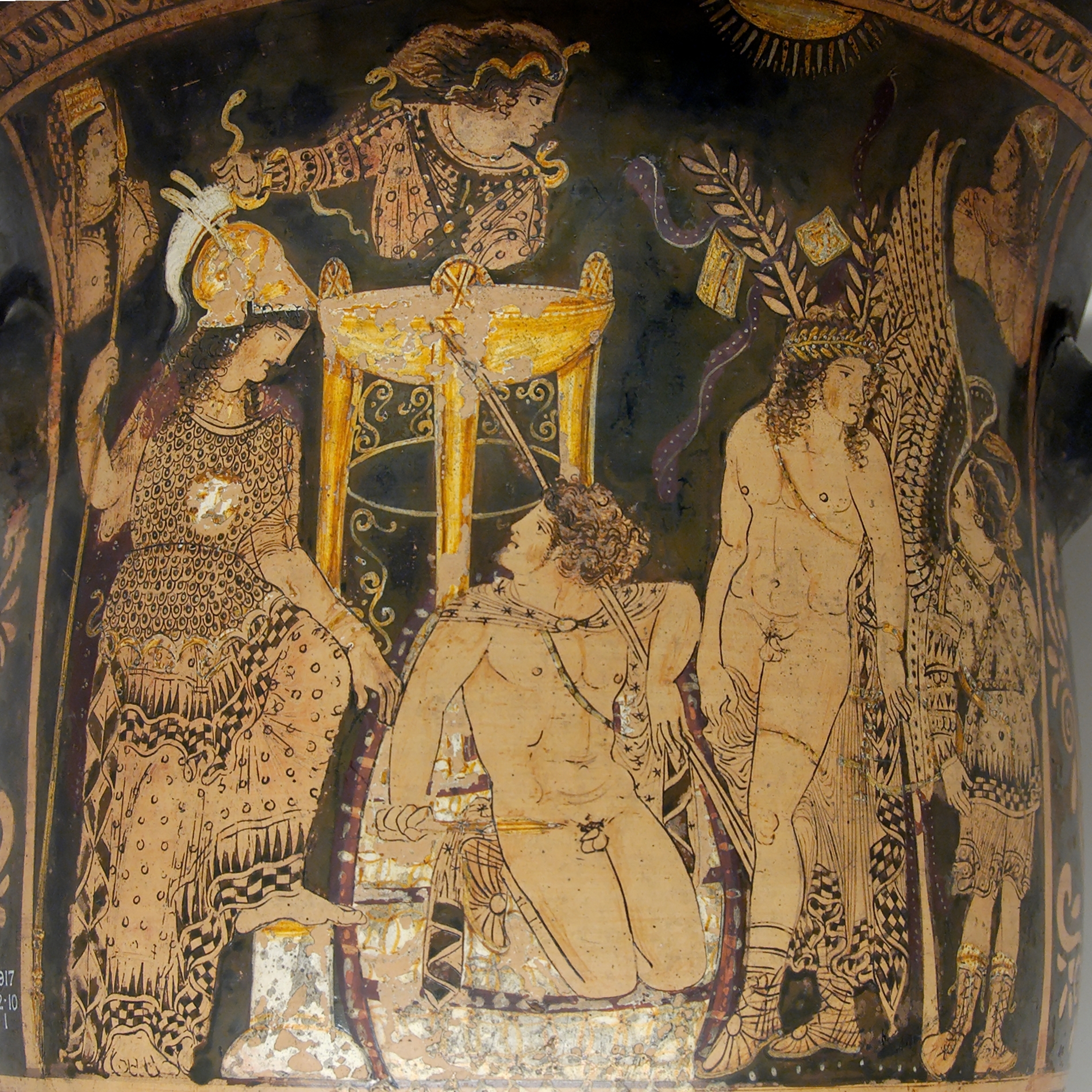
Despite these vivid presentations of Erinyes, the creatures did not have a well-defined appearance until the Greek tragedian Aeschylus featured them in his trilogy, the Oresteia. In this three-part tale, King Agamemnon returns home victorious after the Trojan War, only to be killed by his wife Clytemnestra as revenge for him sacrificing their daughter to the gods. Their son, Orestes, learns what his mother has done and murders her. In the final play of the trilogy, the Erinyes, goaded by Clytemnestra’s vehement ghost, rise up from the underworld and hunt Orestes down.
The Erinyes resemble Gorgons with their snaky hair. They are said to have been so frightening when they appeared on stage women in the audience miscarried. In the play, they stalk Orestes to Athens, threatening to murder him and drink his blood.
“We drive matricides from their homes,” they say. ”We are called Curses in our home below the earth.”
The loathsome Erinyes are finally placated by the goddess Athena, who holds a formal trial for Orestes and casts the deciding vote for his freedom. Athena convinces the Erinyes to take up a place of honor at Athens and become the goddesses of the court, locally worshiped as the Venerated Ones.
The final play in the trilogy was called Eumenides, meaning “Kindly Ones.” This name became interchangeable with Erinyes for Greek writers. It is thought to be a euphemism so that people could avoid saying their real name. After this play was performed in the fifth century BC, the Erinyes their reputation was cemented as avengers of those murdered by their own family members.
In Aeschylus’ tale, the Erinyes were daughters of Night, not Uranos. The Greek writer Apollodorus would revert back to the original genealogy in his Library, where he numbers the creatures at three and identifies them as Alecto, Tisiphone, and Megaera.
The great Roman poets Vergil and Ovid would include the Furies, Latin furiales, in their depictions of the underworld. In Ovid’s Metemorphoses, a spellbinding catalogue of hundreds of Greek and Roman myths, the goddess Juno visits the underworld and finds Tisiphone and her sisters combing snakes from their hair. Juno’s orders the Furies to punish Ino, a mortal who had offended Juno. Tisiphone and her frightening cohort, including creatures called Grief, Fear, Terror, and Madness, visit the house of Ino and her husband Athamas.
From the middle of her hair she seized two snakes
And threw them with a pestilential hand.
The snakes terrified the hearts of Ino and Athamas
And breathed sickness into their minds.
(Ovid, Metamorphoses 4.495-8)
The mortals become infected with madness. Athamas murders one of his children. Ino flees with the other until she is forced to jump off a cliff into the sea.
The Furies in Ovid’s story are not the enforcers of the natural order we met in Homer. By the first century AD their reputation had changed to be fearsome creatures who love to wreak havoc.
In each of these stories, the Furies are especially associated with snakes. This is because in ancient Greek religion, snakes were closely linked with the dead. Snakes would often appear at gravesites to lap up libations and sacrifices offered to the dead. There was even a belief that when a dead body breaks down, the spine slithers off as a snake. The Erinyes, adorned with snakes, have instilled terror for centuries by embodying the dead.
Featured image: Orestes Pursued by the Furies (1921) by John Singer Sargent. (Wikimedia)
By Miriam Kamil
Sources:
- Homer, Iliad
- Hesiod, Theogony
- Aeschylus, Oresteia
- Apollodorus, Library
- Vergil, Aeneid
- Ovid, Metamorphoses
- Aelian, On Animals
- Further reading:
- Walter Burkert, Greek Religion (1985)
- Jane E. Harrison, Prolegomena to the study of Greek Religion (1991)


Aug 17, 2015
Cerberus: Legendary Hell Hound of the Underworld
In ancient Greek mythology, there exists a three headed dog called Cerberus that guards the entrance to Hades, a misty and gloomy underworld in which spirits of the dead are permitted to enter but none are allowed to leave. In the ancient world, dogs were often depicted as wild animals that defied domestication, roamed the streets in packs and scavenged on the edge of town. The mythical Cerberus incorporated not only the feared qualities of the ancient canine, but was a strange mixture of several creatures in one and a nightmarish sight to behold.
The name Cerberus comes from the Greek "Kerberos" meaning “spotted.” To the Greeks, Cerberus was a monstrous three-headed dog, or "hellhound" with a serpent's tail, a mane of snakes, and a lion's claws. His three heads were thought to represent the past, the present, and the future while other sources suggest they were symbolic of birth, youth, and old age. The most potent ability of Cerberus was his look, which was so dreadful that anyone who looked upon him was immediately turned into stone. It was said that Cerberus had razor sharp teeth and a poisonous bite. The poison that drips onto the ground sprung up as a plant that is known as the wolf’s bane.
The father of Cerberus was Typhon, the mightiest and deadliest monster in Greek mythology (as well as a god). A huge fire breathing dragon said to have glowing red eyes, a hundred heads and a hundred wings, the Olympian gods were terrified of him. Everywhere Typhon went, he spread fear and disaster with his mission being to destroy the world and to put obstacles for Zeus along his path to the Kingdom of Heaven.
Cerberus' mother, was Echidna, a half-woman, half-snake creature known as the "mother of all monsters". Had black eyes, the head and torso of a beautiful woman and the lower body of a serpent. In a cave is where she dwelt luring men in with her body before she ate them raw.
Cerberus primary role was the watchdog of the Greek underworld and faithful servant to the god Hades. His main haunt was along banks of the river Styx, a river forming the boundary between Earth and the Underworld. He guarded the gates of Hades and prevented the dead from escaping and the living from entering without his master's permission. Chained to the entrance gates of Acheron, another river of the Underworld, Cerberus fawned on the dead or new spirits as they entered, but would savagely eat anyone trying to pass back through the gates and return to the land of the living.
The Charon known as the ferryman taking souls to the river Styx and through to Hades. Artist: Alexander Litovchenko. 1860. (en.wikipedia.org)
Cerberus is featured in several mythological stories as “hell’s watchdog” and there are even a couple of myths in Greek mythology where a hero gets the better of the beast. The first is when Orpheus, the famed musician of Greek mythology, sneaks into the underworld by lulling the normally alert and aggressive Cerberus to sleep with his lyre (a type of harp). The Thracian singer was revered in Greece and happily married to the nymph, Eurydice. One day she was bitten by a snake and died. Orpheus was so grief stricken by his loss that he stopped singing and playing all together. He then decided to risk his own life in a desperate journey to the Underworld to try and rescue Eurydice. His playing enchanted Charon, the ferryman who carried the souls of the dead across the river Styx and he agreed to take Orpheus across the river, even though he was still living. When he encountered Cerberus, the three headed monster lay down meekly to the strains of Orpheus's lyre after which Orpheus was able to gain passage.
Hades and his wife Persephone, granted Eurydice back to Orpheus under one condition: Eurydice must walk behind him as they ascended back to the upper world, and Orpheus was forbidden to look at her. Just before they reached the surface, Orpheus was so overcome with passion that he turned around to look at Orpheus. She was immediately turned into a ghost and sent back to the underworld forever. Orpheus' own fate was to be dismembered by Thracian maenads, the female worshipers of Dionysus.
Orpheus leading Eurydice out of the underworld after having played his lyre for Cerberus. Painting by Edward Poytner, 1862. (Wikimedia Commons)
The most famous story of Cerberus involves the half man, half god Hercules. As the last of his twelve labors, Eurystheus, the king of Tiryns demanded that Hercules capture and bring Cerberus back alive. Eurystheus was certain that Hercules would fail in this impossible task. Hercules went to the Underworld, found Hades who told him that if could take Cerberus without the use of weapons, he would be allowed to leave the underworld with the beast. When Hercules found Cerberus on the shore of Acheron, he began wrestling with the huge monster using only his bare hands. As the world's strongest man, it took all his power to subdue Cerberus. The monster soon grew weary, and having run out of breath by the strongman's choke hold, finally yielded to Hercules. Cerberus is one of the few monsters who ever met Hercules and survived. Unlike other monsters that crossed his path, Cerberus was returned safely to Hades, where he resumed guarding the gateway to the Underworld.
Hercules fighting Cerberus until he tires the beast but he does not kill him. Artist: Francisco de Zurbaran. 1634. (mlahanas.de)
Cerberus is featured in many works of ancient literature, although, the depiction surrounding the mythological creature often differs by authors and cultures. Cerberus appears in Dante's Inferno, guarding the third circle of Hell rather than the entire underworld. This is the circle of gluttony, and Cerberus is used to personify uncontrollable appetite. Cerberus is also featured in many prominent works of the Roman literature, most famously in Virgil’s Aeneid, and the story of Orpheus in Plato’s Symposium, and in Homer’s Iliad, which is the only known reference to one of Heracles’ labors which first appeared in a literary source. Norse mythology has an equivalent of Cerberus where Hell is guarded by a four-eyed dog named Garm. In Egypt, his incarnation was Anubis, the dog that guarded tombs and conducted the souls to the underworld. Some writers, such as the Greek poets Hesiod and Horace, claim Cerberus had as many as fifty or a hundred heads and in other descriptions, they are in the shape of a lion, dog and wolf, respectively. In popular culture, a character based on the beast appears in the Harry Potter film, The Philosopher’s Stone. Called Fluffy, he is lulled to sleep by a flute by Harry in a manner quite similar to the story of Orpheus and Eurydice.
Featured Image: Painting where we can see Cerberus actively guarding Hades. Artist: Luca Giordano. 1684-1686. (Wikimedia Commons)
By Bryan Hilliard
References
- Lindemans, Micha F. "Cerberus." March 30, 2001. http://www.pantheon.org/articles/c/cerberus.html
- "CerberusPronounced As: Sûrbrs." Cerberus: Mythical Creatures of Legend and Folklore, Myth Beast, Mythology Legends. http://www.mythicalrealm.com/creatures/cerberus.html
- "Cerberus, the Guardian of Hades." Greek Myths Greek Mythology. http://www.greekmyths-greekmythology.com/cerberus-guardian-of-hades/
- "Cerberus." Cerberus. http://www.greekmythology.com/Myths/Creatures/Cerberus/cerberus.html
- "Cerberus." - Conservapedia. http://www.conservapedia.com/Cerberus
- "Cerberus." Greek Mythology Wiki. http://greekmythology.wikia.com/wiki/Cerberus
- "Cerberus of Greek Mythology - The 3-headed Hound of Hell." Cerberus of Greek Mythology - The 3-headed Hound of Hell. http://www.gods-and-monsters.com/cerberus-greek-mythology.html
- "Monsters & Creatures » Typhon, the Monstrous Opponent of Zeus." Greek Monsters-Typhon, the Monstrous Child of Mother Earth Gaea. http://www.greek-gods.info/monsters/typhon




Subscribe to:
Posts
(
Atom
)