Yesterday I was working on a progressively enhanced user interface (without JavaScript) — a scenario that we cater to very frequently at a company I’m currently employed with.
Accidentally, it completely slipped my mind to flip the switch and enable JavaScript back. A door to entirely different Web was suddenly wide open. Let me tell you—I didn’t like what I saw.
It took me a good minute of genuine confusion to figure out why most of the applications I use frequently were hardly usable and content barely available.
The Web without JavaScript is empty and broken
Here are some of the Web giants—Trello, Facebook, Gmail, Dropbox and AirBnB, sans JavaScript.
Some of them handled it better, some worse. From zero information or pointers, that might as well be flipping a bird, to half-functioning interfaces informing about the potential bottlenecks.
As an active empathy practitioner I imagined what the ongoing no JavaScript Web browsing experience could be. While the percentage of these users might be relatively low, we fail to remember that until the scripts load, that scenario is true for all of us.
The Web isn’t always blazing fast
Even now, I’m sitting in one of the most expensive cities in the world, that offers the highest quality of life, on a DSL connection (barely maximum of 15mb/s down, slower than 3G that can reach 56mb/s, an infrastructure introduced over 10 years ago). According to Akamai’s Q4 2015 rankings, the average Internet speed worldwide is at whooping 5.6mb/s.
The global connectedness is rapidly growing, but there’s still a vast space of unmapped territories (for more insight into Internet penetration see Global Internet Maps).
That brings me to a point; the foundation of the Web is plain ol’ Hyper Text Markup Language along with Cascading Style Sheets. I’m not suggesting we should stop using JavaScript at all—it’s a great language and the ecosystem is growing rapidly. npm already surpassed more than one billion module downloads weekly a while back. The community will continue to expand, improve and evolve, as others do too. This is a problem that spans way further than one programming language.
The Web and its technologies have to be treated differently
It’s a privilege to be able to use breaking edge technologies and devices, but let’s not forget basic accessibility and progressive enhancement. Ultimately, we’re building for the users, not for our own tastes or preferences. Sadly, not everyone is born with an equal chance.
Having endless opportunities at our hands is great, blindly obsessing over the stack and not putting people in the forefront never is.
Programming communities are heavily opinionated, very vocal and oftentimes hostile in defending their views. In these completely irrelevant microaggressions we lose sight of the humans we build software for.
If suddenly your audience disappeared, would you continue building and releasing into the void? If you were the end user and no one cared about you, how would you feel?
These questions have to be asked constantly. Empathy is necessary for everything we do. Luckily, one of the giants I’ve mentioned before, Basecamp, fixed their JavaScript problems hours after I tweeted and took the time to thank me for pointing it out. That’s care.
It boils down to understanding how our seemingly user-invisible decisions shape what the Web is. There’s no one programming language that will divide and conquer.
The Web isn’t uniform—it’s countless flowing layers, each affecting user experiences in its own way.
The technological choices are important for teams, but have even more impact for the audience. The Web can and will be built with and on anything we can put our hands on. Let’s not forget who we’re creating it for.
Design Has Gone Too Far for Simplicity and We Need to Fix It.
The
design revolution, sparked by a decade of complicated and
labyrinth-like UIs, has resulted in our current worship of minimalism.
But now we’ve gone too far. Instead of “make things simpler,” we’ve
moved onto “make simple things.” In our pursuit of design simplicity,
we’ve lost sight of the larger picture.
We prefer fewer but more powerful choices. We prefer likes instead of comments. We prefer minimalism over a library of actions.
As
a consequence, our applications now lack depth. Depth, which is
different from but often confused with complexity, is a design element
that we desperately need. Depth is what lets a professional
artist create a beautiful flyer with the same Microsoft Office
application that a second grader uses to create her first banner. Depth
brings a sense of accomplishment, an increase in utility, and a very
real feel of mastery. Users of deep products feel a sense of loyalty
with the application, wherein the mastery of the product becomes a part
of who they are and what they can do.
How then do we bring back depth into our designs without needless complexity? Is it even possible in the first place?
For
that, we need look no further than in the fields of both education and
gaming. One design philosophy that both game designers and teachers have
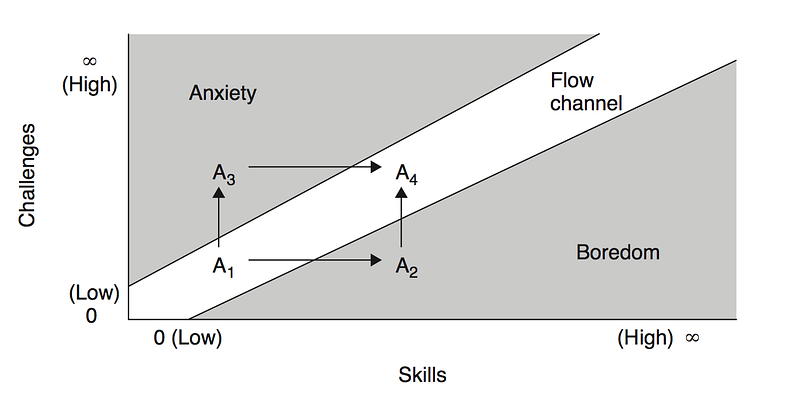
is the concept of flow channels. In the gaming industry specifically,
game designers know this as the graph that indicates the stage of
difficulty versus the amount of experience the user has accrued. Too
hard and players give up. Too easy and they tune out due to boredom.
Photo Credits to “The Art of Game Design” book by Jesse Schell
Likewise,
no experienced high school teacher would start the school year with how
to manipulate imaginary numbers: that would be too difficult and risk
tuning students out with frustration. Yet they also can’t make the
course too easy with simple arithmetic because that would just bore
students instead. In the end, instructors and game designers want the
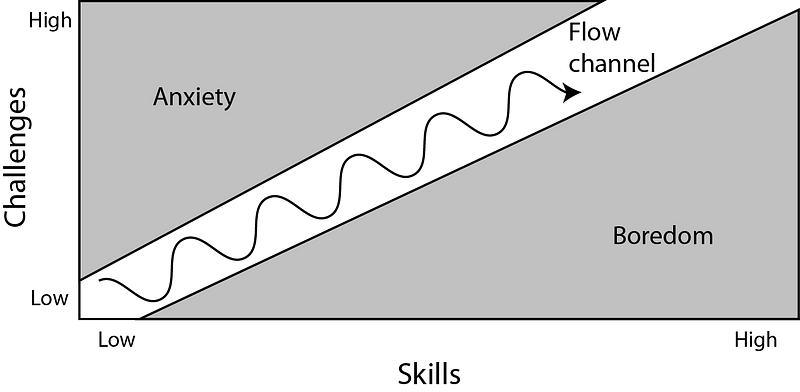
material to start easy but get progressively harder in a constant and
manageable pace. A successful curriculum, like a good game, would see
the chart rendered into a wave function:
Photo Credits to “The Art of Game Design” book by Jesse Schell
Games
and teachers have known about this design philosophy for decades due to
their product’s necessity in maintaining audience interest, but this
concept is critical for every single product: technical or not. It is
easy to see how this applies to products with complicated UIs or complex
professional functions. In fact, that is what sparked our century’s
interest in design in the first place. But the lower end of the spectrum
has been neglected and UX designers have taken things to the extreme.
Instead of adopting a progressive difficulty curve and lowering the
graph intercept, they’ve gone to the mindset of “simplify everything”
with an endless horizontal line.
Complexity is not bad.
As
long as it’s introduced subtly and in a gradual manner, it stands as a
natural byproduct of knowledge and usage. Complexity when done right
means more variety, more impact, and more depth. For a product, this
means a greater value proposition and larger usability. For a user, this
means a more powerful product.
The
difficulty in accomplishing this is that it requires designers to
create an artificial and progressive workflow process. By pushing users
through a voluntary funnel, designers can naturally lead more curious
users into exploring more creative uses by giving them the tools to do
so. The process itself should naturally introduce features one by one,
with each additional introduction bestowing the user new skills and
abilities.
This
is why designers need to rethink how they perceive their users. In
addition to characterizing user personas as a niche with its specific
demographic wants and needs, an additional consideration should be made
for how that demographic learns.
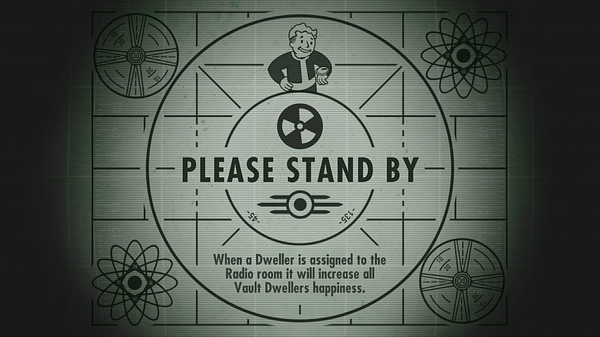
This
tip is one of the only ways to max one of the game stats in play. It
deserves a little more real estate than a loading screen. Photo Credits
to DocPop.org
Currently,
presenting tidbits and trivia is the most common method of products
attempting to do this. Unfortunately, most of the time these efforts are
either ignored by the user because they’re served on loading screens,
or are reduced to bare factual details that grant no value. The loading
screen is too short a process for introducing deep functionality. Even
with the best attention-grabbing graphics, loading screen real estate is
at most suited for event awareness or the simplest of game facts.
At
this point, some of you might scratch your heads. The act of designing a
funneling process seems incredibly difficult. If even such a popular
game as Fallout Shelter cannot perfect it (though the rest of its
channel flow is pretty well done), maybe it’s not the worth the trouble
to consider: especially when the investment in design seems so mammoth
and the goal so hard to measure even if done right. If my product is
neither recreational nor educational, perhaps I can afford to proceed
without this thinking… right?
Wrong.
Every Product is By Nature Educational
From
the mere fact that every product must be used for the first time, each
and every single product has to possess a way for the users to learn how
to handle it. This by nature means that all products must be able to
teach their users. For centuries, we achieved this through manuals. Even
now, many things that we use still come with one: whether it be virtual
or physical.
And
that should not come as a surprise. Designers already know this and
incorporate this into the UX through elements that build user discovery:
constraints, signifiers, and other mechanisms like forcing functions.
These are all great tools for what I think is the ultimate goal of depth
and designing a channel flow: affordance discovery. At it’s simplest,
affordance discovery is designing for users to find out how they can get
new uses out of existing or new features. In context with a channel
flow funnel, affordance discovery is the mechanism to subtly present new
cases and usage to the user.
Clean Master
One
great and simple example I found lie in the smartphone application
Clean Master. Advertised specifically as a way to free up smartphone
RAM, the application begins with a very simple UI that displays a
headboard with some basic commands.
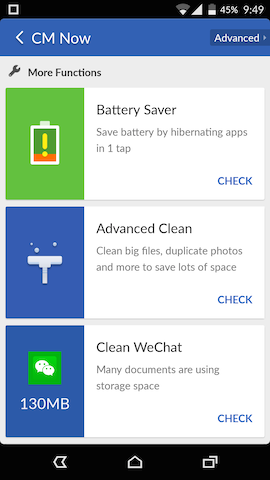
The ordinal procedure of the application goes from Left to Right. Application pictures courtesy of Clean Master.
Due
to its marketing and name however, the user naturally just wants to use
the application to remove the junk files. Easily enough, simple
discovery and signifiers allow the user to find this functionality
through the representation of the trashcan. A simple clicks brings us to
the next step, in where the application provides appropriate feedback
to the user but simplifies the necessary input to a very simple and
direct “Clean Junk” call-to-action at the bottom.
Where
affordance discovery and the user design funnel begins is in the 3rd
and last photo, where the user has already accomplished his main goal.
At this stage, the user has already completed his desired action: but
instead of returning to the initial starting page, he is led to one that
displays some of the other functionalities of the application.
These
additional functionalities are in-line with exactly the type of
services that the user persona would find of interest. By displaying it
after the application has already fulfilled the user’s initial goal, the
presentation of the material in no way obstructs from the original
purpose. Single-goal users will at this point end the application,
satisfied that they’ve accomplished their desire. But those more curious
will voluntarily continue and be led to discovering the application’s
additional functionalities.
That
is the goal of a channel flow funnel. It allows users with flat needs
to complete their objective with no impedance, but also voluntarily
gives those curious and wiling to learn additional functionality in a
nonintrusive way. With each product being unique to itself however, the
best methods of affordance discovery and their flow funnel will differ.
In those times of design formation, ask the same questions as would a
teacher or game designer: “How can I get them interested in the next
step?”
How we may soon no longer need to install apps with help from Google and Surprisingly: Apple.
“There’s an App for That.”
It’s the trademarked slogan that defined the mobile world since 2008. Surely, apps seemed to be the way
to go. Coding bootcamps that claimed to teach you app development chops
within weeks popped up everywhere; products used commercials to go out
of their way and show off their new apps; heck, even that family
restaurant around the block got its own menu app built.
With
the release of the App store in 2008, Apple was the first to popularize
the idea of nicely packaged, downloadable applications on your phone.
However, this concept of centralized software distribution isn’t
actually new. Many handheld and desktop devices
already had some form of application store built in years before
Apple’s App Store debut. The reason why Apple succeeded, in retrospect,
is a combination of timing and technology. By 2008, the iOS (then
“iPhone OS”) platform was able to offer access to a maturing 3G network,
a well-documented development environment, great handheld graphics, and
most importantly, the backing of a technology giant. Mobile apps made
sense. They were the most efficient way to deliver the newest content
and services with native experience and performance.
People
don’t care how it all works, they just want to throw birds at pigs and
show off their #nofilter selfies. The ability to download and run cool
apps was the iPhone’s winning feature for a short while. Android soon
followed suit. Smartphones became cheaper; networks became faster;
handheld processing power quadrupled; apps prevailed.
You
see, mobile apps succeeded because of the right combination of fast
network and capable handheld processors. Technologies have progressed
much further than that in the meantime, and the world of apps has grown
beyond a healthy size. Among all of the headaches that follow the
impenetrable mobile market today, the two most urgent would be the delivery and discoverability of content.
Delivery and Discoverability
Everyone
with a smartphone has experienced this at some point: “Wow, this
restaurant/shop is offering 20% off the special entree…oh, but only if
you have this app,” or “Wait, I have to download an app for this? I just
to want to see what my friend posted.” You probably heard from a friend
or saw in a billboard about this really cool app that’ll transform your
life, but hesitated to install it, or worse, pay for it.
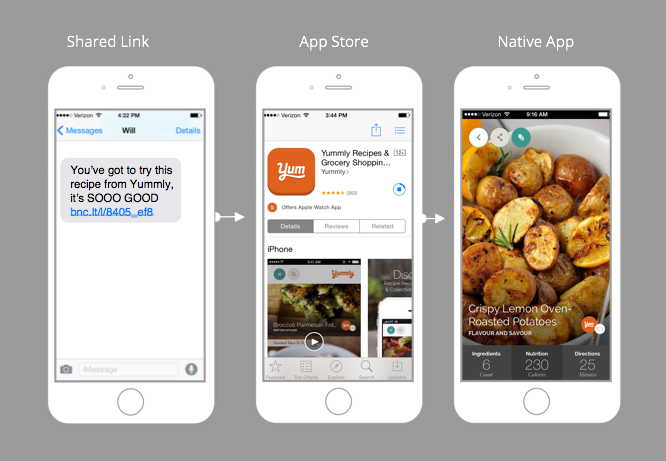
Image by Branch Metrics
The problem is twofold. Let’s start with the first: delivery.
Your average digital couch potato now has a shorter attention span and
less patience. Paying for and installing an app, what was once a
magical, fast, and smooth experience, is an act of commitment for many
nowadays. You won’t believe how many people demand a convincing reason,
your heartfelt speech, and your first-born child just to get them to try
out a new app. Just think about that one friend who still refuses to
download the Messenger app (seriously just get it already). Companies
want to deliver content and services to customers as fast and easily as
possible, but the increasing reluctance for the perceived
installation-barrier is putting up a delivery obstacle. Our home screens are the new San Francisco — space is at a premium.
The second problem, discoverability,
is a little bit more subtle, but was well articulated by a few tech
journalists in the past. Many popular apps, such as Instagram and The Daily,
began as mobile-only apps that surfaced great content only within a
closed platform. You had to download and register for Instagram in order
to see your friends’ Instagram photos. I’m sure that there are many
more apps out there today that I’m not aware of with useful content that
are not searchable or viewable on your browser. A
fragmented Internet where creative and original content are locked up
in proprietary platforms is not the Internet we know and love.
App Linking and Indexing Works, But Not Good Enough
GIF by Branch Metrics
Now
that we understand the problems, let’s take a look at the current
solutions. The word “app linking” may not sound familiar to you, but
every time you tap on a YouTube link in another app and the YouTube app
opens up to play the video, you’re experiencing it. Google, Apple, and
Facebook have all implemented variations of this technology. App linking brings you to the app that best presents the content you want. Great.
The
other half of our existing solution to compliment app linking is app
indexing. Google and Apple have provided ways for third-party content
providers to show their own in-app content in a search query, allowing
previously locked away content to surface on Google and iOS Spotlight.
Perfect.
That seems to have solved our delivery and discoverability problems.
User searches for something, in-app content shows up in the results,
user clicks the link and gets brought into the app.
You
might have already noticed the problems here. What if the app doesn’t
support app linking and indexing? App indexing requires the content
provider to actively put effort into implementing it,
so by default, your content is not visible to the world wide web,
exactly opposite of how most web-based content work. And only until
recently, in order for your app to be indexed by Google, developers had
to build mirroring web versions. Just imagine the troubles. On the
consumer side, what if I don’t have that app to begin with? What if I
don’t want to install that app just to read an article? The list goes
on.
Think
about that one time when you tried to check out something and it
redirected you into App Store instead. Very annoying. And no, no one
wants to install your app.
I don’t want to maintain a walled garden of apps. I want to consume and create content.
“So then, what is the solution?”
Just get rid of “apps.” Let’s see how we might be able to do this.
App Streaming from Google
Google’s
approach to the delivery and discoverability problem has relied on app
indexing and linking. If the developer puts in the effort, users can see
previously mobile-only content surfacing on Google search results. This
is great for Google to stay relevant in a mobile market that is
increasingly reliant on native app content instead of web search. But in
countries like China and India, where mobile phones are the first
computers for millions of people and mobile-only content is king, where
does a search engine provide their links to begin with? Suddenly,
“everything is just a Google search away” loses its magic.
Roughly
four months ago, Google rolled out an impressive technology that almost
no one remembers — App Streaming. It does exactly what it sounds like;
instead of installing applications like we’re used to, you tap a link to
the content and Google will stream the right parts of the app to you
on-demand. No need to install it, ’cause you’re already running it. It
might be Google’s first pilot experiment of their cloud platform, but
the idea of streaming applications onto your phone is not new. In fact,
the very technology itself was bought by Google from Agawi a few years back.
Combine
App Streaming and App Indexing, suddenly you remove the two barriers to
all information previously locked away in mobile apps.
On-Demand Resources from Apple
While
Google’s fantastic solution is still in an experimental stage, Apple is
nudging its developers in more or less the same direction, albeit
characteristic of Apple, in a less obvious or more incremental way.
On-Demand
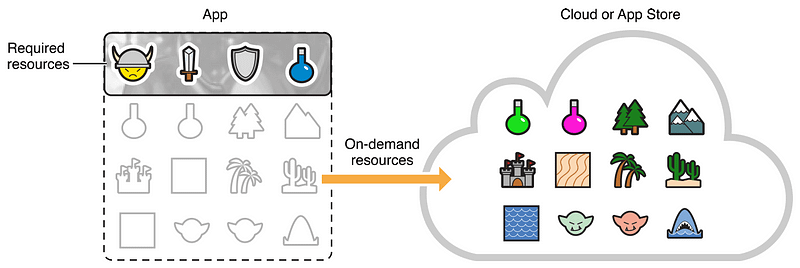
Resources (ODR) is a technology released with iOS 9 that downloads a
small core application only on installation, and then downloads extra
parts and content as needed. ODR currently is being used mostly in
games, where a user only downloads the assets (graphics, videos, etc.)
for a few beginning levels. iOS will then download more levels as the
user progresses, and delete assets for completed levels to make space.
How
does this mirror Google’s approach? It doesn’t. However, if ODR becomes
commonplace and the supporting infrastructure is flexible enough, you
can reasonably imagine Apple extending the framework to a more general
use case. In any case, they got this wonderful tool under the belt that
will potentially blossom into a form of install-free applications.
The Underrated Quest for Web Apps
While
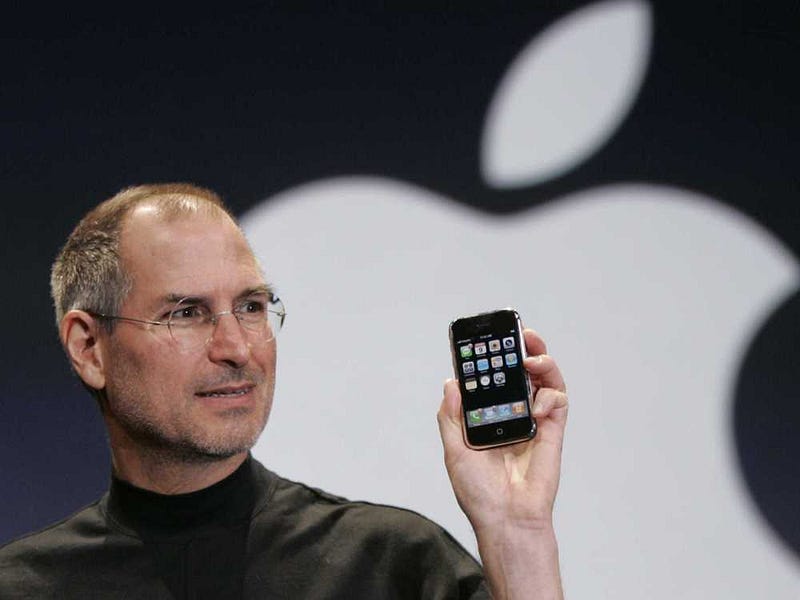
we’re on Apple, I want to bring up Steve Jobs’s vision of the first
iPhone. You might still remember fondly that the first iPhone was a
closed platform with no developer environment or third-party apps. His
solution? Web apps.
Web
apps don’t need to be installed. They run (relatively) securely in
closed browser environment. They are web friendly, meaning they can be
indexed and surfaced by search engines. Oh wait, isn’t that exactly what
we want today? Probably.
This is probably the one billionth time you’ve seen this picture. But I’ll put it up anyways.
I’m
still leaning on the belief that web apps were simply Steve Jobs’s
transitional plan to native apps, but even so, I think he was (at least
accidentally) onto something. If we had in 2008 the powerful Javascript
frameworks we have today, perhaps web apps would have taken off. Feel
free to paint the story into one where Jobs the Visionary foresaw the
discoverability and delivery problem, because perhaps he did predict
this.
A Future without Apps
A
lot of what app streaming offers competes with other sophisticated web
app technologies (React Native, etc.) that are quickly closing the gap
between native and web. However, one decisive differentiating factor
would still be the native look and feel or possibly performance that web
apps sorely lack. There is just no perfect solution yet.
On top of it all, what we really need is a platform-agnostic solution to app streaming that truly overcomes content delivery and discoverability problems. We want something akin to Java applets on browsers
(yikes) on mobile. Imagine the possibilities: regardless of the OS or
the brand of supercomputer you have in your pocket, you will be able to
run an app and view its content with zero friction and with native feel
and performance. As for developers, you can write an app once and stream
it to all devices and browsers.
With
Google streaming apps to your phone and Apple nudging developers to
store parts of their apps in the cloud, we may have just entered the
beginning of a future where installation becomes obsolete and the border
between “website” and “native app” is blurred. This is a future without
apps. And it’s wonderful.
The user forefront of all these insanely complex, powerful, and cool technologies is one of ultimate simplicity and elegance.
In its mind,
Silicon Valley creates the future, while the rest of the world will soon
become the “idle class.” What if they instead helped people build
wealth for themselves?
Last month, Y-Combinator, Silicon Valley’s blue-chip startup fund, announced a request for proposal to study a universal basic income.Sam Altman, the President of Y-Combinator, wrote in a separate essay that in the future, we will have a “smaller and smaller number of people creating more and more of the wealth. And we need a new solution for the people not creating most of the wealth — many of the minimum wage jobs are going to get innovated away anyway.”
The people without jobs will be an “idle class” — and the obvious conclusion, to Altman, “is that the government will just have to give these people money.” (Emphasis ours.)
And you wonder why political candidates on both sides are tapping into anti-elitist anger with great success.
Silicon Valley is, with good reason, the envy of the entrepreneurial world. Brilliant people have created transformative companies — and have earned a great living in the process. Facebook and Twitter have given people the ability to express themselves in authoritarian governments; the inventors of the mobile phones have brought information and services to billions; and Google makes the world’s information available to everyone.
But Silicon Valley’s view towards the rest of the world is often one of unchecked arrogance.
In the universal basic income proposal, the Y-Combinator team posits that Silicon Valley’s wonderful creations will create an incredible amount of wealth, but will put a lot of people out of work. Silicon Valley frequently worries, for example, that if self-driving cars are commercialized, truck and taxi drivers will be out of work. As such, a universal basic income will ensure that they’ll be happy and society will be successful. It’s a seductive idea, but they are asking the wrong questions.
The idea here is borne from an underlying assumption that capitalism has winners and losers, and the victors have a responsibility to take care of the rest. Instead, we’d posit that many of the “winners” in Silicon Valley are part of a faux meritocracy — being born into the right city or social network.
Silicon Valley seems to be worried that the rest of the world won’t find its way. A recent podcast from venture firm Andreessen Horowitz described how a few “Alpha Cities” are going to drive the future, while other metropolises will struggle to find their meaning. When India didn’t go for a Silicon Valley-led internet proposal, Marc Andreessen gained global denunciation (including from Silicon Valley CEOs such as Mark Zuckerberg) for a tweet that said, “Anti-colonialism has been economically catastrophic for the Indian people for decades. Why stop now?” And Y-Combinator themselves say that for startups to be successful, they have to move to Silicon Valley. “We would not be doing a startup a favor by not making them move,” their website reads.
So Silicon Valley, in its own mind, creates the future, while the rest of the world (by virtue of zip code or differing world view) should follow suit or risk being left behind.
One could take this to its logical (and cynical) conclusion and say that the rest of the world will eventually be out of work and become a burden on the enlightened few. They’ll storm the gates of Silicon Valley’s kingdom, and the resulting social unrest will be an unfortunate distraction to the wonders of artificial intelligence, research into extending life past the age of 120, and other great wonders of modern technology.
The universal basic income will keep “these people” at bay.
Combinator and their Silicon Valley counterparts
often talk about the value of geography. The best ideas, we are led to
believe, come from a small stretch of earth close to San Francisco.
James Fallows in a recent Atlantic essay describes
how most of America’s elite believe in “The Big Sort” — that to be
successful, one must be sorted into a few metro areas: San Francisco,
New York, Boston, perhaps Seattle or Washington D.C. When it comes to
people investing in new ideas, this is absolutely true. 78% of investment in startups
goes to three states (New York, Massachusetts, California). While in
the past 20 years startup investing has increased 300% in those states,
it has actually declined in the other 47 across the country.
Silicon
Valley has become a “monocrop” culture where entrepreneurs are
well-educated, have frictionless access to capital, and have their basic
needs taken care of. The majority of resources today are going to
entrepreneurs whose lived experience is in well-off, well-connected
cities.
Successful
startups are born at places like Y-Combinator and go through the
venture capital gauntlet frictionlessly — the same way big factory farms
across America churn out cheap corn and beef.
Yet there is a problem with monocrop culture: ultimately, you deplete the soil. In a recent podcast
with Kleiner Perkins partner Randy Komisar and legendary Silicon Valley
“coach” Bill Campbell — mentor to Steve Jobs and Larry Page — Randy
asked whether, over time, entrepreneurs were solving increasingly
frivolous problems. Campbell responded, tellingly, that entrepreneurs
solve problems that they can understand.
“While
you and I might think Snapchat is frivolous,” Campbell said, “my
grandchildren find it a great solution for how better to communicate
with their friends.”
Snapchat
may be solving an important problem for well-connected young people in
America who don’t have to worry about basic needs. But whether it’s
unemployed young people in St. Louis looking for their next paycheck or a
family in Flint, Michigan worried about clean water, many Americans
have more immediate problems.
But
the entrepreneurs there — “those people” —often don’t have access to
resources or opportunities to solve their problems. And Silicon Valley
can’t foresee a future where St. Louis or Flint could create the jobs of
the future.
Because
most of today’s entrepreneurs have their basic needs taken care of,
their problem-solving often seems frivolous to the rest of the country.
Take
Uber, for example. Uber’s great at solving how people with smartphones
and disposable income can get around major cities — a small fraction of
the global population. Uber is less good at helping the drivers, whose
income is much lower than the riders, benefit from this new paradigm.
Uber has hailed their impact as letting people work flexibly and use
assets more productively, but strategically is investing hugely in
driverless cars.
And we don’t blame Travis Kalanick
(actually we do, but that’s not the point of this story). Uber’s
founders’ experiences are as riders, not drivers. But imagine an
ownership structure in which, for example, drivers could earn fractional
equity in the company for each ride they gave. What if a percentage of
the $50B valuation were shared among the drivers, based on a merit-based
system?
We’re
not saying that Uber should do this (they can’t at this stage); we are
saying that if Uber’s leadership had different lived experiences, the
company might look different.
2015 has been a year of tremendous growth in AgTech, both in terms of the technology and the companies that create them. We (the AgTech nerds of the world) are right to be proud of the advances made in our little corner of the world, but our success isn’t achieved in a vacuum. As this year draws to a close, I’ve tried to place the work we do every day into its global context, the context of conflicts, victories, humanity and inhumanity we see everyday on the nightly news and our Twitter feeds. I love what I do, but I’ve been forced to ask, does AgTech really matter?
My search for answers led me to the internet. AgTechnologists turn perpetually towards the “70% more food by 2050” statistic, and set for ourselves the goal of feeding 9 billion people in the world by mid-century. But what about today? What goals might we set for ourselves in 2016? The attention of the world was captured in 2015 by terrorism, the refugee crisis in Europe, severe weather and climate change, and the ongoing struggles against racial and economic inequality. At first blush, AgTech has no answers for these problems. But for posterity, let’s take a closer look.
From Charlie Hebdo and Paris to San Bernardino, ISIS is the boogey man of the Western conscious. Though this latest incarnation of anti-Western extremism in the Middle East has turned our social technologies against us, their rise was not so different from that of their predecessors. We know that famine and starvation contribute to the instability that leads to the rise of terrorism. Food instability in the Middle East arises because water, healthy soils, meaningful information about weather and markets, and other vital resources are scarce. As AgTechnologist Norman Borlaug said, “You can’t build a peaceful world on empty stomachs.”
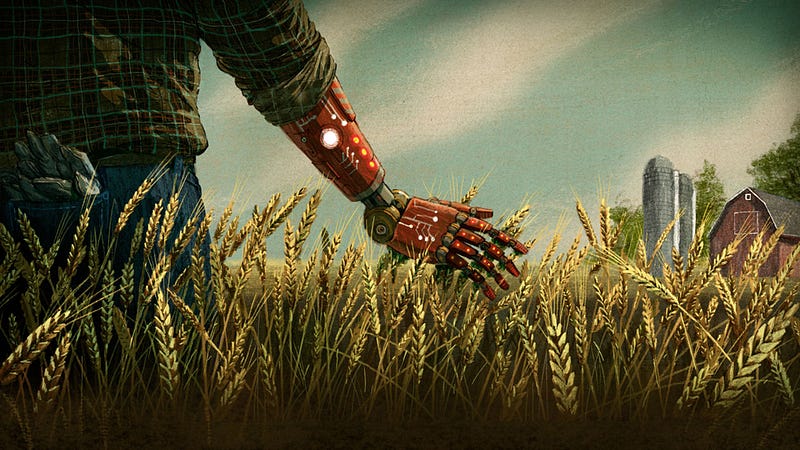
The refugee crisis in Europe shares many of the root issues of terror in the Middle East, but the link to agriculture is even stronger. According to research done by the Carnegie Endowment for International Peace, the Syrian Civil War was driven by “severe social crisis” that came to a head after mass migrations out of rural areas due to four long years of drought led to a general collapse of Syrian agriculture.
Syrian Agriculture
Now, AgTech doesn’t have a magic wand that will make these resources abundant, but we do have the ingenuity to make the existing resources more meaningful. Take, for example, our friends at SWIIM and CropX, who are pioneering technologies to use and allocate water effectively so that rural and urban populations are well served. Companies like TerViva are commercializing crops that grow effectively even in poor soils. The teams at aWhere and Descartes Labs are making serious strides in weather prediction, and companies like OnFarm and Farmers Business Network are helping make farm data meaningful to growers. We’re not soldiers, diplomats, aid workers, but the work we do everyday goes towards addressing the root cause of extremism. It makes sense really. Like our growers, when something’s wrong, we intuitively look to the roots.
As the Paris Climate Conference drew to a close this month and much of the US and the world is either drowning beneath extreme floods or parched by extreme drought, climate change is fresh on our minds. Agriculture is often fingered as a climate culprit, so we, as lovers of farmer and field, have made protecting the environment our overt strategy.
I don’t know of a single AgTech company that does not think of itself as climate-minded (like our growers, we care about the wellbeing of the Earth and environment more than most), but there are a few technologies that stand out for their innovativeness and futurosity. Companies like Impossible Foods and Beyond Meat are looking to make a dent in the carbon emission produced by livestock by making synthetic meat (and Modern Meadow does the same for leather!). As 40% of all food produced in the US goes to waste, companies like California Safe Soils and FiberStar Bio are saving this organic material from clogging landfills and turning it into nourishment for deteriorating soils. We are uniquely positioned to address climate issues that have been created or perpetuated by the current agricultural system, and it is our responsibility both to the growers we serve and the ordinary humans who co-habit our planet to leverage our technology.
Racial and economic inequality in America is, unfortunately, not a recent phenomenon, but 2015 was a year when these issues could no longer be overlooked. What role could AgTech possibly have in addressing these systemic injustices? For one, poor communities tend to be characterized by food deserts (lack of restaurants, groceries stores, etc.), which means poor families tend to have limited access to whole foods and good nutrition. So companies like Edenworks and Freight Farms are bringing sustainable agriculture to urban centers. Even when healthy food is available, it’s expensive, so companies like Kuli Kuli and Exo are revolutionizing our use of alternative nutrient sources (in this case, Moringa and cricket flour, respectively). This issue might be the hardest for AgTech to address, but it hasn’t stopped us from trying to do what we do best; level the field, cultivate change, and create the best possible conditions for growth.
2015 was a big yera for urban agriculture
The short of it is, yes, AgTech matters. Will we, as AgTechnologists, single-handedly save the world anytime soon? Probably not. But we are the pioneers at the frontier of an industry that has defined human civilization for 8,000 years. In that way, redefining agriculture is redefining something fundamental about ourselves. Changing the way we grow our food to make it, as Michael Pollan says, “Good to eat and good to think,” feels like a meaningful goal to strive for, not in 5 years or 30 years, but today. All of this makes me even more proud of our growth this year, we’ve come a long way, and though we still have many rivers yet to cross before we can put hunger behind us, I’m ready to show up to my AgTech job on Monday morning, and be part of making 2016 even better.
It seems like no matter how on top of technology we try to stay these days, our gadgets are only ever a few months away from being rendered obsolete by a newer, shinier model. Honestly, it can get mind-boggling. If you ever want to track me down, I'll gladly share my own woeful tale of how I was once just a mere few more weeks with my old phone away from actually having the newest model of something for once in my life. That being said, there is that old saying: the more things change, the more they stay the same.
Even though computers are evolving faster than ever, there's one aspect of all this new technology that has stayed mostly unchanged for over a hundred years - the keyboard. Sure, there are some cosmetic additions here and there, added functions for specialty professions, and ergonomic designs for improved comfort, but these are mostly surface-level. It may be hard to believe, but the modern keyboard has had pretty much the same basic design and layout since 1873!
We're all familiar with keyboards these days, and today there are many of us have pretty much grown up with them since day one.
To answer the first question, we've got to go back to 1873. That's when the Sholes and Gidden typewriter company sold a design for a new keyboard layout to Remington, who launched this seemingly jumbled layout with the Remington 1 typewriter.
Previous arrangements of letters on typewriters led to certain letters being typed too quickly in succession, which caused frequent jamming of the keys. The QWERTY layout (named after the first six keys on the first row) placed letters in a way that led to frequently used letter pairs (like "th" or "st") not being on neighboring bars.
Still, even a QWERTY keyboard wasn't immune to the occasional jam.
Some people think that QWERTY was invented to slow people down so they have to search for each letter before typing, kinda like Grandma does today!
In fact, the introduction of QWERTY helped raise people's typing speeds because they had to deal with far less jamming interfering with their work. Improvements in the Remington 2 only served to make the layout even more popular. A few years later, the introduction of "touch typing" increased typing speeds further.
With touch typing, users are trained to rely on muscle memory instead of sight. The fingers on each hand are supposed to rest as shown in the diagram below. After some time spent training the hands to move around in this way, muscle memory takes over and users can type without having to look at the keyboard, achieving speeds of 60 words per minute (WPM) or more.
You know how that old coffee jingle goes: “the best part of waking up
is when your alarm clock puts Folgers in your cup.” Wait, that’s not
how it goes? Someone should probably tell the guy who invented an alarm
clock that actually does just that, then. He’s probably gonna feel
pretty silly.
Called “The Barisieur,” this nifty contraption was created by
industrial designer Josh Renouf and first unveiled to the world at New Designers 2014.
The base is a standard digital alarm clock, but the top of the piece
has a chemistry lab-style setup that blows hot water out of the beaker
through induction heating and over ground coffee in a stainless steel
filter, until it finally drops out into a glass mug on the other side.
There’s also a little container in the middle of the tray that holds
cream and a drawer for sugar, and the designer hopes that setting up the
machine for each morning would become a nightly ritual of sorts. Sure, I
guess calling an extra chore a “ritual” is a good way to keep someone
from getting annoyed about it. But how does it wake you up, you ask? The ball bearings in the beaker
gently clink together, which is supposed to be less traumatic than your
average loud beeping alarm and, combined with the smell of coffee,
awaken several of your senses at once in a non-obtrusive way. That
sounds lovely. I’d probably still need to supplement it with my usual
carhorn, but hey, I would never say no to coffee! (via psfk, images via Josh Renouf)
“Sleep Dealeris remarkably topical for a film set in the future (albeit one described by Rivera as taking place “five minutes from now”). Central themes include outsourcing, corporate ownership of water, remote warfare, confessional internet diaries and military contractors who are accountable to no one. It’s the rare political film without any reference to contemporary politics; like Blade Runner and other big-brained sci-fi flicks, it’s about ideas, not selling merchandise.”
“Films like Star Wars use terms like empire and rebellion, but they are bandied about in bland ways — powerful words used to describe nothing,” Rivera said. “One of the original propositions of my film is that we (create that sense) of a world divided between wealth and power.”
“I love gnomes and goblins and elves,” said Rivera, who’s made a name for himself touring museums and festivals with his award-winning shorts. “But what I’m really interested in is speculative fiction. I wanted to use this film to ask the question, ‘Where are we going?’”
Sci-fi has for a very long time served the purpose of framing current sensitive social and political issues and putting them into a clear perspective without making people feel preached to. It was a way to get people to think about issues that they normally wouldn’t or didn’t want to think about for various psychological reasons.
I feel that this has always been the greatest strength of the genre and during the 60′s, 70′s and 80′s, with the exception of Star Wars and a few other more trivial pieces, the genre as a whole set out to bring a multitude of social issues into the spotlight. It was like film directors and authors realized this magic lamp where they could very surreptitiously put these unquestioned injustices into peoples minds and make them question them for the first time. I wouldn’t call this a ‘golden age’ of sci-fi but it certainly was a purer age. There was less science fiction being produced (as there were less movies in general being produced) but on a per capita basis they were overwhelmingly more thought provoking and taking full advantage of the above-mentioned strength of the medium.
The porno of the sci-fi world
Today however that is changed, and not that it is necessarily a bad thing as the more Sci-fi blockbusters we have the more
interest and acceptance the genre has as a whole and the easier it will be for true science fiction to get funded, but today is certainly a different age where Sci-fi is big business. We have more and more pieces of strictly eye candy, where the strength of the medium to affect change in our thinking and society in general is thrown out for the ability to create big explosions and satisfy the increasingly shrinking attention span and ever expanding mental laziness of the developed world. People don’t want to think, they want to be distracted from thinking by exploding starships and revenge seeking Romulans(referring of course to the latest Star Trek Film – thanks Abrahms).
Turn on your brain
However this isn’t a doom and gloom article, this is an article of hope for as I mentioned the more play these pieces of porno-graphic eye-candy get the more interest there will be in the genre overall and we are starting to see more and more thought provoking sci-fi than ever before. While it may seem like the 60′s,70′s and 80′s were pumping out great sci-fi at a faster rate, it certainly wasn’t so.. There were so many classics made in this era no doubt but they were certainly spaced out over a long period separated by years at times.
Whereas we are seeing 2-3 fairly profound films coming out almost yearly now and even some of the frivolous eye candy such as Avatar will have an obvious and simplistic thought provoking message behind it.
Here’s a great resource that lays out a timeline of the SF era of the past: http://www.magicdragon.com/UltimateSF/timeline1960.html
Because of this evolution of the genre I feel that we are going to see a clear divide coming down between Sci-fi action flicks such as the last Star Trek, or Avatar and then the sci-fi that attempts to shine light on these dark recesses of our mind that we so conveniently block out such as District 9 or Soylent Green.
Alex Rivera, in the linked article at the top of this post mentioned ‘Speculative Fiction‘ which is a great term to show the other greatest strength of this medium. As apposed to regular fiction or fantasy Sci-fi and speculative fiction forces us to look forward instead of being stuck in the mud of the past or present, but more importantly it forces us to look forward to where we are going and ask ourselves ‘Is that really where we want to go?’ .
I think that is where we are going to see a divide forming even stronger than before between Science Fiction and Speculative Fiction. The latter intending to provoke debate and thought about our evolving society and the former meant to simply turn off your brain and take you on a mini-vacation from your everyday. Both certainly having merits but I feel it is going to be incredibly dangerous to undervalue the importance of the former over the latter.
What cliff?
We live in a world that is incredibly frightening for a growing portion of the population because of the exponential rate of change and development we are experiencing. So much so that some scientists playfully predict the emergence of a species of humans, homo evolutis, engineered by us. Our world is changing so fast now that we often don’t have time to contemplate the full ramification that come with the increasingly rapid adoption of new technologies and social changes.
Most often this is simply because these changes are being introduced almost one after another after another without any time to breath. Speculative fiction however, if widely adopted makes it almost instinctive that we think about these situations and possible outcomes before they even arise. It puts our brains into a future simulator of sorts where we are running through countless of possible outcomes for our society every week, culminating to subconscious database of sorts of ‘what if’ scenarios that we carry around with us.
Without this database in our heads we blindly charge forward through the jungle of our progress without any regard of potential cliffs that lay ahead until it is too late. With a mind that is constantly being challenged with deep thought-provoking what if scenarios we will hopefully be able to recognize some of the signs of these impending cliffs before we are spinning our tires in mid air about to drop 1000 meters to our doom.
Clearly I am not saying that Speculative Fiction is going to single-handedly save this world however with the current rate of adoption of technology, a rate which is increasing exponentially, we can no longer afford to live in the past or even the present for that matter. The logical part of our brains must exist 100% in the future at all times, not just one future but many possible futures. A failure to do this could very likely destroy our future all together.

















 Syrian Agriculture