In news organizations, female leaders outnumber men in only one division. What does that mean for the future of women in the newsroom?
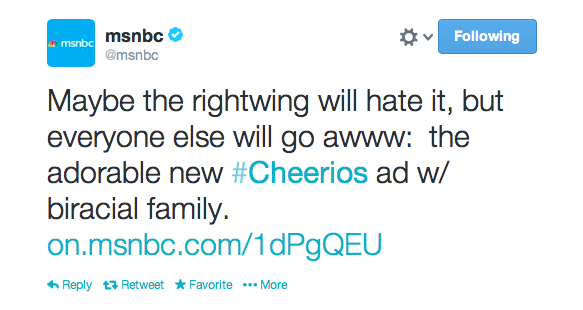
Myboss brought up the infamous Cheerios tweet on my first day. Almost a year had passed, but it was still a cautionary tale: At 8:06 pm on a casual Wednesday night, a seemingly innocuous tweet was sent out and quickly caused a firestorm. Within 24 hours, Republican National Committee Chairman Reince Priebus called for a boycott of the network and the president of MSNBC had to issue a formal apology. Unsurprisingly, they said they had “dismissed the person responsible.”
Horror stories of Social Media Editors Gone Wild are a dime a dozen, and I was keenly aware of all of them over the eight months I spent as an engagement editor at a political news site. Every terrible tweet that went viral contributed something different to my near-constant state of anxiety. I’d frequently imagine myself as that MSNBC employee, getting a talking to for a social media post that showed too much Democratic leg, or being the subject of a blog post for attaching the wrong picture to a tweet. If constantly being on social media wasn’t enough make me lose sleep, there was also the prospect of potentially sparking an entire day’s or week’s conversation with as little as 140 characters.
Even inside the politics of the newsroom, the pressure was high to perform. In a culture of fast-paced digital newsrooms where traffic is king, “social” can make or break a story. For sites relying on advertising as their bread and butter, social media editors help to save the newsroom from inevitable slumps in traffic. (For context, BuzzFeed, whose numbers are the envy of the online news industry, gets 75 percent of its traffic from social media). My work was critical to the success of my colleagues, reporters and editors with high page view goals— a reality that was both empowering and stressful.
I thought it might help to reach out to other social media editors to see how they were handling the pressure. I noticed a pattern: a shocking number of them were also women. I already knew that, statistically, women use social networks more than men. But additional research revealed that social media is one of the few areas of the news industry where women outnumber men in leadership positions. A study by the Colorado Women’s College at the University of Denver found that women are only 23.3 percent of leaders in media at large, but in social media that number is 55 percent. The role of social media editor stands in opposition to that of writer or editor, which is still predominantly male. The Women’s Media Center annual report found that only 37.2 percent of newsroom staffs were made up of women, a figure that has gone nearly unchanged since 1999.
How do these statistics play into the culture of the newsroom? As a possible explanation, Taylor Lorenz, a social media strategist and editor, says that in her experience “women are not encouraged as much to get into hard news.” Similarly, many other social media editors who work in the industry (some of whom wish to remain anonymous) describe the perception that social media is a “girly job.” One woman notes a vibe of “let’s give this easy job to a girl, she can handle it” around the office; that social media is seen as easier, “fluffy,” and not on par with other editorial roles. Even though it’s no secret that social media is critical to the current business models, one woman who works as a social media editor in news thinks “the position is always gonna be viewed as some dumb 20-year-old woman job.”
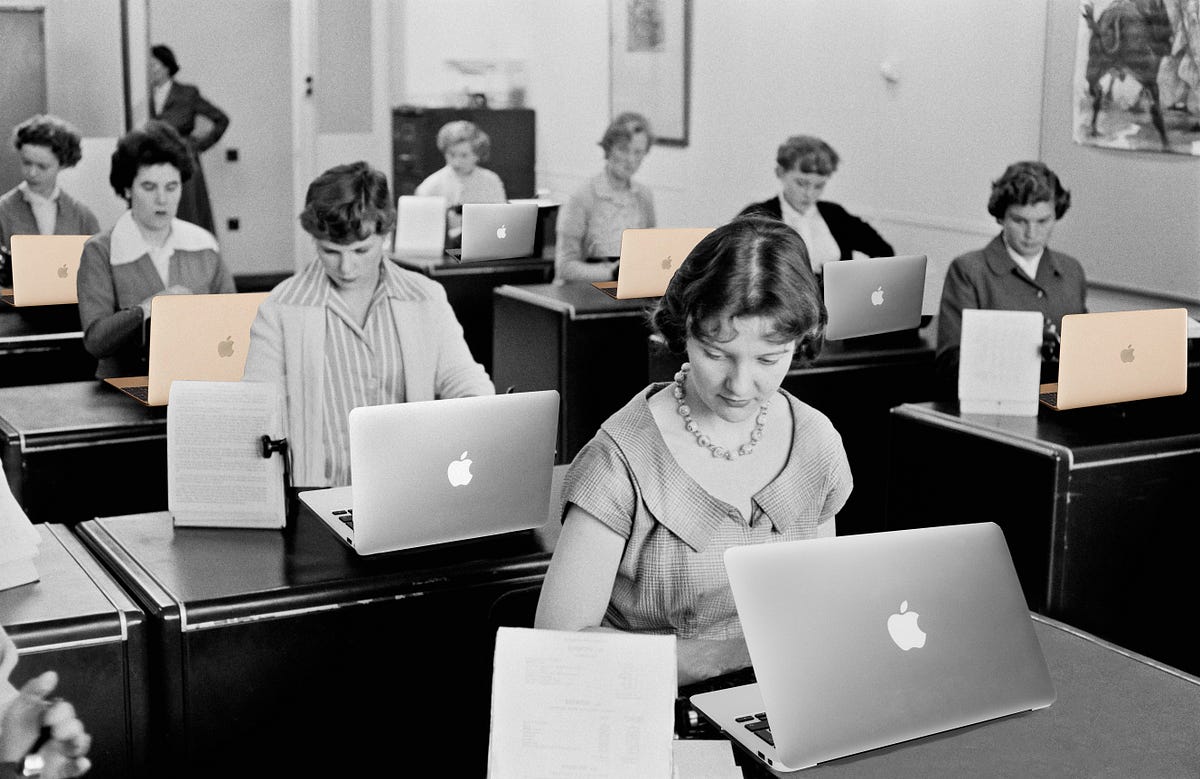
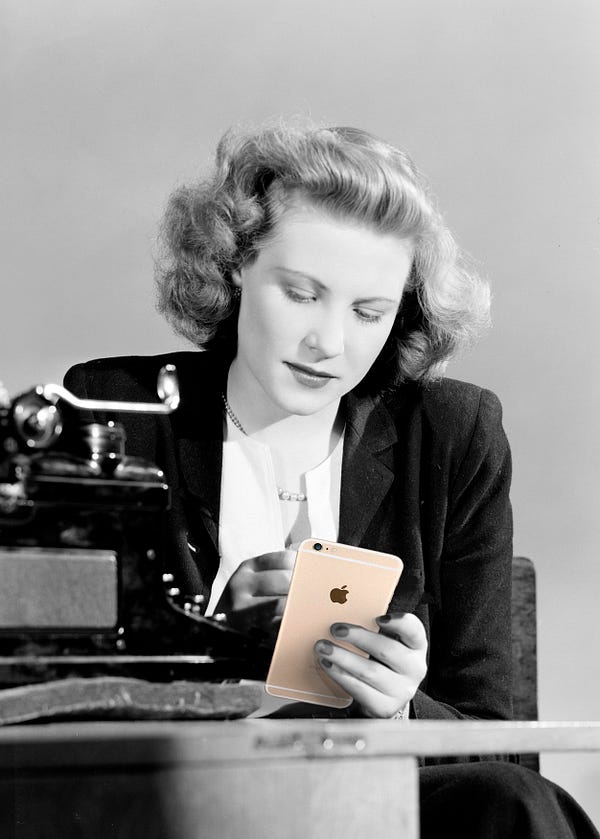
Young women today are looking to break into a news industry that’s concurrently trying to diversify and beefing up social media jobs; it’s no wonder that a lot of them end up in these roles. But Amy King, chair of VIDA: Women in Literary Arts, says women have long been cast as supporting players in the office. “Think of the classic trope of the secretary who does the work that her boss is actually getting all the credit for,” she says. The volunteer organization has done groundbreaking work in tracking the abysmal byline gender gap by combing through select national magazines annually for the past six years. The studies have revealed a persistent woman problem: “Women tend to do the behind-the-scenes work that is unrecognized or unappreciated,” King adds, partly because they are willing to.
It’s hard not to hear these stories and draw a parallel to public relations, an industry where 85 percent of workers are women. “People in the media like to say that PR is a pink ghetto,” because the often low-prestige jobs are almost exclusively populated by women, says a female editor, who left her job in social media at a major news organization. “But social media is the true pink ghetto.” She says her time in her previous role was characterized by unpaid overtime and a dearth of promotions and raises.
In her 2014 Jacobin magazine piece “Pink Collar,” Jennifer Pan explores why the entire PR industry is so heavily judged by the media, despite being critical to the news-making process. She posits that the “spoken heart of their criticism is the failure on the part of the publicist to adequately conceal that she is performing emotional work for money”:
The palpable distaste for PR practitioners that continues to swell — spearheaded by the very same members of the media with whom publicists theoretically enjoy a symbiotic relationship — requires, then, a deeper look at how gendered assumptions about work continue to shape our contemporary notions of creative labor under capitalism.
Though a field like social media requires a more direct relationship with a consumer than public relations, they both, at their essence, involve promotion; and they’re both — if done well — invisible. The newsroom’s social media manager doesn’t tag her tweets with her name, and the “flack” gets no byline when he gives a journalist access to a source. Unlike the job of editor, which also goes uncredited, these positions don’t have a high level of prestige.No one brags over martinis that they wrote the Facebook prompt for a Gay Talese piece.
“In my experience, women are the ones behind the scenes, just keeping the day-to-day process of the magazine running,” says Annie Shields, engagement editor at The Nation, where I was an intern in 2009. “[They’re] editing, polishing things up, and not getting credit.” Shields observes that although the editorial staff at the publication is largely female (the editor-in-chief is a woman), that doesn’t translate to content (only 29 percent of all Nationarticles are written by women). Men are in more visible roles, Shields says, ones that allow them to make media appearances and become well-known brands. For these guys, there is a straighter path to advancement, to becoming an opinion writer or thought leader in politics.
This element of invisibility begs many troubling questions: When an article blows up on Facebook, who gets credit? The reporter who wrote the story or the engagement editor who came up with the prompt? And who takes responsibility for the “frequent occurrence of criticism of the company getting channeled through social media” that Pan recalls dealing with on a daily basis? During her two years working in book PR, which involved running the publisher’s social media channels, Pan says she would often field tweets from people who hated certain books or editorial choices: “I wasn’t really making the decisions [about what books to publish], but I was acting as the buffer between the outraged public and the company.” The experiences left her feeling frustrated, and she ultimately left.
As I know personally, being this kind of middle man can be particularly exhausting, especially in political news. In order to be effective, I’d need to rewrite headlines to make them more conversational and “social media friendly.” But this, of course, would inspire some readers to email or comment that I was ruining the organization with “clickbait” — something that only added to my stress level. Writers, especially those that are pushing boundaries, get criticized too. But they have the advantage of resources like editors and fact-checkers (and the ownership of a byline). At a smaller news organization, social media editors are often writing tons of copy that never gets looked over. One weekend, Shields remembers making a typo in a Facebook prompt, and returning on Monday to hundreds of nasty comments about “the 20-year-old idiot intern” that must have made the mistake. “The criticism is over the top,” she says. “I don’t know if other people at the magazine know what that’s like.”
The emotional toll social media jobs can take isn’t balanced by the security of an established career trajectory. “I was given increasing responsibility, but not increasing opportunity,” says the former female social media editor I spoke to. She, along with others I talked to, mention a kind of topping out that happens in the social media track, unlike other positions in the newsroom, like the path from cub reporter to writer to editor. That can be great for rising fast, but challenging longer-term. “There’s a limit to what you can do in a small organization in this role,” says Shields — one reason why she doesn’t see herself in it for the long haul. When she started to excel at her job, she was given new editorial duties like homepage editing, but was still expected to do all the old social media tasks. That’s not really a promotion or a job change — “it’s a recipe for burning out.”
Not everyone who works in social media feels drained, or wants to move on to the glory of writing. For some, the creativity of hyping journalistic work, and the mastery of analytics that often comes with it, is a destination in and of itself. Depending on the outlet, the job can involve tasks as varied as audience growth, original content creation, and breaking news. Lorenz, after a stint editing and reporting, went back to social media because she found she preferred the challenges of strategy and development. Similarly, Rubina Madan Fillion, the digital engagement editor at the Intercept who spent years doing social media at the Wall Street Journal, has always been an early adopter of social networks and finds her job to be a natural fit. “There’s just a lot more interaction with readers and the community [in social media],” she says. “It’s more interesting.”
Whether one finds social media personally compelling or not, its increasing importance to media companies is undeniable. Take “the dress,” Buzzfeed’s viral phenomenon that garnered 28 million views in 24 hours and brought issues surrounding social media and virality to the forefront. The post required the company to enlist additional tech support to manage the servers, and two editorial teams were tasked with finding new angles on the story. Many don’t know that “the dress” was not brought into mainstream consciousness by a reporter. It was Cates Holderness, a Buzzfeed community growth manager, who ran the organization’s Tumblr. When a reader messaged a question about “the dress,” Holderness thought it would make a good post. “It took me five minutes,” she told Digiday, who called her a “celebrity” in this interview. “I just pasted the Tumblr embed code and put up a poll.” (Holderness’ title is now Tumblr Editor at Buzzfeed BFF, a team that makes original content for social media sites and apps.)
Lexi Mainland, managing editor at A Cup of Jo, and the editor who led The New York Times’ first (almost all female) social media team, points out that the emerging field “can be a little bit of a back door, because it is a role that respects a different skill set.” She says many of her former female colleagues who started there at The New York Times have gone on to more traditional reporting roles within the company. I’m living proof of her observation: When I realized I wasn’t cut out for the social media editor game, I was able to parlay my experience into a staff writer position here at Matter. [I’m told I wouldn’t have gotten it without my social media expertise.]
Is there a downside to the increasing mainstream recognition of social media as a truly valuable editorial skill? Tiffani Lennon, the lead researcher and author of the University of Denver study on women’s leadership, says she thinks so. “If social media gets more credibility, you are going to see men pushing women out of leadership roles,” she says. “That’s what happens in every field once it becomes more institutional.” Historically, it’s been easier for women to dominate spaces that men don’t want to be part of.
Wallpaper’s associate editor of Audience Daisy Alioto doesn’t see things quite so bleakly. At just 23 years old, she held the title of director of social media and analytics at the International Business Times. Alioto thinks that part of what’s great about working in social media is that a lot of the old guard media men don’t get it, and in their ignorance, give young women carte blanche. Plus, maybe these ladies will stick around: “In another ten years, social will be a given. We will all be working on some other crazy iteration that’ll be dominating news,” she says. “And the industry will be run by all the women that got their start in social media.”
Open source extraordinaire Sahat Yalkabov has given up his search for a front end developer job after a series of technical interviews that he described to me as a “humiliating and dehumanizing process.”
Various
recruiters lined up interviews for him at six different companies over
the past few months. Each of his interviews revolved around scrawling
algorithms on a whiteboard, in front of other developers, who stood by
to render judgement on his fitness for the job.
And
after each interview, he received a brisk email informing him of the
company’s decision not to proceed with his candidacy, without any
further explanation.
Sahat
isn’t exactly an outsider. He has a computer science degree, has worked
as a developer at Yahoo, and is among the most prolific open source
contributors.
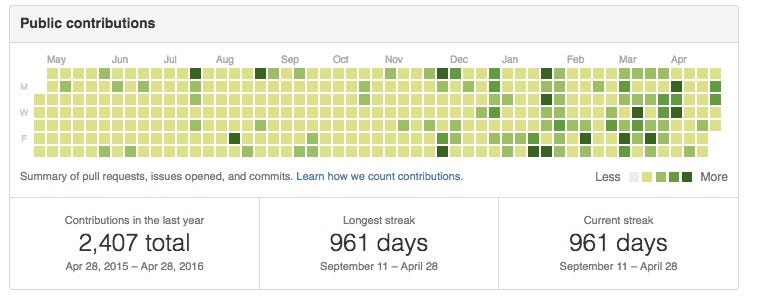
Sahat’s open source contribution activity on GitHub.
At
a time when big tech companies are scrambling to find capable
developers, why is he having so much trouble getting job offers?
The answer lies in part in with how big tech companies interview developers.
You
might assume that in this high tech industry, interviewers use fancy
tools to analyze the quality of code samples, or look at how widely a
candidate’s code was included as a dependency in a package ecosystem
like npm. That’s how an academic researcher’s work would be judged — by
how many other academics cite them.
Unfortunately,
interviewing practices at big tech companies aren’t that scientific.
The decision of whether to hire a developer usually comes down to the
candidate walking up to a whiteboard and regurgitating algorithms that
haven’t changed since the 1970s, like a (classically) trained monkey.
Sahat
is not alone in his frustration with the whiteboard-centric technical
interview process used by most major software companies. Virtually every
developer I’ve talked with agrees that one’s ability to write
algorithms from memory on a whiteboard has almost nothing to do with
real day-to-day developer work.
How whiteboard interviews work
The most common tasks meted out at the whiteboard are recalling algorithms and writing them bug-free on the whiteboard.
There’s
usually an element of time pressure. If you don’t remember the
algorithm or never learned it (i.e. never had a use for it), your
interviewer may push you to guess your way into a working
implementation.
Your
interviewer will probably ask about time complexity, seeing if you can
reduce the time it takes to run your algorithm from say O(n log(n)) to
O(n).
And
remember that this is a whiteboard — not a code editor. You can’t
actually run the code to see if it works, let alone benchmark it. So
your interviewer serves as judge, jury and (literally) executioner of
your code.
The
good news is you can prepare for whiteboard interviews, just like you
can cram for a college entrance exam. And there’s a cottage industry of
books and websites aimed specifically at helping you ace the whiteboard
interview process.
Whiteboard
interview questions generally come from a predictable pool of around
200 questions, the solutions of which are all available in Cracking the Code Interview.
This book is the closest thing to a whiteboard interview playbook. Its
author wrote it based off of her experience interviewing developers for
Google, Amazon, Microsoft, and Apple.
Of
course, your interviewer is under no obligation to ask you one of those
questions you so diligently prepared for. If you’re unlucky, they could
ask you to write out an algorithm you’ve never heard of before. This is
the essence of the “algorithm question lottery.”
Developers
will often defend whiteboard interviews as meritocratic. Anyone who
wants to spend months of their life toward committing algorithms to
memory can go and get that job at Google.
And a majority of these algorithms are already touched on as part of a computer science undergraduate program.
So what’s the problem?
The case against whiteboard interviews
The problem is that writing algorithms on a whiteboard has almost nothing to do with modern software development.
In
real life, you would rarely just whip up an off-the-cuff algorithm from
memory in the middle of a coding session. You are almost always going
to use an existing library, which has its own test suite, and has
survived the scrutiny of other developers.
The
only world where you would actually need to be able to recall an
algorithm would be a post-apocalyptic one, where the hard drives of all
the computers connected to the internet were fried, and all copies of
foundational academic papers and computer science textbooks had been
reduced to ashes.
Whiteboard
interviewing is a discrete skill, much like being able to remember Pi
to a thousand decimal places. And students of programming are spending a
disproportionate amount of their time mastering this skill instead of
practicing real software development by building projects, maintaining
legacy code, or contributing to open source.
This
ultimately reduces the quality of entry-level hires, as it becomes
difficult for the average interviewer to figure out who’s good at
developing software, and who’s merely good at whiteboard interviewing.
It
also freezes out many of the people who are under-represented in the
software development field. If you’re busy working and raising kids, you
want to spend as much of your scarce time as possible learning to
code — not performing rote memorization that won’t matter once you start
your job.
Even
if you could afford to pay for a cram school (and some will garnish
your future wages instead of asking for cash up front), you would still
need to allocate time from your busy life to attend.
Whiteboard
interviews also punish more experienced developers who are too busy
doing real software development to drop everything and cram for a month.
They also punish people who don’t have a computer science degree, or
who finished theirs so long ago that they’ve forgotten most of these
(rarely needed) algorithms.
Whiteboard
interviews favor fresh graduates from theory-heavy computer science
programs. But it’s hard to believe that those are the people who will
perform best in the highly collaborative, practical 21st century
developer workplace.
So why do we do whiteboard interviews?
Whiteboard
interviews are akin to a hazing ritual — a rite of passage that one
must endure before joining an organization — because everyone else there
did. “I went through a battery of whiteboard interviews when I got
here, so why shouldn’t this person?”
Supporters of the whiteboard interview will argue that it tests one’s ability to solve problems under pressure, or that it tests fundamental competence.
Whiteboard
interviews provide an interviewer a defensible reason for passing on a
candidate that their gut tells them they don’t like. Instead of
attributing a no-hire decision to a poor “culture fit”, the interviewer
can tell themselves and their superiors that “she just didn’t know how
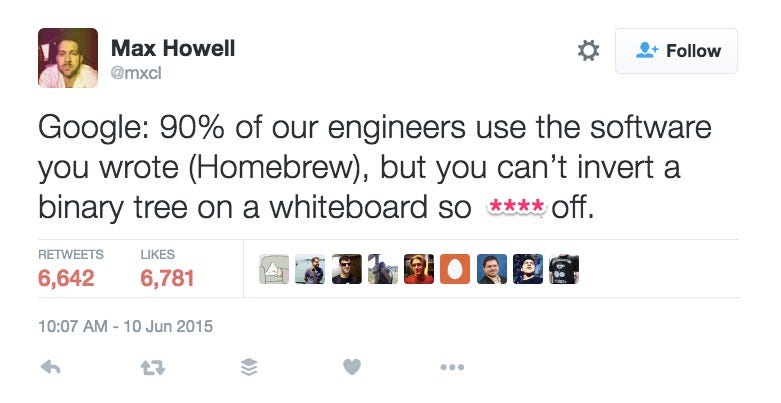
to invert a binary tree.”
It
also provides the interviewer with an opportunity to feel smart and
validate that “they’ve still got it” and that they aren’t themselves an
imposter, by critically examining the work of an outsider who wants in.
Because
of these forces, whiteboard interviews may stick around for a long
time, like a circle of retribution — an ordeal inflicted upon one
generation of developers by the previous, that will in turn be inflicted
upon the next.
How can a good developer cope with whiteboard interviews?
There are only two good options here (other than to give up and go farm goats).
Option 1: Accept it and cram.
Every responsible academic program is encouraging new developers to learn these algorithms. Dozens of the algorithms in Free Code Camp’s curriculum come directly from common whiteboard interview questions.
Many
of our students have told me that their prior experience with these
specific algorithm questions was critical in landing their first
developer jobs.
We
have also created a lot of videos focused on time complexity and data
structures, and are working on a system for conducting live mock coding
interviews through our platform.
Option 2: Avoid companies that do whiteboard interviewing
Already, many experienced developers will flat out refuse interviews that involve whiteboards. Many of these developers are so good that they can often afford to be more selective.
We
were concerned that [the whiteboard interview] process filtered out
many other great engineers for reasons other than their abilities. Some
possible reasons include variation between interviewers, candidate
nervousness, or the unnaturalness of whiteboard coding generally.
In doing so, Four Square has gotten rid of the random false negatives that can result from the “algorithm question lottery.”
Pivotal Labs
is famous for their pair-programming-centric interview. You come in to
their office in the morning and pair all day with a one of their
developers. One of our students went through their interview process,
loved it, and accepted a job there.
Whatever
you do, don’t give up and go farm goats. Regardless of the stubborn
hiring practices of big tech companies, the world needs a lot more good
developers! So keep fighting the good fight.
Thanks for reading my article! If you found it helpful, recommend it to your friends on Medium by clicking the green heart bel
Yesterday I was working on a progressively enhanced user interface (without JavaScript) — a scenario that we cater to very frequently at a company I’m currently employed with.
Accidentally, it completely slipped my mind to flip the switch and enable JavaScript back. A door to entirely different Web was suddenly wide open. Let me tell you—I didn’t like what I saw.
It took me a good minute of genuine confusion to figure out why most of the applications I use frequently were hardly usable and content barely available.
The Web without JavaScript is empty and broken
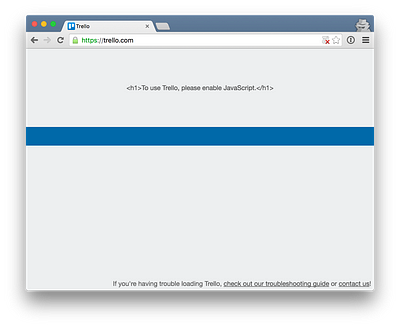
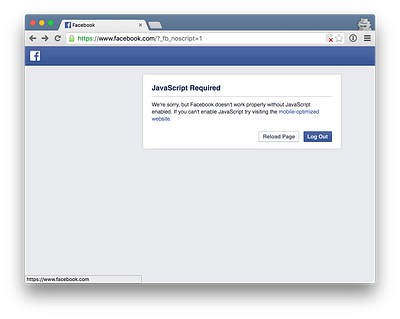
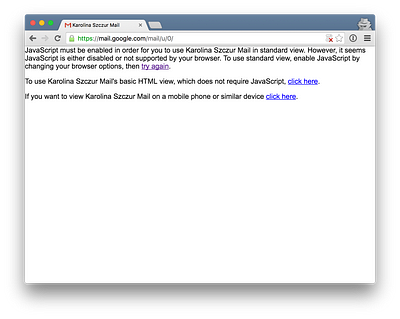
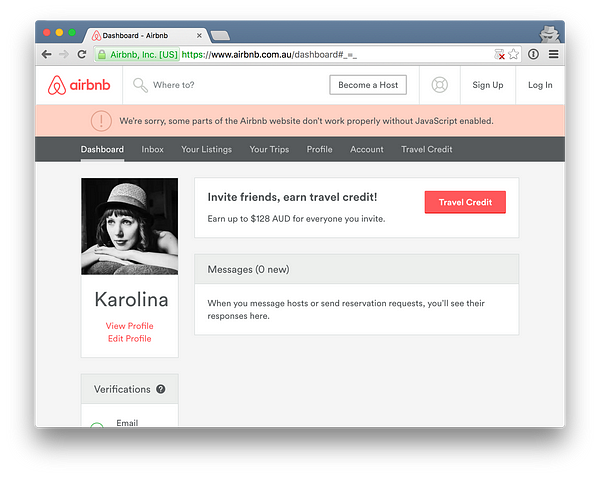
Here are some of the Web giants—Trello, Facebook, Gmail, Dropbox and AirBnB, sans JavaScript.
Some of them handled it better, some worse. From zero information or pointers, that might as well be flipping a bird, to half-functioning interfaces informing about the potential bottlenecks.
As an active empathy practitioner I imagined what the ongoing no JavaScript Web browsing experience could be. While the percentage of these users might be relatively low, we fail to remember that until the scripts load, that scenario is true for all of us.
The Web isn’t always blazing fast
Even now, I’m sitting in one of the most expensive cities in the world, that offers the highest quality of life, on a DSL connection (barely maximum of 15mb/s down, slower than 3G that can reach 56mb/s, an infrastructure introduced over 10 years ago). According to Akamai’s Q4 2015 rankings, the average Internet speed worldwide is at whooping 5.6mb/s.
The global connectedness is rapidly growing, but there’s still a vast space of unmapped territories (for more insight into Internet penetration see Global Internet Maps).
That brings me to a point; the foundation of the Web is plain ol’ Hyper Text Markup Language along with Cascading Style Sheets. I’m not suggesting we should stop using JavaScript at all—it’s a great language and the ecosystem is growing rapidly. npm already surpassed more than one billion module downloads weekly a while back. The community will continue to expand, improve and evolve, as others do too. This is a problem that spans way further than one programming language.
The Web and its technologies have to be treated differently
It’s a privilege to be able to use breaking edge technologies and devices, but let’s not forget basic accessibility and progressive enhancement. Ultimately, we’re building for the users, not for our own tastes or preferences. Sadly, not everyone is born with an equal chance.
Having endless opportunities at our hands is great, blindly obsessing over the stack and not putting people in the forefront never is.
Programming communities are heavily opinionated, very vocal and oftentimes hostile in defending their views. In these completely irrelevant microaggressions we lose sight of the humans we build software for.
If suddenly your audience disappeared, would you continue building and releasing into the void? If you were the end user and no one cared about you, how would you feel?
These questions have to be asked constantly. Empathy is necessary for everything we do. Luckily, one of the giants I’ve mentioned before, Basecamp, fixed their JavaScript problems hours after I tweeted and took the time to thank me for pointing it out. That’s care.
It boils down to understanding how our seemingly user-invisible decisions shape what the Web is. There’s no one programming language that will divide and conquer.
The Web isn’t uniform—it’s countless flowing layers, each affecting user experiences in its own way.
The technological choices are important for teams, but have even more impact for the audience. The Web can and will be built with and on anything we can put our hands on. Let’s not forget who we’re creating it for.
I vividly remember the first time I was about to build my own UX design team for a big multinational company. When the hiring process started, the lady from recruitment asked me what sort of educational background I was looking for in potential candidates. My answer: “I don’t particularly care”.
My senior creative director, a well-respected authority in product design (and in many ways a mentor to me) with many decades of experience all but exploded with rage. He prided himself in always hiring the most promising talents from the most prestigious design institutes. Of course it mattered what background a candidate has!
Since then I’ve done my share of hiring UX/UI design talent, and I still stand by my statement: I don’t care what background you have. Just show me you have the UX-factor.
We’re building this brave new world together
Back when I started as an interaction designer in the early 90s, the field of expertise barely existed. As I wrote in another article, we were rebels; using design to avenge the atrocities of technocracy from the 80s. The eternally blinking 00:00 on VCRs, excessively button-laden copy machines, the “underwater” screens of Wordperfect, the insufferable arrogance of the DOS prompt.
In the 20 years that followed, interaction design evolved into user experience design and a smorgasbord of related competencies. The most influential contributors of the field came from myriad backgrounds: human factors, graphic design, architecture, AV arts, software engineering, philosophy, cognitive psychology, people research. I can’t think of any other profession that encompasses such a holistic spectrum of arts and sciences.
But since the founding fathers and mothers of the UX expertise are so diverse, why should we narrow the process of UX design recruitment down to people with a highly specific background? Unless I’m looking to fill a very specific vacancy (e.g. UX trend research, or user testing) I’m just as open to interviewing candidates with a background in architecture or scenography as, say, someone who was trained as a graphic designer but taught herself interaction design skills.
So what is the UX-factor?
Educational background is obviously not completely irrelevant. It will show me things about your interests, the context in which your skills were initially formed, whether you’re likely taught to take an academic approach versus an intuitive approach, etc. But when it comes down to it, for me it’s all about the portfolio. Show me what you’ve done. Tell me about the process and your ideas. And while we’re talking, I’m hoping to spot three things - the trinity of a true UX designer’s character traits:
A passion for design
Empathy for people
A knack for problem solving
Passion for design
While interaction design (with its roots in human factors and HCI) has always been a pretty rational specialism, User Experience design -by its very definition- is an expertise that makes technology and communication resonate with people on a rational AND on an emotional level. It has to.
You can design something to be 100% usable and logical to your end-user, but if the product is dull-as-dishwater people may still have no interest in using it. Don’t underestimate the irrational side of people; the importance of warm fuzzy feelings. (And that’s why I feel user testing is a double-edged sword; it often ignores the unquantifiable qualities of design. But that’s a discussion for another article).
Don’t underestimate the irrational side of people; the importance of warm fuzzy feelings.
I believe that the passion a designer puts into her work always shines through in the end-result. The fun you have making something will be reflected somehow, no matter how mundane or utilitarian the product you’re working on. That’s why it’s essential for a designer to truly have a passion for the irrational, the beautiful, the elegant, the superficial, the emotional, the unnecessary, the enjoyable. It’s what will make technology feel human.
Empathy for people
As a user experience designer you have to identify with the people you design for. Empathy is much more than just understanding your user. If you understand your user, you’re half-way there. It means you know what people do and the logical rationale behind those actions — a workflow, if you like.
But you still don’t really know why people do things, what drives them emotionally. Is it enjoyment, fear, boredom, pride, convenience or curiosity? Knowing such motivations can help your design tremendously. It can make the difference between indifference and engagement. For example: it’s what makes the difference between a wearable step-counter and a wearable that motivates people to sustainably change their behavior.
But you still don’t really know why people do things, what drives them emotionally. Is it enjoyment, fear, boredom, pride, convenience or curiosity?
Feeling a bond with your user is an absolute must to take your designs beyond their rational purpose.
A knack for problem solving
I recently read an article claiming the definition of design is “solving problems”. I think that’s both an oversimplification and a disservice to the wonderful kaleidoscope of facets that make up design. Having said that, creative problem solving is certainly one of the defining qualities of design. And especially in UX design and interaction design there are often many problems to solve and obstacles to remove.
The Tao of user experience design is a concept called “flow”. In a perfect user experience all tasks flow seamlessly and uninterruptedly into each other. All obstructions have been removed, all friction is smoothed out by the designer, there are no perceivable hoops to jump through.
The Tao of user experience design is a concept called “flow”. In a perfect user experience all tasks flow seamlessly and uninterruptedly into each other.
This means problems are not just solved, but the solutions are seamlessly embedded into a bigger context. It takes a designer that can zoom in and out of problems: draw the blueprint for a complex construct of tasks, but also come up with clever micro-interactions.
Serving the Trinity
As I stated earlier, we’re building this brave new world together. I don’t believe the field of User Experience design has finished evolving. We’re not even close. This means there is still a lot of opportunity for cross-pollination with other professions, arts and sciences. And none of the three characteristics I described are exclusive to a single design competence. They can exist in many different professional contexts. So, I don’t care what your background is, as long as you love design, care about people and surprise me with clever ideas.
Myboss brought up the infamous Cheerios tweet on my first day. Almost a year had passed, but it was still a cautionary tale: At 8:06 pm on a casual Wednesday night, a seemingly innocuous tweet was sent out and quickly caused a firestorm. Within 24 hours, Republican National Committee Chairman Reince Priebus called for a boycott of the network and the president of MSNBC had to issue a formal apology. Unsurprisingly, they said they had “dismissed the person responsible.”