In this fast-paced business world, female leaders need to make sure they’re not perceived as pushy, aggressive or competent. One way to do that is to alter your leadership style to account for the (sometimes) fragile male ego.
Should men accept powerful women and not feel threatened by them? Yes. Is that asking too much? IS IT? Sorry I didn’t mean to get aggressive there. Anyhoo, here are 9 non-threatening leadership strategies for women :-)
#1
When setting a deadline, ask your coworker what he thinks of doing something, instead of just asking him to get it done. This makes him feel less like you’re telling them what to do and more like you care about his opinions.
#2
When sharing your ideas, overconfidence is a killer. You don’t want your male coworkers to think you’re getting all uppity. Instead, downplay your ideas as just “thinking out loud,” “throwing something out there,” or sharing something “dumb,” “random,” or “crazy.”
#3
Pepper your emails with exclamation marks and emojis so you don’t come across as too clear or direct. Your lack of efficient communication will make you seem more approachable.
#4
If a male coworker steals your idea in a meeting, thank him for it. Give him kudos for how he explained your idea so clearly. And let’s face it, no one might’ve ever heard it if he hadn’t repeated it.
#5
When you hear a sexist comment, the awkward laugh is key. Practice your awkward laugh at home, with your friends and family, and in the mirror.Make sure you sound truly delighted even as your soul is dying inside.
#6
Men love explaining things. But when he’s explaining something and you already know that, it might be tempting to say “I already know that.” Instead, have him explain it to you over and over again. It will make him feel useful and will give you some time to think about out how to avoid him in the future.
#7
Pointing out a mistake is always risky so it’s important to always apologize for noticing the mistake and then make sure that no one thinks you’re too sure about it. People will appreciate your “hey what do I know?!” sensibilities.
#8
When collaborating with a man, type using only one finger. Skill and speed are very off-putting.
#9
When all else fails, wear a mustache so everyone sees you as more man-like. This will cancel out any need to change your leadership style. In fact, you may even get a quick promotion!
Starring Peggy, the adversity-destroying careerist from Mad Men.
Maybe you’ve been at your job for a while, and your salary hasn’t kept pace with your city’s cost of living.
Or maybe they hired you at a below-market salary because you were new to the field.
Whatever the reason, it’s high time you earned an at-market salary.
But being a competent professional isn’t enough to get that raise you deserve. You’ll need leverage. And you’ll need to be prepared to use it.
Talking about your salary may feel awkward. Or greedy. Or disloyal. Jam those feelings down the nearest garbage disposal.
It’s OK to feel loyal to your boss. They hired you. They helped train you. They may even genuinely care about you.
But any loyalty you feel toward your employer — that legal entity that employs you and your boss — is probably misplaced.
This is, after all, the 21st century. If there ever was an era of lifetime employment and the “company man,” it has long since passed.
Any loyalty you may feel toward your employer will not be reciprocated. New employees will be hired above you, with fancier job titles and better pay. When investors demand layoffs, your years of dutiful service won’t save you from the chopping block.
Who profits when you decline a call from a recruiter out of loyalty to your employer? Investors.
Who profits when you accept a standard annual raise instead of negotiating for a larger one? Investors.
Who profits from a culture where employees keep their salaries to themselves instead of freely sharing this information with peers? Investors.
In an opaque, imperfect labor market, investors profit at employees’ expense. And that’s who ultimately owns the company you work for. Not your boss, or your boss’s boss — though they may own some of it. Investors have extra money lying around, which they can risk on a speculative investment in your employer. They are the people who are profiting from your loyalty.
Employers will use sketchy — even illegal — tricks to retain you.
Many industries have secret agreements not to poach one another’s employees. This is good for employers, who can keep their wages artificially low as a result.
The US Department of Justice recently reached settlements with tech companies who intentionally — and illegally — made it harder for employees to change jobs — companies like Adobe, Apple, Google, Intel, Intuit, and Pixar.
Employers will use a carrot: “golden handcuffs” such as signing bonuses that you have to pay back if you leave within a certain period. Or stock options that take several years to fully vest. Or stock options that are intentionally designed to be too expensive to exercise, forcing you to stay at the company indefinitely or walk away with nothing.
Other employers will use a stick: noncompete agreements, which prevent you taking a new job in the same field.
Even though noncompetes are increasingly unenforceable, employers won’t tell you this. They’ll leave it to you to seek out a lawyer.
The White House has condemned employers’ use of noncompetes as aperversion of their original purpose — which was to slow the spread of trade secrets. Instead, noncompetes have become just another tool for keeping you from leaving your current job for a better one.
Despite all this, smart people change jobs all the time.
It takes courage to leave a stable job in search of a better one. Especially when you have kids to feed, student loan debt to service, or a house to pay off. But people do this all the time.
The average length of time that software developers stay at a given company is surprisingly short:
The circled numbers are the median length of a developer’s tenure at the company. Read the full study here. Which brings us to the most important rule for negotiating your raise. Be prepared to walk away.
If you want to have any leverage at all in your salary negotiation, you need to be prepared — financially and psychologically — to actually to leave the company.
If your employer has succeeded in lulling you into a complacency where you dine on fancy meals and lease expensive cars instead of saving — if you are like 62% of Americans who are one pay check away from living on the street — you will have zero leverage in the negotiation. Because your employer can just say “no” and there’s nothing you can do about it.
So before you initiate any sort of salary negotiation, you need to establish a Best Alternative to a Negotiated Agreement (BATNA). Your BATNA is your recourse if negotiations fail.
Attempting to negotiate without a BATNA will waste your boss’s time, and weaken your position in future negotiations.
The best BATNA you can have is a job offer from a competitor.
Your BATNA could be that you’ll quit and work as a freelancer, or that you’ll go back to school and transition into a new career.
But employers hear these kinds of ultimatums all the time. Your boss will call your bluff, lecturing you on how these options are more risky — and less desirable — than continuing in your current job. You may start to doubt the soundness of your BATNA, and back away.
Luckily, there’s a much better BATNA out there — though it will take some work to secure.
You know those recruiters who email you, cold call you, and stalk you at events? Try talking to some of them.
You’re already productively employed at ABC Co. You could be productively employed at XYZ Co, and they will probably offer more money to entice you away.
So you take the recruiter’s advice and duck out for a few long lunches (interviews) at the conglomerate next door. Solve some problems on a whiteboard. Once XYZ Co extends you an offer, your BATNA is secured.
But wait — how strong this job offer? Just because a job offer is higher than your current salary doesn’t mean it’s a strong offer. In reality, you could be grossly underpaid in your current job, and this new offer may not be as strong as you think.
Before you can counter-offer and ratchet up the value of your BATNA, you need to understand the at-market salary for a professional of your talents.
Analyze data. Ask around. Do your research.
The main factors that determine salary are company, city, and job title. You should conduct a two-prong investigation:=
Talk to your peers within your company. Figure out how much money they make. One trick for getting a ballpark figure in an indirect way is to ask them how much they think your mutual employer would pay a new recruit with their skills and experience.
Study the salaries that employers in your city are in are paying to people in positions comparable to yours.
The US government publicly shares salary data for all employees who enter the US on an H1-B work visas. All these data are available in one big databaseof more than 1.6 million salaries. You can search by company, city, and job title. It’s free, and even has charts and filtering options. If you’re a US national, your salary should be at least as high as the salaries you find here.
You may want to look into other forms of compensation, too: insurance providers and their premiums, paid time off, stock options, even perks like free lunch and parking spaces.
At the end of the day, salary is king. For better or worse, salary is the objective measure that professionals use to compare themselves to one another. And most perks indirectly come out of your salary, anyway (as Netflix CEO Reed Hastings makes clear in the most widely viewed PowerPoint of all time).
Knowing the at-market salary for a person of your talents will help you negotiate with confidence.
Market Research + BATNA = Leverage
So you know the at-market rate for professionals in your city with your job title. You also know what peers within your own company are getting paid. And you have solid BATNA. Now you’re ready to suit up and march into your boss’s office.
Don’t wait until performance review time to negotiate a raise. Find out when your company plans their annual budget for salary increases. Be sure to negotiate your raise before that date — otherwise your boss will use the budget as an excuse to give you less.
The best time to negotiate is when you’ve just delivered a project or hit a major milestone. Then you’ll have a good answer to the “what have you done lately that’s worthy of a raise?” question.
Don’t flinch if your boss fires back at you with some policy about salary ranges or salary caps for your job title. They just gave you a great opening to negotiate for a promotion as well.
Be fearless. But also be mindful of what’s happening on the other side of the negotiation table.
Most employees fail to prepare for their raise discussion. They’ll argue for a raise based on things like their seniority, their recent performance, or rising housing costs. These are terrible negotiating positions with no leverage. Is it any surprise that bosses become accustom to handing out small token raises to these people
Imagine your boss’s surprise when you come along with real leverage. You’ve done your homework. You have a serious BATNA.
Your boss may be caught off-guard by such a well-equipped adversary at the negotiation table. This can quickly become a terrifying conversation for them. If they lose one of their employees to a competitor, it will reflect poorly on them as a manager. And they will have to spend months — and tens of thousands of dollars — finding a replacement for you.
So be polite throughout the process. If they agree to pay you what you’re worth, you will still have to work with this person. And you don’t want your boss to resent having to grovel before their bosses to approve an abnormally large raise for you. You want to come across as savvy and serious—not mercenary.
Be sure to follow up all of your salary discussions with an email describing what you talked about. This will not only document your conversation — it will give your boss a script for arguing your case to all the other managers who will need to sign off on your raise.
Remember — you don’t need to be a “rockstar” to get a raise. If you could be earning a higher wage somewhere else doing the same job that you’re doing now, your employer probably should have been paying you more all along.
And don’t feel obligated to work any harder after they give you your raise. They didn’t give you a raise so you’d work harder. They gave you a raise so you’d continue working for them in your current capacity. It is they who shortchanged you, by not proactively — and frequently — raising your salary to at-market levels.
It takes a lot of guts to tell your boss that you deserve a higher salary, which is why most of your peers will continue to be underpaid. But not you. You’re the smart one. The tough one. And if they don’t pay you an at-market salary, someone else will
During
over ten years in the tech industry I went through the hiring process
at small startups, mid-sized agencies and well-funded corporations at
least a dozen times. I’ve seen colleagues struggling when interviewing
and being under tremendous amount of stress and so was I.
At
the beginning of my career I assumed that seeking employment simply
cannot be a pleasant journey—it’s one of those situations when you grit
your teeth and push forward, looking forward to (hopefully) exciting
times ahead when being already hired.
There’s a lot of talk on company values, equal opportunity, diversity and transparency in hiring. Unfortunately it seems like even companies that are publicly known for exemplary ethics and culture make the same mistakes.
During last couple months of heavy interviewing I’ve personally
experienced unacceptably unprofessional slips and widespread lack of
empathy. Sometimes mishandling was obviously a part of not-so-great
culture but often recruitment was simply an afterthought.
The dynamics of hiring
Employers
looking for filling the gaps in human resources are naturally in a
privileged position, holding major advantage over the applicants. They
hold the power to decide who’s going to be most valuable to their goals
and needs, forgetting there’s an actual human on the other side of the
line.
The
hiring scale is tipped in employers favour. The fact that finding a
great fit isn’t a single-sided operation and means living up to your
values even before new employee joining sadly slips unnoticed.
Nowadays
in the tech industry more senior, experienced candidates, feel
comfortable and empowered to not to take on recruitment processes that
seem unfair, too long or lacking in transparency. Even though, that’s
still a very privileged position to be in.
Changing these dynamics is a hard problem to solve, but we definitely can improve and make hiring processes more humane, as they should be in the first place. Having had said that, let’s dive into what the common missteps are and how to avoid them.
Define clear expectations and process
It’s
a common problem to struggle with defining what skills are needed and
what type of people would make a great addition to a given team. There
are several reasons why that is happening:
job
ads are written based off other companies’ postings, which might relate
to a similar role, but reside within entirely different context — this
leads to ads that over-emphasise common buzzwords/patterns and
misrepresent real needs
individuals working in given roles aren’t involved in defining what’s necessary to get the work done,
career
openings rely on specific technology not necessarily willingness to
learn, collaboration skills and other character traits that are more
important, especially long term.
Building teams and products strongly relies on clarity in understanding the necessities, context and future goals.
Expectations have to be transparent and customised for each use case
(organisation) and even more importantly base off character traits a
little bit more than learnable technologies.
Doing
that alongside with describing the hiring process in detail, in the
open, will filter out candidates, who’d realise it’s not a good fit
early on and by proxy show respect to everyone’s time.
Keep job postings up-to-date
Startups are especially prone to exponential, rapid growth but it’s no excuse for keeping up ads for positions that have been filled long time ago. In
all cases it’s a waste of candidates time, and oftentimes, on larger
scale, weeks waiting for an answer simply saying “we’re not hiring right
now” or never receiving one at all.
There
are multiple solutions, the easiest one being accepting accountability
for weekly or bi-weekly quick check-up whether everything’s up to the
minute.
Over-communicate, especially when it’s hard
Usually
there’s a fair bit of back and forth when interviewing, unfortunately
the communication lapses when it’s crucial. Delayed in reviewing a code
test? Notify the applicant. Can’t make a decision to hire when you
promised to? Notify the applicant immediately. Employers often fail to acknowledge these breakdowns in communication are a major stress cause to future team members.
Being upfront about the state of the process is even more important when the company decides not to proceed. We’re dealing with two cases:
obvious mismatch between the opening and candidate’s skills on applying initially,
rejection further in the process.
Ideally
in both cases you’d be given reasons why it’s not a good fit, but
looking realistically at number of applicants in some places and
available bandwidth simple email saying “Unfortunately, we can’t
proceed” is better than silence. While over-communication is key,
over-promising lets people down and sets them up with expectations that
are far from reality (ever got one of those emails saying “check back in
couple months”? We all know how that ends up going.)
Over-communication sheds additional light and empowers to make the decisions important to careers and make them quickly.
Use inclusive language
In
the male-dominated tech industry often job ads are written using
exclusionary language sub, or consciously, perpetuating sexism. When composing a career posting make sure not to make any gender assumptions.
Moreover,
don’t facilitate unrealistic expectations by referring to people with
“ninja”, “guru” or “wizard”. That approach has been dubbed a dark
pattern long time ago but keeps resurfacing. In professional settings, we’re dealing with people, not mythical creatures. Additionally, that language is alienating for less senior developers or designers.
Gear up for better company culture
These
are only a few pointers to multidimensional process that hiring is, but
I strongly believe, from both the position of employer and employee,
that taking these steps leads towards more empathetic approach.
Have
any tips on how empathetic hiring is implemented at your organisation
or stumbled upon great examples elsewhere? Comment on the post or tweet
with #empathetichiring.
Open source extraordinaire Sahat Yalkabov has given up his search for a front end developer job after a series of technical interviews that he described to me as a “humiliating and dehumanizing process.”
Various
recruiters lined up interviews for him at six different companies over
the past few months. Each of his interviews revolved around scrawling
algorithms on a whiteboard, in front of other developers, who stood by
to render judgement on his fitness for the job.
And
after each interview, he received a brisk email informing him of the
company’s decision not to proceed with his candidacy, without any
further explanation.
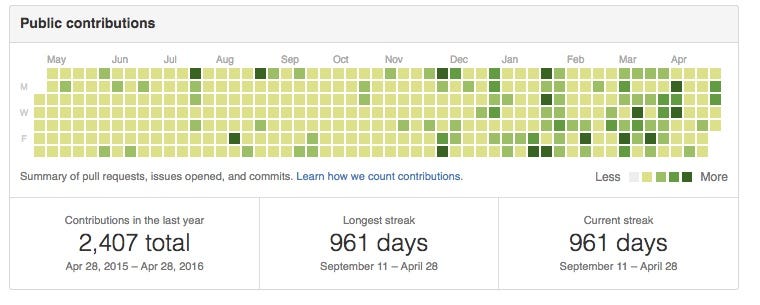
Sahat
isn’t exactly an outsider. He has a computer science degree, has worked
as a developer at Yahoo, and is among the most prolific open source
contributors.
Sahat’s open source contribution activity on GitHub.
At
a time when big tech companies are scrambling to find capable
developers, why is he having so much trouble getting job offers?
The answer lies in part in with how big tech companies interview developers.
You
might assume that in this high tech industry, interviewers use fancy
tools to analyze the quality of code samples, or look at how widely a
candidate’s code was included as a dependency in a package ecosystem
like npm. That’s how an academic researcher’s work would be judged — by
how many other academics cite them.
Unfortunately,
interviewing practices at big tech companies aren’t that scientific.
The decision of whether to hire a developer usually comes down to the
candidate walking up to a whiteboard and regurgitating algorithms that
haven’t changed since the 1970s, like a (classically) trained monkey.
Sahat
is not alone in his frustration with the whiteboard-centric technical
interview process used by most major software companies. Virtually every
developer I’ve talked with agrees that one’s ability to write
algorithms from memory on a whiteboard has almost nothing to do with
real day-to-day developer work.
How whiteboard interviews work
The most common tasks meted out at the whiteboard are recalling algorithms and writing them bug-free on the whiteboard.
There’s
usually an element of time pressure. If you don’t remember the
algorithm or never learned it (i.e. never had a use for it), your
interviewer may push you to guess your way into a working
implementation.
Your
interviewer will probably ask about time complexity, seeing if you can
reduce the time it takes to run your algorithm from say O(n log(n)) to
O(n).
And
remember that this is a whiteboard — not a code editor. You can’t
actually run the code to see if it works, let alone benchmark it. So
your interviewer serves as judge, jury and (literally) executioner of
your code.
The
good news is you can prepare for whiteboard interviews, just like you
can cram for a college entrance exam. And there’s a cottage industry of
books and websites aimed specifically at helping you ace the whiteboard
interview process.
Whiteboard
interview questions generally come from a predictable pool of around
200 questions, the solutions of which are all available in Cracking the Code Interview.
This book is the closest thing to a whiteboard interview playbook. Its
author wrote it based off of her experience interviewing developers for
Google, Amazon, Microsoft, and Apple.
Of
course, your interviewer is under no obligation to ask you one of those
questions you so diligently prepared for. If you’re unlucky, they could
ask you to write out an algorithm you’ve never heard of before. This is
the essence of the “algorithm question lottery.”
Developers
will often defend whiteboard interviews as meritocratic. Anyone who
wants to spend months of their life toward committing algorithms to
memory can go and get that job at Google.
And a majority of these algorithms are already touched on as part of a computer science undergraduate program.
So what’s the problem?
The case against whiteboard interviews
The problem is that writing algorithms on a whiteboard has almost nothing to do with modern software development.
In
real life, you would rarely just whip up an off-the-cuff algorithm from
memory in the middle of a coding session. You are almost always going
to use an existing library, which has its own test suite, and has
survived the scrutiny of other developers.
The
only world where you would actually need to be able to recall an
algorithm would be a post-apocalyptic one, where the hard drives of all
the computers connected to the internet were fried, and all copies of
foundational academic papers and computer science textbooks had been
reduced to ashes.
Whiteboard
interviewing is a discrete skill, much like being able to remember Pi
to a thousand decimal places. And students of programming are spending a
disproportionate amount of their time mastering this skill instead of
practicing real software development by building projects, maintaining
legacy code, or contributing to open source.
This
ultimately reduces the quality of entry-level hires, as it becomes
difficult for the average interviewer to figure out who’s good at
developing software, and who’s merely good at whiteboard interviewing.
It
also freezes out many of the people who are under-represented in the
software development field. If you’re busy working and raising kids, you
want to spend as much of your scarce time as possible learning to
code — not performing rote memorization that won’t matter once you start
your job.
Even
if you could afford to pay for a cram school (and some will garnish
your future wages instead of asking for cash up front), you would still
need to allocate time from your busy life to attend.
Whiteboard
interviews also punish more experienced developers who are too busy
doing real software development to drop everything and cram for a month.
They also punish people who don’t have a computer science degree, or
who finished theirs so long ago that they’ve forgotten most of these
(rarely needed) algorithms.
Whiteboard
interviews favor fresh graduates from theory-heavy computer science
programs. But it’s hard to believe that those are the people who will
perform best in the highly collaborative, practical 21st century
developer workplace.
So why do we do whiteboard interviews?
Whiteboard
interviews are akin to a hazing ritual — a rite of passage that one
must endure before joining an organization — because everyone else there
did. “I went through a battery of whiteboard interviews when I got
here, so why shouldn’t this person?”
Supporters of the whiteboard interview will argue that it tests one’s ability to solve problems under pressure, or that it tests fundamental competence.
Whiteboard
interviews provide an interviewer a defensible reason for passing on a
candidate that their gut tells them they don’t like. Instead of
attributing a no-hire decision to a poor “culture fit”, the interviewer
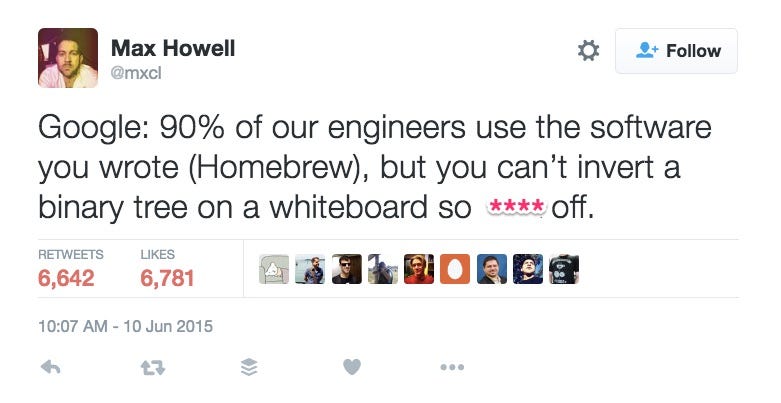
can tell themselves and their superiors that “she just didn’t know how
to invert a binary tree.”
It
also provides the interviewer with an opportunity to feel smart and
validate that “they’ve still got it” and that they aren’t themselves an
imposter, by critically examining the work of an outsider who wants in.
Because
of these forces, whiteboard interviews may stick around for a long
time, like a circle of retribution — an ordeal inflicted upon one
generation of developers by the previous, that will in turn be inflicted
upon the next.
How can a good developer cope with whiteboard interviews?
There are only two good options here (other than to give up and go farm goats).
Option 1: Accept it and cram.
Every responsible academic program is encouraging new developers to learn these algorithms. Dozens of the algorithms in Free Code Camp’s curriculum come directly from common whiteboard interview questions.
Many
of our students have told me that their prior experience with these
specific algorithm questions was critical in landing their first
developer jobs.
We
have also created a lot of videos focused on time complexity and data
structures, and are working on a system for conducting live mock coding
interviews through our platform.
Option 2: Avoid companies that do whiteboard interviewing
Already, many experienced developers will flat out refuse interviews that involve whiteboards. Many of these developers are so good that they can often afford to be more selective.
We
were concerned that [the whiteboard interview] process filtered out
many other great engineers for reasons other than their abilities. Some
possible reasons include variation between interviewers, candidate
nervousness, or the unnaturalness of whiteboard coding generally.
In doing so, Four Square has gotten rid of the random false negatives that can result from the “algorithm question lottery.”
Pivotal Labs
is famous for their pair-programming-centric interview. You come in to
their office in the morning and pair all day with a one of their
developers. One of our students went through their interview process,
loved it, and accepted a job there.
Whatever
you do, don’t give up and go farm goats. Regardless of the stubborn
hiring practices of big tech companies, the world needs a lot more good
developers! So keep fighting the good fight.
Thanks for reading my article! If you found it helpful, recommend it to your friends on Medium by clicking the green heart bel
“A
lot of people like to fool you and say that you’re not smart if you
never went to college, but common sense rules over everything. That’s what I learned from selling crack.” -Snoop Dogg
My
name is Stephanie St.Claire, and I am an unfunded entrepreneur. I’ve
been in business for 6 years, after engaging in my own personal and
tenuous renaissance (uh…divorce) and rediscovering my Divine Core
Purpose. In other words, I grew a pair of ladyballs, launched a
business, and started figuring out how to coalesce my efforts into
profit.
But there was a LOT to learn, and some of those things weren’t covered in Who Moved My Cheese.
Throw these 4 rockstars into a blender, and you’ll have a composite sketch of me in the first three months of my business:
Glitter
was literally shooting out of my eye sockets as I quit my PR firm job
and started my own business. Full of optimism, living in New York City,
and surrounded by a tribe of friends who were also launching businesses,
art, and gigs, I felt it was the perfect time to make the bold move to
entrepreneurship. I was now officially Living My Dream and Working For
Myself which meant that I was In Charge of My Financial Destiny and
Captain of My Promising Future.
Luckily
my initial hyper-optimism buoyed me whilst, oscillating between
euphoria and despair, I was slowly but systematically forced off The
Magic School Bus and onto the S.S. Battleship Long Haul.
I
was a quick and eager learner, but despite the hours of webinar
watching, countless Friday nights pumping out site copy, and teaching
myself everything I could about HTML, there were just some things I
didn’t get. I had to fall on my ass to procure the “masters degree in life survival” every entrepreneur has to earn on their “journey.”
Yes, those are bitterly gesticulated air quotes.
Here
are 11 things I wish I knew when I started my business. I hope they
will save you some time, but at the very least, some anguish
because — experience is a good teacher here — the sodium from your tears
acts as a corrosive melting agent on all brands of premium ice cream,
but otherwise, makes a superb saline for your dirty martini. Cry over a
cup, oh fathomless bird of preneurial gumption!
ONE.
Running the business is your first priority.
Your
success (and financial stability) will come from expertly running your
business — not writing copy, rebranding your client’s website, teaching
yoga, podcasting, or making jewelry. In other words, you will spend 15%
of the time doing what you love (your gift..in my case coaching and
writing) and 85% of the time marketing, administrating, selling,
strategizing your business, and answering a shitload of email. Survival
will totally hinge on how quickly you adopt this role of Business Owner
first, creator of pretty things, second.
This
sucked for me because I wanted nothing to do with running a business. I
just wanted to be a writer and a life coach who wrote and coached all
day. I didn’t get it.
TWO.
Ready to meet your soul mate? It’s you.
Entrepreneurship
is the most life changing relationship (like marriage or parenthood)
that a person can have. You will be confronted overandoverandover with
your fears, your insecurities, your crappy excuses, your limitations,
your justifications, your shitty integrity, and your inefficient time
management. The standard you held yourself to in the work-a-day world
was good enough then, but it won’t be good enough to run your own
business. And you will learn to accept yourself through all this because
in order to get up every day and create a profit, you have to. Somehow
through that process of acceptance, while you’re busy putting yourself
out there in spite of your flaws, your weaknesses will transform and you
will fall in love with yourself. Not in the over-hyped “SELF LOVE 2012”
way, but in a quiet way that sneaks up on you after witnessing a
thousand splinter-sized moments of transcending the baser aspects of
yourself.
THREE.
Your trajectory for success will take as long as everyone else’s, even though you’re special and brilliant.
I
heard the “two-year rule” when I started my biz, but I was confident I
could do it in 6 months. I believed with every fiber of my glittery,
go-gettin’ heart that my work ethic (15-hour days/7 days a week), along
with my talent, skills, and personal magic, I could rip a path to
accelerated success because also, this was A Leap of Faith and I was
Living in My Divine Authenticity and that was worth some express lane
juju points from Heaven.
Jesus had other plans.
See #4.
FOUR.
Running out of money is a common part of the journey.
You won’t expect it, because you prepared for the long haul. You
secured a business loan, or got some investors, or sold your house
(cough, cough), or have one year’s worth of savings and you have planned accordingly.
But
then all of the sudden, midst the puffy clouds and blue skies, your
little twin engine Entreprenairplane will sputter, the needle on the gas
gauge unexpectedly plummeting to zero, and you will have only one
choice… land your plane on the wild, abandoned air strip called Bank
Balance: Fourteen Dollars. And this will be the LAST PLACE you ever
thought you’d crash land, because didn’t you pass this test on No More
Sephora Island?
Well.
The
good news is this is a rite of passage that will launch you into the
League of Business Badassery in which, once you are out of the money hellhole,
you will be unstoppable. You’ve been to the baddest prison there is,
you looked down the barrel of your worst fear, and you stood your
ground. You didn’t quit. You got up the next day, and you wrote your
next post, created your next offering, and answered the email with zero
dollars in your bank account.
There
is nothing more beautiful than running out of money and realizing that
you are doing your work because you’ve got the guts to stand above
proof, and push through your worst fears when there is no evidence of
security. You really, truly love what you do, and you’d do it for free
if you had to.
Irony is a sassy bitch, isn’t she?
FIVE.
Build a hybrid stream of income.
Take
a second job if it will give you peace of mind. Please don’t be a
jackass like I was and make it mean that you’re failing at your
business. I was so resistant to “dividing my focus” or taking any action
which I interpreted as undermining my commitment to being a successful
writer and coach. Do you see the hellish mousetrap that was? I really
thought that by making a Plan B I was telling the Universe I wasn’t 100%
serious about my success. Don’t even get me started with my crazy aversion to Plan B’s. I created a worse problem by allowing financial stress to gut me of my sanity.
If having a steady stream of part-time income would be in service to your peace of mind, do it.
I
finally came to terms with the fact that I was being obnoxiously naïve
about how money, peace, survival, and timing all work together and I got
a second job. By doing this, I supernaturalized my own path to freedom
and self-sustainability. And since I wasn’t freaking out about money
anymore, I liberated more creative real estate in my brain to apply
toward my business.
The
biggest challenge you will deal with in running a business is your own
resistance. Period, end of story. Before you study anything about
marketing, social media, money, or time management, read this book.
You’ll be treated to gems like this:
Our
enemy is not lack of preparation; it’s not the difficulty of the
project, or the state of the marketplace, or the emptiness of our bank
account. The enemy is resistance. The enemy is our chattering brain,
which, if we give it so much as a nanosecond, will start producing
excuses, alibis, transparent self-justifications, and a million reasons
why he can’t/shouldn’t/won’t do what we know we need to do.
A
professional distances herself from her instrument. The pro stands at
one remove from her instrument — meaning her person, her body, her
voice, her talent; the physical, mental, emotional, and psychological
being she uses in her work. She does not identify with this instrument.
It is simply what God gave her, what she has to work with. She assesses
it coolly, impersonally, objectively.
Does
Madonna walk around the house in cone bras and come-f*k-me bustiers?
She’s too busy planning D-Day. Madonna does not identify with “Madonna.”
Madonna employs “Madonna.”
SEVEN.
Spend less time researching, more time doing.
Researching/studying/
reading other people’s blogs is a form of resistance. In order to get
clarity, you must act. Clarity does not come by learning more, it comes
by jumping in with your instincts and putting yourself out there, even
if you don’t know exactly what you’re doing.
Block
out the distractions (turn off the phone, social media, and email
notifications) and take inspired action that feels tangible and
measurable. Set a timer for 25 minutes and go to town on a task. Do not
look up. Do not go to the bathroom. Do not cruise the fridge for cheese
sticks. Get something done, despite the fact that at times you will feel
like you are pissing into the wind. Piss into the wind 4 times a day,
and you’ll make a difference in your bottom line.
EIGHT.
Only say yes to clients/collaborative projects that are HELL YESES.
Scrutinize
any joint project carefully and qualify the person you are doing the
project with (even if they are your friend and have more page likes than
you). Get everything in writing before you embark on the project, with a
clear division of labor and deadline dates. You will most likely be
splitting the profits, so have two numbers in your head: The $ number
you NEED to make in order to pay for your time, and the $ number would
LIKE to make. Set the first financial deadline early to make your NEED
number so that you both have the freedom to walk away if the project
isn’t going to be profitable. Have a transition strategy in mind so in
case that happens and one of you wants to continue on with the project,
there is a way to pass the baton gracefully.
Summed
up: COMMUNICATE ABOUT EVERYTHING, even though you’re friends, even
though you love each other, even though you trust each other, even
though you’ve worked together at XYZ Company, because projects have a
way of going sideways and making everyone a little custodial and
overreactive.
NINE.
You must devote time to becoming a brilliant marketer.
MUST.
I know you just want to spend all your days making hipster
sarsaparilla-scented mustache wax, or needle pointing edgy throw pillows
for Etsy, or writing your YA zombie novel, or life coaching
entrepreneurs to stratospheric success, but if you don’t spend time
marketing you will not make money.
This
was my biggest weakness when I started because I thought marketing =
slimy sales letters with big arrows and opt-in boxes and I couldn’t! I
wouldn’t! So I put my head in magical fairyland sand, stubbornly
insisting that my customers would be tractor-beamed into my budding
practice by the pulsating, heavenly light that radiated from my vision
boards and 4 blog posts.
And then I ate canned food and spaghetti for a long, long time.
But
this rescued me — knowing what marketing personality I embody. There
are three main types: The Guru (Brendan Buchard, Danielle LaPorte, Gary
Vaynerchuck, Marie Forleo, Tony Robbins), whose marketing boldly states,
“Listen to me. I have the answers.” Then there’s the Wisdom Advisor
(Brene Brown, Chris Guillebeau, Marianne Williamson, Dave Ramsey), whose
marketing feels like, “This is what I’ve found to work best. Let’s
brainstorm together, and I’ll help you find out what’ll work for you.”
And finally, The Connector (Oprah, Jonathan Fields, Mark Zuckerberg) who
connect people with other people/resources. Once you have figured out
your marketing personality, selling to your customers will be a thousand
times easier because you will be working within your natural vibe.
Learn
what way you like to market and stick to that and do it consistently
and often. Even if you hire a pro, you will be doing some marketing
yourself. Keeping your website fresh and current is essential in your
marketing, so learn how to work WordPress and learn some HTML code. You
will be in the guts of your website A LOT.
TEN.
Email will be your new best frenemy.
Your
inbox will explode. You care about everyone, but you can’t help
everyone. Read: Not everyone is your customer. Your inbox will be a
jumble of people who want to say thank you, people who want free stuff,
and people who want your services. Your job is to quickly discern who’s
who and respond in the most appropriate way.
Shorten
the email back-and-forth as quickly as possible with people that are
your potential clients. If your business is a consultancy where you are
selling your time, I recommend having two form letters on hand that you
can customize to the occasion: one for your potential customer and the
other for your not potential customer.
Your
Customer: Acknowledge their situation, request, or problem and invite
them to a 20-minute call. Include your available dates, times, and a
phone number you can be reached.
Not
Your Customer: Acknowledge their situation, request, problem and direct
them to other resources, practitioners, blogs, or articles that would
be a splendid fit for them.
I
love personally connecting with my clients. In this area of business, I
am 1997 all the way, and I pick up the phone and talk to them live. I
set up all the calls on one day or schedule them after my regular client
sessions. I have found this to save a colossal amount of time. In a 20
minute phone call, I accomplish the following:
Find out their history and current issues.
Explain to them how coaching works and pricing.
Ascertain if we are a right fit and they are ready for coaching.
Answer any of their logistical questions.
Give
them a personal sense of what it would be like to work with me on the
phone (my tone of voice, cadence through the call, etc.).
Process the invoice.
Set up the first session.
Do you know how long that would take back-and-forth by email? 5 days to a month. Do not screw your own time economy.
ELEVEN.
Number eleven is a hodge-podge:
Do
not work your business 7 days a week. Cover your legal ass from day
one. From time to time, forget everything you know about the “right way”
to run a business and run it like a neighborhood lemonade stand. Do not
price your offerings around your personal ability to pay for it — you
are not your ideal customer. Work out perplexing issues in your business
and it will resolve problems in other areas of your life. Connect with
other entrepreneurs and set up a skype brainstorming session (with
wine). Take a walk around the block every day at lunch. If you want to
be smarter in business, read everything these two people write: Regina Anaejionu and Ash Ambirge.