Showing posts with label studies. Show all posts

Mar 10, 2016

The “Third World” Is Not Your Classroom

Courtney Martin

A growing number of privileged Americans are studying and working in low-income countries. How do you prime the young and high-achieving for humility — and even reverence?

 
Illustration by Michael Howard


Nodidi Mgudlwa, an 11-year-old with coltish legs to match, walked around the red dirt roads of Langa with a white American girl trailing behind her. She had learned that when the stares got to be too much from her neighbors, who no doubt wondered what a white person was doing in a South African township, she could get a reprieve by advancing a few strategic feet in front.

Nodidi would teach the rotating cast of American college girls who lived in her home things — how to eat samp and beans, speak Xhosa, and dance to kwassa kwassa. They, in turn, would let Nodidi listen to the mix CDs that their boyfriends made them before they left home — places like New York and Boston and Washington DC. They played spoons and Egyptian Rat Killer and watched old seasons of One Life to Live.

I was that white girl, or at least one of many, that trailed Nodidi around for six months. As a college junior in 2001, I was mostly so wrapped up in my own anxiety about being away and excitement about all that I was experiencing, that I don’t remember pausing, even once, to wonder what my presence was really like for Nodidi, my host mother Nokwezi, or the staff at the high school where I volunteered. I wrote an unconscious, overly simple story about our time together — that having me there was a welcome divergence from their normal family or professional life, maybe even a breath of fresh air.
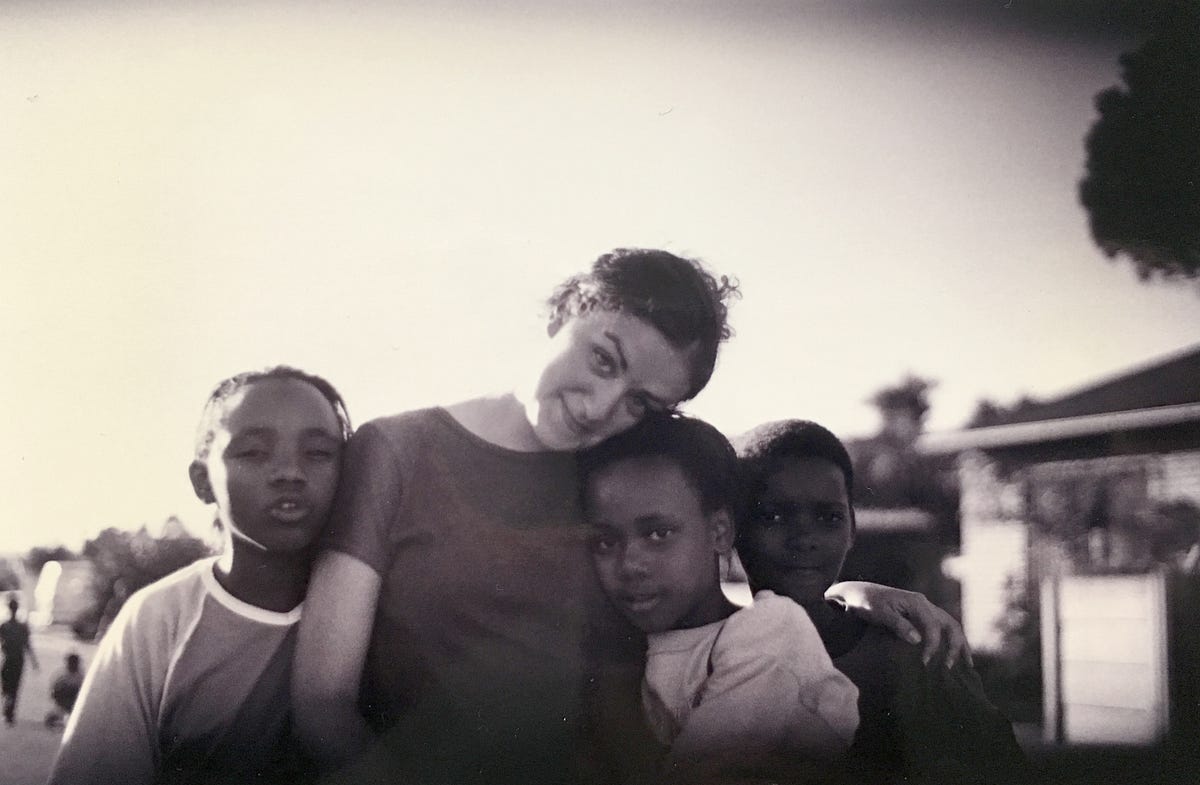

 
Nodidi, the author, and two other neighborhood girls hit the streets before sunset.

Twenty-year-old me was not unique. There is a sort of autopilot story of privilege that so many of us tell about our time abroad — whether we are part of a study abroad group, living with a host family while interning at a nonprofit organization, or volunteering with a religious organization. We go to help and learn, and we tell ourselves and others that those we met were similarly appreciative of the exchange.

Setting aside the question of whether our help is actually effective (well-explored in this recent piece by Habitat for Humanity volunteer Katia Savchuk), let’s look more deeply at this question of how privileged people learn. It is not uncommon for us to see our learning as something that we, alone, manifest; this one-sided point of view is strengthened by the language of our most elite institutions, where college students have a “shopping period” during which they decide which classes they want to take. Learning, rather than being an exchange, becomes an act of consumption.
In fact, where there is a learner, there is most often a teacher. And teaching, as gratifying as it can be, is labor — work that is, even in the best of circumstances, draining.

This dynamic is particularly pronounced when power differentials are involved: for instance, the white woman who asks her black friend: “Can you explain black women’s hair to me? I just don’t get it.”

The white woman may see her request as open-minded, even generous, while her friend might feel exasperated with the assumption that, once again, it is her responsibility to teach. It’s not that there’s anything particularly pernicious about the question; the problem lies in the assumption that marginalized people are always at the ready to enlighten the privileged.

Now take this to the global scale. If you ask a contemporary global development leader to pinpoint the genesis of her work, she will often get misty-eyed talking about a deeply formative year in her 20s when she was a “fish out of water” somewhere in the Global South. It’s where so many learn about the limitations and occasional gifts of being an outsider. It’s where they are often first introduced to a profoundly new culture. It’s where, best case scenario, they get a hands-on experience that complicates their ideas about “saving the world.”

Famed educator Jean Piaget argued that leaps in learning happen when we encounter new information that doesn’t fit into our previously held worldview — what he called a schema — and we’re thrown off — what he called disequilibrium. Studying and working abroad is, in a sense, a perpetual schema buster, an endless opportunity for the kind of disequilibrium that leads to wisdom. These experiences make us better students, better leaders, better citizens.

This isn’t just speculation. An assessment by the University of Georgia found that students who studied abroad had a 17.8 percent higher 4-year graduation rate than those who didn’t. And analysis by the SAGE Research Project of 6,000 alumni over 50 years demonstrates that study abroad has a substantial long-term impact on individuals’ career paths and global engagement. (It’s no wonder that the Institute of International Education created “Generation Study Abroad” in 2014, a five-year initiative that seeks to double the number of U.S. students studying abroad.)

Time spent working abroad can also make you a more attractive employee in an increasingly globalized world. Learn another language? Have experience collaborating cross-culturally? Those are valuable skills in almost all of the most rapidly expanding sectors of our economy. According to Forbes, 31 percent of American executives speak more than one language, and workers of all rank who do earn 20 percent higher, on average.
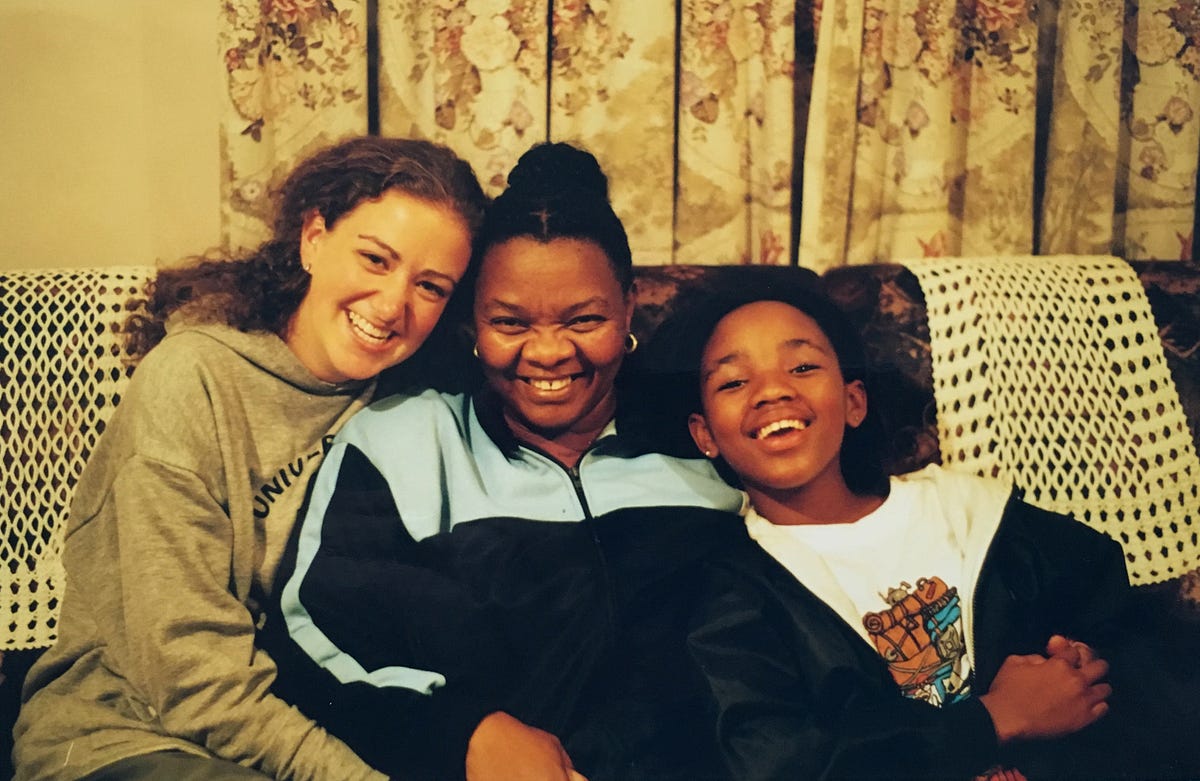
 
Cuddles on the couch with Nokwezi and Nodidi Mgudlwa.

So there are real, tangible benefits to having experiences abroad. And yet, too often we celebrate the revelation without considering the labor that makes it possible. Who does the work of teaching privileged people who choose to study, work, and live in comparatively less resourced countries? What are the economic and emotional benefits and costs of that teaching? What are the most genuinely reciprocal ways for Americans to benefit from the unique learning that occurs in new and unfamiliar communities?

When I approached a range of leaders who host Americans at their nonprofit organizations in the Global South with these concerns, they often responded with a sort of polite shock that I was even posing the questions. Most often, they explained, being offered the opportunity to host American students is posed as a boon, or at the very least, a win-win, by international agencies and universities. The complexity is flattened out to what essentially amounts to free labor.

It doesn’t always work out that way, as anyone who has had unpaid interns — stateside or elsewhere — can attest. Many times, an organization puts more energy into training and nurturing a newbie than they feel they get out, in terms of genuine contribution to the organization’s mission. (As a note, it is customary for families to be paid for hosting students, but such is not the case with most internships.)

This already challenging situation is made even tricker by cultural divides. Sisonke Msimang, the former Director of Advocacy and Accountability at South Africa-based nonprofit Sonke Gender Justice, wrote me with this story:
 
I once hosted a young American woman who was on summer break. It is really hard to fundraise for administrative work, so having a university graduate to help with basic admin is a massive boost for small NGOs. She wanted to be in the field doing direct service. The project I was working on dealt with sexual and reproductive health and rights. It would have been an absolute disaster for her to speak to older women in English and tell them how to use condoms with their husbands. She was disappointed and offended. She thought I was being racist because she was white and wanted me to give her a chance to ‘prove herself.’ I was not prepared to jeopardize the trust we had built in order to ‘prove’ my point. It was pretty awful. I spent a huge amount of time managing her feelings at the expense of the project.

Deborah Ahenkorah, the Co-founder and Executive Director of Ghana-based Golden Baobab, shared another case of the American ego run amuck:
I know a volunteer who once worked with an after-school program I support. She came in with very strong views about how things should be done. So for example, the girls in the program would come to her with boy problems and she would give advice like, ‘It’s okay to kiss. It’s okay to hug and have a boyfriend. Girls in my country do that. Just do not let it go far.’ These were young Muslim girls who lived in a very conservative community where they would get into a lot of trouble for following her advice. The volunteer did not believe in restricting young girls and so went with what she stood for. The end results were disastrous. The volunteer left eventually and the organization had to suffer the consequences of her actions.

For my own part, I remember standing in front of an overcrowded classroom in the township high school where I interned, armed with a binder full of poems from the anti-apartheid era and a head big with good intentions. After a few minutes of talking to a room of blank faces, I realized that the new friend I’d dragged along — a local poet and rapper named Melisizwe Lugulwana — was better positioned to connect with these students. I pulled him up, handed over the binder, and became a witness.
Not all Americans cause grief within their host organizations. Many make themselves truly useful, while gaining knowledge and perspective in the process. So what makes an experience like this successful and fulfilling for all parties?
Clear structure and expectations, I heard, over and over again. It’s imperative that study abroad programs have representatives in-country who can nurture local relationships, meet with potential organizational hosts, and make sure that everyone is on the same page about what the students can most realistically offer and expect to gain.

For those who volunteer abroad without an intermediary coordinating the experience, they’d be wise to ask a lot of questions up front, and take note if an organization seems too overwhelmed to answer their inquiries. It’s a sign that the experience on site will be unsatisfying for everyone, leaving the intern feeling underutilized and the supervisor frustrated by what he or she sees as unrealistic demands.

And perhaps even more essential, but far less straightforward, is humility on the part of visiting Americans. Humility, put simply, is our capacity to know that there is much we don’t know, and act accordingly. It’s a sign of wisdom. As physicist Robert A. Millikan put it: “Fullness of knowledge always and necessarily means some understanding of the depths of our ignorance, and that is always conducive to both humility and reverence.”
But how do you prime Americans, especially the young and high-achieving, for humility and even reverence?

This is exactly the kind of question that drives Abby Falik. She’s the founder and CEO of Global Citizen Year, an 8-year-old program that gives graduating high school seniors in America a chance to spend a “bridge year” in Brazil, Senegal, Ecuador, or India.

Students live with a family and “apprentice” at a local organization (language Global Citizen Year has adopted, as opposed to the more patronizing “serve” or “volunteer,” precisely because they believe it promotes the right kind of attitude). Their admissions process is designed to screen for curiosity, genuine motivation, and resilience — all characteristics that Falik believes predispose kids to be humble while in country.

Participants, eighty percent of whom receive some financial aid, not only have a week-long pre-departure training, but also a month-long orientation in country. Part of that is informational, but much of it is cultural and even social-emotional — urging students to surface their own schemas and prepare for the pending disequilibrium.
“Some of our kids come in with the save-the-world mentality of so many high-achieving Americans,” said Falik. “But ultimately, we hope that, by the end of the experience, they say, ‘I was there long enough to ask really good questions.’ We consider that success.”

Robin Pendoley, co-founder of educational institution Thinking Beyond Borders has a similar approach to cultivating participants’ capacity to embrace the virtue of grappling rather than serving. “We challenge students each day with critically reflective questions and educators who are there to help them understand how these questions shape their lives and their view of the world,” he explained. “None of this is easy, nor does it assume that just going somewhere will provide deep learning that forwards justice and equity.”

While in country, Global Citizen Year students write blog posts — many of which contain the kind of introspection that marks a truly transformative learning experience. Eighteen-year-old Emily Hanna, living in Senegal, reflected: “Before embarking on my Global Citizen Year, I was already a believer in the importance of education in the developing world; however, all my attention was focused on building schools. Now, after seeing firsthand how the school system works and what it’s like in the classroom, I’ve realized that the actual construction of a school is only a small piece of the process — and probably the easiest piece, at that.”

She goes on: “How can we ensure follow-through, accountability, and positive progress after years of developing-and-dashing? In Senegal, at least, the solution appears to be simply this: put the development projects in the hands of well-trained locals. Handing the reigns to the Senegalese themselves creates a sense of ownership that does not exist when its foreigners swoop in to do the work.”
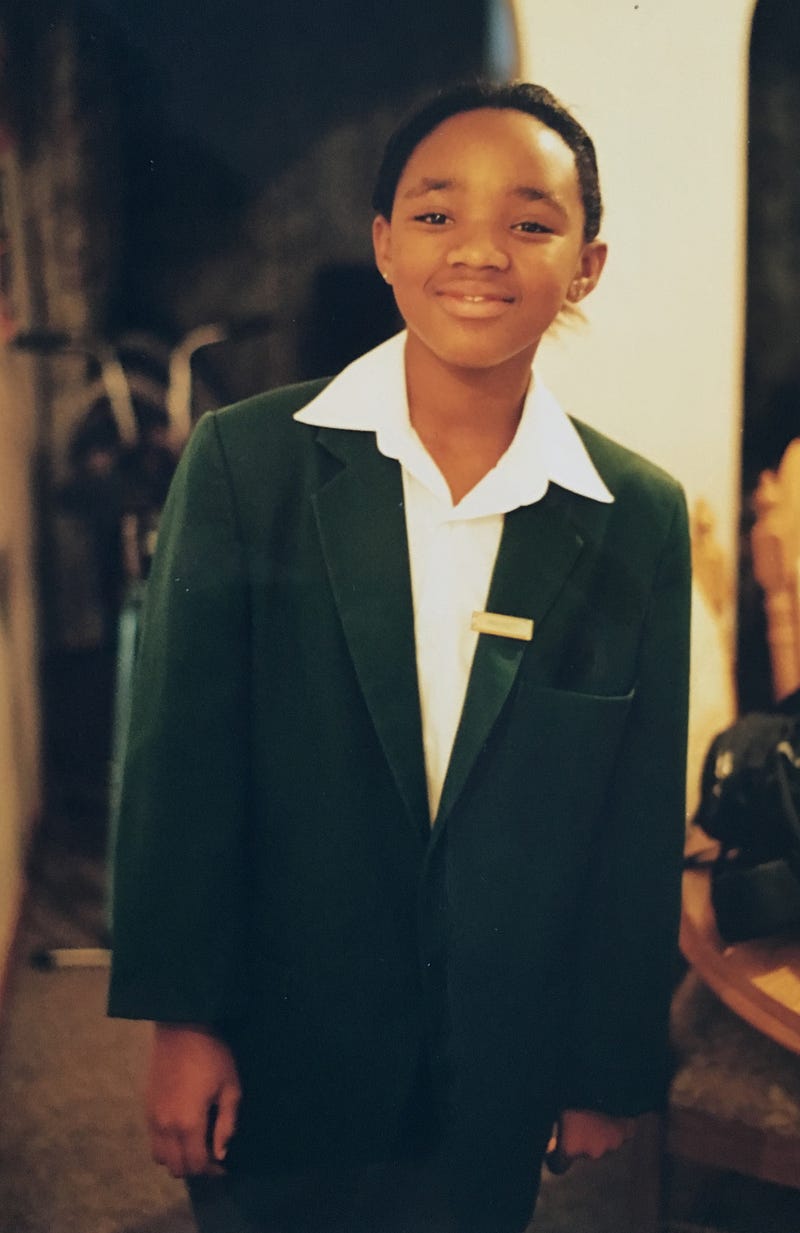
 
Nodidi Mgudlwa, looking sharp in her school uniform back in 2001.

Humility, taken to its logical end in a setting like this, often leads one to conclude that the best thing you can do as a privileged outsider is step back, shut up, even leave. Sometimes it means playing a different role in a development project — serving as the liaison between funders and practitioners, for example, or agitating for policy changes in America that affect people in the Global South. Ultimately, one of the gifts of on-the-ground experience can be a renewed commitment to finding where, within the complex systems that govern development, privileged Westerners are best positioned to use their privilege to improve conditions for those they met abroad.

I’ve kept in touch with my “little sisi” Nodidi, through Facebook. “What did you really think of having all those American students in your house?” I messaged her recently.

Looking back a decade later, she says that it was mostly a good experience. It gave her a chance to practice her English and meet confident American woman at such a formidable moment in her own life. Some of the benefits were tangible: “The first book I ever read was given to me by one of my host sisters. I believe I am a reader today because of it.”

There were some challenges, too: “Trying to assimilate this American into your family and community of friends is especially awkward when some of them either don’t speak English or just don’t get why there’s a white person in your house. In early post-Apartheid South Africa it was quite strange to see white people willingly wanting to be in the Township.”

In the end, I suppose, there was disequilibrium all around. I’m grateful that hers felt as productive as mine.

Pendoley points out that the best learning happens not just when you’re thrown off a bit, as Piaget posited, but when you have the context of real, complex relationships within which you can find your footing again: “The goal is to build humanizing relationships with others. We want students to return home thinking of their host community abroad as family — with all of the love, nuance, and tensions that entails.”

Photographs courtesy of Courtney Martin. The Development Set is made possible by funding from the Bill & Melinda Gates Foundation. We retain editorial independence. // The Creative Commons license applies only to the text of this article. All rights are reserved in the images. If you’d like to reproduce the text for noncommercial purposes, please contact us.

May 3, 2014

Taking Notes On Your Laptop Could Be Ruining Your Test Scores


Taking Notes On Your Laptop Could Be Ruining Your Test Scores

Many people take notes during interviews, presentations and lectures not with pen and paper, but with a laptop. But a newly published study concludes that people actually remember better when they've taken handwritten notes, rather than typed ones. In fact, studying from typed notes could actually hurt your test scores.
The study – which was led by UCLA researchers Daniel Oppenheimer and Pam Mueller, and appears in the latest issue of Psychological Science asked students to watch a video of a lecture or TED talk and to transcribe notes either longhand or on laptops. Students were later quizzed on the presentations, either after 30 minutes of difficult problem solving or a week's time.
To many people, a laptop is the clear choice of note-taking device because it allows them to take down more of what the speaker is saying. But according to UCLA researchers Oppenheimer and Mueller, the temptation to capture everything we're listening to might actually be the biggest issue with typed notation.
"We don't write longhand as fast as we type these days, but people who were typing just tended to transcribe large parts of lecture content verbatim," Mueller tells The Atlantic's Robinson Meyer. "The people who were taking notes on the laptops don't have to be judicious in what they write down."
In other words: Transcribing on a laptop in real-time may lead to verbatim notes, but doing so means you spend less time processing the lecture, and more time focusing on typing.
What's interesting is that warning test subjects against taking verbatim notes "was completely ineffective at reducing verbatim content." Another surprising takeaway: When research subjects were tested a week after the lecture and were allowed to study their notes, the students who took notes by hand still outperformed those who took notes on their computers. In fact, studying verbatim notes prior to the quiz seemed more likely to hurt test scores than help them.
Read more details at The Atlantic. For the full findings check out the study in the latest issue of Psychological Science.

Dec 29, 2013

Students describe their theses in a single self-mocking sentence


Students describe their theses in a single self-mocking sentence
"Summing up years of work in one sentence." That's the tagline for Lol My Thesis, where PhD candidates (Edit: and undergrads) make fun of their own theses by reducing them to just a sentence or two.
Edit: I mistakenly thought these were mostly graduate theses. The about page describes them as "undergraduate (and some post-graduate) theses."
Students in areas from accounting to aerospace engineering come up with absurd, obvious, and sometimes defeated descriptions of their research. Here are a few examples:
  • Don't be anxious about your decisions driven by anxiety. -Social Neuroscience, Beijing Normal University
  • When people have to pick stuff up with a robotic arm and can only see with on board cameras, they're worse than infants; please pay me to make them as good as 5 year old. -Integrated Systems Engineering, Ohio State University
  • We dug a lot of holes and still don't know if measuring beryllium in dirt is useful, but it does cost a lot of money. -Geology, Amherst College
  • Going into space is pretty dangerous, and the government should keep making rules about folks trying it -Aerospace engineering, MIT
  • A mathematical theory of discarding irrelevant crap when making a team decision. -Electrical Engineering, Stanford University
  • Turns out, you can make bacteria have sex! -Chemical Engineering, Rice University
  • So, colonialism. -History, Wesleyan University
If you want to snark on your own thesis, you can submit your one-sentence description to the site.

  • Mine would be (and I'm still writing it): "I try to teach writing in a progressive manner, but people in Engineering are sure this approach is full of shit.
  • My undergraduate thesis was "Jews and Christians have opinions on whether embryonic stem cell research is theologically permissive." 
  • My economics thesis was about the procurement of the SAAB Gripen fighter for the Royal Swedish Air Force. It could be summed up like this:
    "Economics has little to do with military aircraft procurement. Duh.
  • "Please let me graduate" MS Electrical Engineering 
  • College students like to binge drink, unless they are busy.

    Sociology, University of Wyoming
  • Mine would be: Quebec and the US have nothing in common, but they both became full of paranoid jerks in the 60s. What gives? 
  • Well originally you should know how to work as an academic at the point of your master's graduation.
    A PhD is a special brand grad that shows you have significantly contributed to science and knowledge on this planet.
    Of course at this point, we have lots and tons more of people wanting a PhD than there are actual scientific breakthroughs available (realistically, concerning time, money and progress). And there will always be subjects an individual not interested in that specific subject will deem uninteresting and useless (literature studies, anyone?)
    So because of the splintering of academic subjects and the large numbers of people who want to acquire a PhD we face a devaluation of the PhD itself and the scientifical "breakthroughs" become smaller and smaller, more detailed, more specialized but in the end more meaningless.
    That doesn't mean that a study on the evolutionary traits of the red-footed rainbow toad is meaningless. It may actually contribute a large chunk to biology, a big progress to toxicology and a huge new potential to medicine as the researcher may find out the toxin of RFRT can be used to make you immune to athlete's foot.
    I still hope my thesis will one day help calculating propagandist behavior to adequately plan political further steps in international action.
    However, by the sheer mass of new theses even the significant "breakthroughs" drown and thereby become meaningless. You can really advance science a lot and receive your summa cum laude and yet nobody will know what you did or even USE this astonishing new knowledge because there are just too many.
    And there are disciplines like medicine where you get your doctorate for shit that's basically a bachelor thesis if you're lucky just because you have to have a doctorates degree. Today 4:59am
     
  •  During a masters program you learn to communicate your thoughts in a manner appropriate to your field (I am a biologist so in scientific paper format, which is only telling a story in a prescribed way) both in written and oral forms. And you learn to read papers in a critical manner, answer and ask questions and engage in academic discourse much more fully than in a bachelor's program. You also learn everything there is to know about a small area of study and how your work fits into the big picture. But learning how to WRITE and how to lecture on a complex topic is a major part of any study and that can't be tested, per say. Writing your own is the best way to demonstrate your proficiency.
    A phd builds upon that with more practice and also generally some practice teaching. Critical engagement with a subject matter and peers and mentors is not a skill people are born with - it must be developed and practiced and a phd in theory also teaches you to teach it to others.
    People who get phds and go into research or a combination of research/teaching do these things over and over again: ask new questions and write new papers. So the upper level programs are practice for the process they will literally do again and again.
    I don't have a phd, just a masters, but I did get my thesis (which was less than 30 pages, btw) developed into a scientific paper, printed in a scientific journal, so I contributed to the body of work on my topic. It also looks great on a resume - its proof that I can communicate complex topics in a well written and accepted manner.
    Meanwhile, I work in government environmental policy, and my masters taught be to more critically engage with technical subject matter, which I do every day as a reviewer, making sure the documents are solid with no glaring holes. I also sometimes write documents, and having practiced with my thesis and other smaller projects I am better at conveying complex topics in a straightforward well written manner. Today 5:38am
  • Mine (English lit): "Scifi prisons are like real prisons!"

    (BTW, reading science fiction scholarship has made me cringe every time I hear the term scifi!) 
  • Mine diploma thesis: "Goethe was mostly under influence. Sometimes by Kant."
    But really, I pitched it to my mentor even shorter - Kant's influence on Goethe.
  • Mine was "You CAN totally mind control people if you built a nice statue, some buildings painted in various colors and call it 'ancient.'"
  • oh and the undergrad:
    "Chinese people don't mind being oppressed as long as they can do what they always did, but if you oppress them too much (especially with (pseudo-)religious shit) they will form strong, unkillable, secret societies that may or may not be religious. Also, beware milleniarism." 
  • "I Couldn't Get Into Med School So I Spent Five Years Studying Lung Biology Instead. Here's Some Graphs." - Toxicology, me...Five years from now... 
  • Undergrad: You can tell awesome literary narratives in comics in ways you can't do in film or text, and I'm going to go on and on and on about it ad nauseum.
    Masters: Make those metaphors move, or how those wise-guys Joyce and Beckett make texts that seem to read themselves (thank you Phaedrus).
    PhD: There probably isn't a way to break a narrative down into an algorithm, but let's creatively fail to prove it.
  • I don't know I love this one personally,
    This is a weird star cluster and we absolutely have no idea how it formed - sorry.
    Astrophysics, Whitman College
  • Mine would have been:
    Authors on WWI agree; war is stupid.
    (My actual thesis was "Didacticism of Young Adult Literature with Regards to WWI: Activism vs. Pacifism" - it was an analysis of how the motivations for war are portrayed in YA/children's literature)
  • "Light-reactive antibiotics are all very interesting, but I got to fire lasers at bacteria every day, so the original message might have been lost."
    I spent four years on that! :D
  • "If there are such things as plumbers, college students, and Thanksgiving, then there are such things as human races." — philosophy Ph.D. dissertation, Syracuse University 
  • Mine would be: "Finding where you go and what u do and how u do it from your GPS data" - Geoimformatics (just submitted)
  • "Could this possibly make a trip to mars feasible without us dying of excruciating radiation sickness?" Biomedical physics -Me 
  • Mine will be, "Supernatural: So, how about that slash?" - Comm. Major (focusing on human behavior and technology) 
  • My new thesis proposal would be, "No one has a better sense of humor than PhD students" - io9 lurker, hoping for a non greyed status one of these days. 

Labels

Giveaway ( 3088 ) Excerpt ( 1336 ) blog tour ( 942 ) Book Blitz ( 864 ) Cover Reveal ( 543 ) Guest post ( 518 ) Teaser ( 347 ) Book blast ( 283 ) Interview ( 260 ) Culture ( 245 ) Books ( 242 ) Trailer ( 228 ) freebie ( 227 ) Art ( 226 ) Funny ( 225 ) History ( 219 ) Promotion ( 207 ) Science ( 202 ) Articles ( 181 ) free kindle ( 145 ) Literature ( 142 ) Release Day ( 131 ) Review ( 120 ) Photography ( 115 ) nature ( 113 ) kindle ( 112 ) Gender ( 105 ) Book tour ( 90 ) Authors ( 89 ) myth ( 77 ) new release ( 77 ) Coffee ( 76 ) newsletter ( 71 ) Children ( 70 ) Music ( 66 ) box set ( 60 ) Archaeological ( 59 ) illustration ( 56 ) food ( 50 ) spotlight ( 50 ) PLAYLIST ( 49 ) social ( 48 ) 0.99 sale ( 46 ) YA ( 45 ) contest ( 43 ) fantasy ( 43 ) Mythology ( 42 ) Grand Finale ( 41 ) sale ( 39 ) blog hop ( 37 ) words ( 37 ) Poetry ( 35 ) artist ( 34 ) Characters interviews ( 32 ) Game ( 32 ) syfy ( 32 ) language ( 30 ) quotes ( 30 ) recipe ( 30 ) Release Party ( 29 ) Expert ( 27 ) ads ( 21 ) mystery ( 21 ) Photos ( 20 ) reading ( 20 ) Romance ( 19 ) Animals ( 18 ) Design ( 18 ) Education ( 18 ) Street Photography ( 18 ) book highlight ( 18 ) facts ( 18 ) comics ( 17 ) health ( 17 ) writing ( 17 ) Folklore ( 16 ) Holidays ( 16 ) Movies ( 16 ) poem ( 15 ) Biology ( 13 ) top 10 ( 13 ) Book release ( 12 ) Maps ( 12 ) covers ( 12 ) Book trailers ( 11 ) Cash Giveaway ( 11 ) Giveaways ( 11 ) Twitter Blast ( 11 ) Valentine ( 11 ) Friday revel ( 10 ) Libraries ( 10 ) Paranormal ( 10 ) Release blitz ( 10 ) agriculture ( 10 ) events ( 10 ) sport ( 10 ) Characters cast ( 9 ) Publishing ( 9 ) Sneak Peek ( 9 ) dream cast ( 9 ) work ( 9 ) BOOK SIGNING ( 8 ) Steam-punk ( 8 ) astronomy ( 8 ) interviews ( 8 ) plants ( 8 ) technology ( 8 ) Free Book ( 7 ) Halloween ( 7 ) NA ( 7 ) Thanks Giving ( 7 ) blog ( 7 ) blog blast ( 7 ) economy ( 7 ) letters ( 7 ) street art ( 7 ) Christmas ( 6 ) Contemporary Romance ( 6 ) Genetic ( 6 ) Goodreads giveaway ( 6 ) This and That ( 6 ) YA RELEASES ( 6 ) news ( 6 ) short story ( 6 ) writing tools ( 6 ) Amazon. ( 5 ) Audio ( 5 ) Philosophy ( 5 ) Spring ( 5 ) YA Fantasy ( 5 ) hosting ( 5 ) jobs ( 5 ) mother day ( 5 ) top 5 ( 5 ) Black Friday ( 4 ) BookRave ( 4 ) Fun Facts ( 4 ) Grammar ( 4 ) Song ( 4 ) Sunday Read Recommendation ( 4 ) Weather ( 4 ) Web ( 4 ) cakes ( 4 ) deals ( 4 ) evolution ( 4 ) gift card ( 4 ) horror ( 4 ) lol ( 4 ) photographer ( 4 ) soundtrack ( 4 ) studies ( 4 ) video ( 4 ) Architecture ( 3 ) Book Swapping ( 3 ) Book tor ( 3 ) Cartoon ( 3 ) Characters ( 3 ) Computing ( 3 ) Dance ( 3 ) Easter ( 3 ) Erotica ( 3 ) Indian ( 3 ) Kindle Fire HDx Giveaway ( 3 ) St. Patrick's day ( 3 ) Suspense ( 3 ) TV series ( 3 ) Thriller ( 3 ) Translation ( 3 ) bookstore ( 3 ) chapters ( 3 ) chemistry ( 3 ) contemporary ( 3 ) ecology ( 3 ) fall ( 3 ) film director ( 3 ) guest review ( 3 ) hope ( 3 ) icon ( 3 ) launch day ( 3 ) math ( 3 ) story ( 3 ) summer ( 3 ) syfi ( 3 ) urban ( 3 ) winter ( 3 ) 10 Fun Facts ( 2 ) 10 things ( 2 ) 4th of july ( 2 ) Adventure ( 2 ) Audiobook ( 2 ) Awards ( 2 ) Blogger Appreciation ( 2 ) Book reveling ( 2 ) Bookstores ( 2 ) Characters bio ( 2 ) Clean Sweep ( 2 ) Cover wars ( 2 ) Crime ( 2 ) Debut Author Challenge ( 2 ) Dystopian ( 2 ) Family ( 2 ) Free Shipping ( 2 ) Fun ( 2 ) Gifts ( 2 ) Graphs. STAT ( 2 ) Hop International ( 2 ) Introduction ( 2 ) Literature awards ( 2 ) Nostalgic ( 2 ) Ocean ( 2 ) Psychological ( 2 ) Psychological Thriller ( 2 ) Reading Contest ( 2 ) Release week ( 2 ) Selfies ( 2 ) Summer Reading ( 2 ) Summery of the year ( 2 ) Tablets ( 2 ) Tea ( 2 ) Titles ( 2 ) add ( 2 ) art Articles ( 2 ) birds ( 2 ) book bash ( 2 ) book contest ( 2 ) bread ( 2 ) cell & molecular biology ( 2 ) children’s literature ( 2 ) climate change ( 2 ) codes ( 2 ) discussion ( 2 ) dragons ( 2 ) ebooks ( 2 ) epic ( 2 ) extreme ( 2 ) facebook ( 2 ) facebook Blast ( 2 ) games & gadgets. test ( 2 ) ilustration ( 2 ) immunology ( 2 ) incredible ( 2 ) internet ( 2 ) labels ( 2 ) lists ( 2 ) lunch blitz ( 2 ) martial ( 2 ) min-interview ( 2 ) monsters ( 2 ) physics ( 2 ) poets ( 2 ) sea ( 2 ) tips ( 2 ) tv ( 2 ) water ( 2 ) wolf ( 2 ) 5 Fun Facts ( 1 ) 5 Rapid Fire Round ( 1 ) A vote ( 1 ) Action ( 1 ) Adult ( 1 ) Adult Historical Fantasy ( 1 ) Adult fiction ( 1 ) African-American Lit ( 1 ) Amazing ( 1 ) Amazon ( 1 ) Amazon.Tech ( 1 ) Announcement ( 1 ) Apology ( 1 ) April ( 1 ) Atlit Yam ( 1 ) B-day ( 1 ) Badass heroes ( 1 ) Baking ( 1 ) Bibliophile ( 1 ) Black & White ( 1 ) Blogoversary ( 1 ) Book Hop ( 1 ) Bookfest ( 1 ) Booklikes ( 1 ) Bravery ( 1 ) Bundles ( 1 ) Catalog ( 1 ) Concepts ( 1 ) Critique ( 1 ) Cut Scene ( 1 ) DVD ( 1 ) Did you know ( 1 ) Discovery ( 1 ) Disney ( 1 ) Donation Campaign ( 1 ) Earth Day ( 1 ) Etymology ( 1 ) Extravaganza ( 1 ) FAQ ( 1 ) Falafel Day ( 1 ) Favorite Reads ( 1 ) Folklure ( 1 ) Gadgets ( 1 ) Garden ( 1 ) Geography ( 1 ) Greating ( 1 ) Happy New Year. greatings ( 1 ) Heroes ( 1 ) High-Rise Buildings ( 1 ) Highlights ( 1 ) Holocaust ( 1 ) Infographic ( 1 ) Inspiration ( 1 ) International ( 1 ) Japan ( 1 ) Jazz ( 1 ) Kindness ( 1 ) Linguists ( 1 ) Literary Fiction ( 1 ) Maleficent ( 1 ) Meet the author ( 1 ) Misconceptions ( 1 ) Multicultural ( 1 ) New Adult ( 1 ) New Adult fiction ( 1 ) New Series Releases ( 1 ) New Year ( 1 ) Offers ( 1 ) PRE-RELEASE ( 1 ) Parental ( 1 ) Passover ( 1 ) Personal message ( 1 ) Picture Revision ( 1 ) Piracy ( 1 ) Pirates ( 1 ) Preview ( 1 ) Print Design ( 1 ) Psychology ( 1 ) QA ( 1 ) Query Contest ( 1 ) Quet ( 1 ) Quiz ( 1 ) Quize ( 1 ) Random Facts ( 1 ) Rapid Fire Round ( 1 ) Recommends ( 1 ) References ( 1 ) Religion ( 1 ) Reveal ( 1 ) Rhymes ( 1 ) Romantic Suspense ( 1 ) Scavenger Hunt ( 1 ) Scots ( 1 ) Sleeping Beauty ( 1 ) Sparkiversary ( 1 ) Target ( 1 ) Tax day ( 1 ) Tour ( 1 ) Tour Highlight ( 1 ) Tourney ( 1 ) Trivia ( 1 ) Typography ( 1 ) Unbelievable ( 1 ) Urban Fantasy ( 1 ) Vintage ( 1 ) Virtual Book Tour ( 1 ) Visa ( 1 ) WWII ( 1 ) Waiting on Wednesday ( 1 ) Western Historical Romance ( 1 ) What I'm reading ( 1 ) Women ( 1 ) Women’s Fiction ( 1 ) Women’s Lit ( 1 ) YA nonfiction ( 1 ) academic ( 1 ) alternative medical ( 1 ) angry robot ( 1 ) anima ( 1 ) author blog ( 1 ) available ( 1 ) book hunt ( 1 ) book industry ( 1 ) book sketch ( 1 ) book swag ( 1 ) brain ( 1 ) calligraphy ( 1 ) ceremony ( 1 ) challenge ( 1 ) clips ( 1 ) clocks ( 1 ) confidence ( 1 ) convention ( 1 ) crazy ( 1 ) creative ( 1 ) cupping ( 1 ) daimonds ( 1 ) diet ( 1 ) digital copy ( 1 ) discount ( 1 ) drugs ( 1 ) east ( 1 ) editing ( 1 ) essays ( 1 ) fairy tales ( 1 ) fashion ( 1 ) fiction ( 1 ) fool day ( 1 ) genre ( 1 ) gift ( 1 ) global warming ( 1 ) gov ( 1 ) green ( 1 ) greeting ( 1 ) guns ( 1 ) harvest ( 1 ) help ( 1 ) ideas ( 1 ) indi ( 1 ) infectious disease ( 1 ) info ( 1 ) insects ( 1 ) intro for audio ( 1 ) introducing ( 1 ) labor day ( 1 ) lego ( 1 ) make up ( 1 ) manga ( 1 ) meaning ( 1 ) message ( 1 ) money ( 1 ) monthly ( 1 ) mystical ( 1 ) names ( 1 ) names.culture ( 1 ) new cover ( 1 ) note ( 1 ) olympic ( 1 ) organic ( 1 ) out takes ( 1 ) outage ( 1 ) packing ( 1 ) palentology ( 1 ) party ( 1 ) pepco ( 1 ) physiology ( 1 ) pk ( 1 ) protein ( 1 ) protein folding×¥ ( 1 ) protest ( 1 ) public transportation ( 1 ) pulp fiction ( 1 ) rare ( 1 ) recommendation ( 1 ) rescued ( 1 ) retail ( 1 ) reveal tour ( 1 ) revel party ( 1 ) shopping ( 1 ) solutions ( 1 ) songs tracks ( 1 ) support ( 1 ) surfing ( 1 ) survival ( 1 ) swords ( 1 ) tags ( 1 ) theater ( 1 ) title reveal ( 1 ) top 12 ( 1 ) trees ( 1 ) update ( 1 ) visual ( 1 ) winner of giveaway ( 1 ) wo ( 1 )