Showing posts with label Gender. Show all posts

Jul 14, 2016

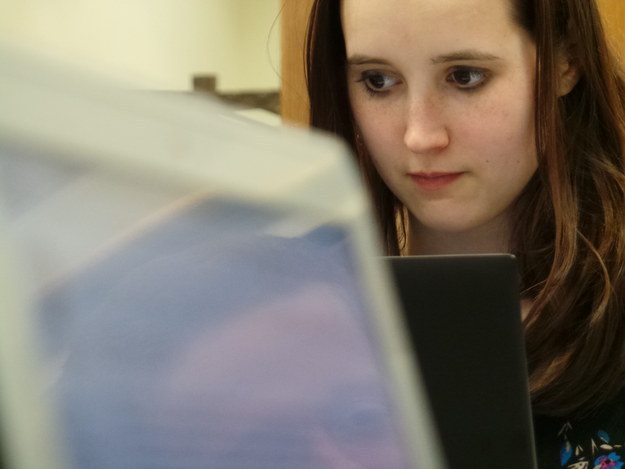
The Pink Ghetto of Social Media By Alana Hope Levinson


In news organizations, female leaders outnumber men in only one division. What does that mean for the future of women in the newsroom?


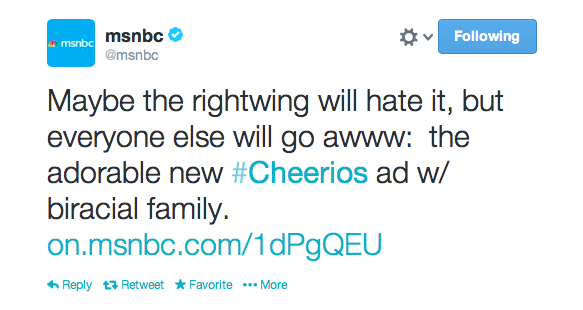
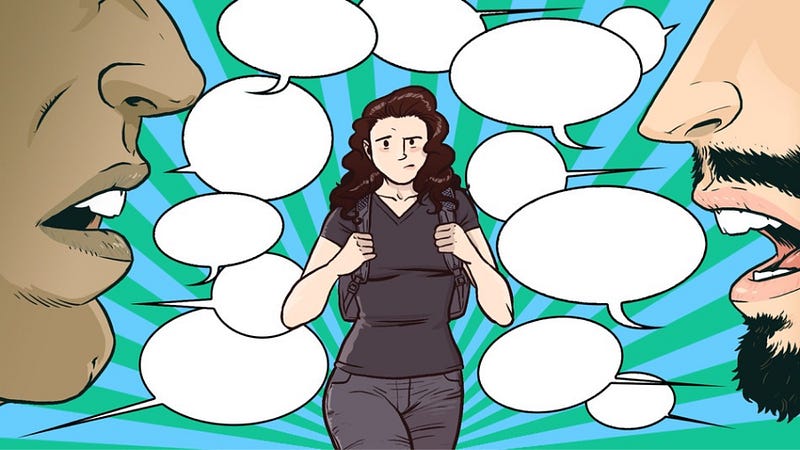
Myboss brought up the infamous Cheerios tweet on my first day. Almost a year had passed, but it was still a cautionary tale: At 8:06 pm on a casual Wednesday night, a seemingly innocuous tweet was sent out and quickly caused a firestorm. Within 24 hours, Republican National Committee Chairman Reince Priebus called for a boycott of the network and the president of MSNBC had to issue a formal apology. Unsurprisingly, they said they had “dismissed the person responsible.” 
 
Horror stories of Social Media Editors Gone Wild are a dime a dozen, and I was keenly aware of all of them over the eight months I spent as an engagement editor at a political news site. Every terrible tweet that went viral contributed something different to my near-constant state of anxiety. I’d frequently imagine myself as that MSNBC employee, getting a talking to for a social media post that showed too much Democratic leg, or being the subject of a blog post for attaching the wrong picture to a tweet. If constantly being on social media wasn’t enough make me lose sleep, there was also the prospect of potentially sparking an entire day’s or week’s conversation with as little as 140 characters. 
Even inside the politics of the newsroom, the pressure was high to perform. In a culture of fast-paced digital newsrooms where traffic is king, “social” can make or break a story. For sites relying on advertising as their bread and butter, social media editors help to save the newsroom from inevitable slumps in traffic. (For context, BuzzFeed, whose numbers are the envy of the online news industry, gets 75 percent of its traffic from social media). My work was critical to the success of my colleagues, reporters and editors with high page view goals— a reality that was both empowering and stressful. 
I thought it might help to reach out to other social media editors to see how they were handling the pressure. I noticed a pattern: a shocking number of them were also women. I already knew that, statistically, women use social networks more than men. But additional research revealed that social media is one of the few areas of the news industry where women outnumber men in leadership positions. A study by the Colorado Women’s College at the University of Denver found that women are only 23.3 percent of leaders in media at large, but in social media that number is 55 percent. The role of social media editor stands in opposition to that of writer or editor, which is still predominantly male. The Women’s Media Center annual report found that only 37.2 percent of newsroom staffs were made up of women, a figure that has gone nearly unchanged since 1999. 
 
How do these statistics play into the culture of the newsroom? As a possible explanation, Taylor Lorenz, a social media strategist and editor, says that in her experience “women are not encouraged as much to get into hard news.” Similarly, many other social media editors who work in the industry (some of whom wish to remain anonymous) describe the perception that social media is a “girly job.” One woman notes a vibe of “let’s give this easy job to a girl, she can handle it” around the office; that social media is seen as easier, “fluffy,” and not on par with other editorial roles. Even though it’s no secret that social media is critical to the current business models, one woman who works as a social media editor in news thinks “the position is always gonna be viewed as some dumb 20-year-old woman job.” 
Young women today are looking to break into a news industry that’s concurrently trying to diversify and beefing up social media jobs; it’s no wonder that a lot of them end up in these roles. But Amy King, chair of VIDA: Women in Literary Arts, says women have long been cast as supporting players in the office. “Think of the classic trope of the secretary who does the work that her boss is actually getting all the credit for,” she says. The volunteer organization has done groundbreaking work in tracking the abysmal byline gender gap by combing through select national magazines annually for the past six years. The studies have revealed a persistent woman problem: “Women tend to do the behind-the-scenes work that is unrecognized or unappreciated,” King adds, partly because they are willing to. 
It’s hard not to hear these stories and draw a parallel to public relations, an industry where 85 percent of workers are women. “People in the media like to say that PR is a pink ghetto,” because the often low-prestige jobs are almost exclusively populated by women, says a female editor, who left her job in social media at a major news organization. “But social media is the true pink ghetto.” She says her time in her previous role was characterized by unpaid overtime and a dearth of promotions and raises. 
In her 2014 Jacobin magazine piece “Pink Collar,” Jennifer Pan explores why the entire PR industry is so heavily judged by the media, despite being critical to the news-making process. She posits that the “spoken heart of their criticism is the failure on the part of the publicist to adequately conceal that she is performing emotional work for money”: 
The palpable distaste for PR practitioners that continues to swell — spearheaded by the very same members of the media with whom publicists theoretically enjoy a symbiotic relationship — requires, then, a deeper look at how gendered assumptions about work continue to shape our contemporary notions of creative labor under capitalism. 
Though a field like social media requires a more direct relationship with a consumer than public relations, they both, at their essence, involve promotion; and they’re both — if done well — invisible. The newsroom’s social media manager doesn’t tag her tweets with her name, and the “flack” gets no byline when he gives a journalist access to a source. Unlike the job of editor, which also goes uncredited, these positions don’t have a high level of prestige.No one brags over martinis that they wrote the Facebook prompt for a Gay Talese piece. 
“In my experience, women are the ones behind the scenes, just keeping the day-to-day process of the magazine running,” says Annie Shields, engagement editor at The Nation, where I was an intern in 2009. “[They’re] editing, polishing things up, and not getting credit.” Shields observes that although the editorial staff at the publication is largely female (the editor-in-chief is a woman), that doesn’t translate to content (only 29 percent of all Nationarticles are written by women). Men are in more visible roles, Shields says, ones that allow them to make media appearances and become well-known brands. For these guys, there is a straighter path to advancement, to becoming an opinion writer or thought leader in politics. 
This element of invisibility begs many troubling questions: When an article blows up on Facebook, who gets credit? The reporter who wrote the story or the engagement editor who came up with the prompt? And who takes responsibility for the “frequent occurrence of criticism of the company getting channeled through social media” that Pan recalls dealing with on a daily basis? During her two years working in book PR, which involved running the publisher’s social media channels, Pan says she would often field tweets from people who hated certain books or editorial choices: “I wasn’t really making the decisions [about what books to publish], but I was acting as the buffer between the outraged public and the company.” The experiences left her feeling frustrated, and she ultimately left. 
As I know personally, being this kind of middle man can be particularly exhausting, especially in political news. In order to be effective, I’d need to rewrite headlines to make them more conversational and “social media friendly.” But this, of course, would inspire some readers to email or comment that I was ruining the organization with “clickbait” — something that only added to my stress level. Writers, especially those that are pushing boundaries, get criticized too. But they have the advantage of resources like editors and fact-checkers (and the ownership of a byline). At a smaller news organization, social media editors are often writing tons of copy that never gets looked over. One weekend, Shields remembers making a typo in a Facebook prompt, and returning on Monday to hundreds of nasty comments about “the 20-year-old idiot intern” that must have made the mistake. “The criticism is over the top,” she says. “I don’t know if other people at the magazine know what that’s like.” 
The emotional toll social media jobs can take isn’t balanced by the security of an established career trajectory. “I was given increasing responsibility, but not increasing opportunity,” says the former female social media editor I spoke to. She, along with others I talked to, mention a kind of topping out that happens in the social media track, unlike other positions in the newsroom, like the path from cub reporter to writer to editor. That can be great for rising fast, but challenging longer-term. “There’s a limit to what you can do in a small organization in this role,” says Shields — one reason why she doesn’t see herself in it for the long haul. When she started to excel at her job, she was given new editorial duties like homepage editing, but was still expected to do all the old social media tasks. That’s not really a promotion or a job change — “it’s a recipe for burning out.” 
Not everyone who works in social media feels drained, or wants to move on to the glory of writing. For some, the creativity of hyping journalistic work, and the mastery of analytics that often comes with it, is a destination in and of itself. Depending on the outlet, the job can involve tasks as varied as audience growth, original content creation, and breaking news. Lorenz, after a stint editing and reporting, went back to social media because she found she preferred the challenges of strategy and development. Similarly, Rubina Madan Fillion, the digital engagement editor at the Intercept who spent years doing social media at the Wall Street Journal, has always been an early adopter of social networks and finds her job to be a natural fit. “There’s just a lot more interaction with readers and the community [in social media],” she says. “It’s more interesting.” 
Whether one finds social media personally compelling or not, its increasing importance to media companies is undeniable. Take “the dress,” Buzzfeed’s viral phenomenon that garnered 28 million views in 24 hours and brought issues surrounding social media and virality to the forefront. The post required the company to enlist additional tech support to manage the servers, and two editorial teams were tasked with finding new angles on the story. Many don’t know that “the dress” was not brought into mainstream consciousness by a reporter. It was Cates Holderness, a Buzzfeed community growth manager, who ran the organization’s Tumblr. When a reader messaged a question about “the dress,” Holderness thought it would make a good post. “It took me five minutes,” she told Digiday, who called her a “celebrity” in this interview. “I just pasted the Tumblr embed code and put up a poll.” (Holderness’ title is now Tumblr Editor at Buzzfeed BFF, a team that makes original content for social media sites and apps.) 
Lexi Mainland, managing editor at A Cup of Jo, and the editor who led The New York Times’ first (almost all female) social media team, points out that the emerging field “can be a little bit of a back door, because it is a role that respects a different skill set.” She says many of her former female colleagues who started there at The New York Times have gone on to more traditional reporting roles within the company. I’m living proof of her observation: When I realized I wasn’t cut out for the social media editor game, I was able to parlay my experience into a staff writer position here at Matter. [I’m told I wouldn’t have gotten it without my social media expertise.] 
Is there a downside to the increasing mainstream recognition of social media as a truly valuable editorial skill? Tiffani Lennon, the lead researcher and author of the University of Denver study on women’s leadership, says she thinks so. “If social media gets more credibility, you are going to see men pushing women out of leadership roles,” she says. “That’s what happens in every field once it becomes more institutional.” Historically, it’s been easier for women to dominate spaces that men don’t want to be part of. 
Wallpaper’s associate editor of Audience Daisy Alioto doesn’t see things quite so bleakly. At just 23 years old, she held the title of director of social media and analytics at the International Business Times. Alioto thinks that part of what’s great about working in social media is that a lot of the old guard media men don’t get it, and in their ignorance, give young women carte blanche. Plus, maybe these ladies will stick around: “In another ten years, social will be a given. We will all be working on some other crazy iteration that’ll be dominating news,” she says. “And the industry will be run by all the women that got their start in social media.”
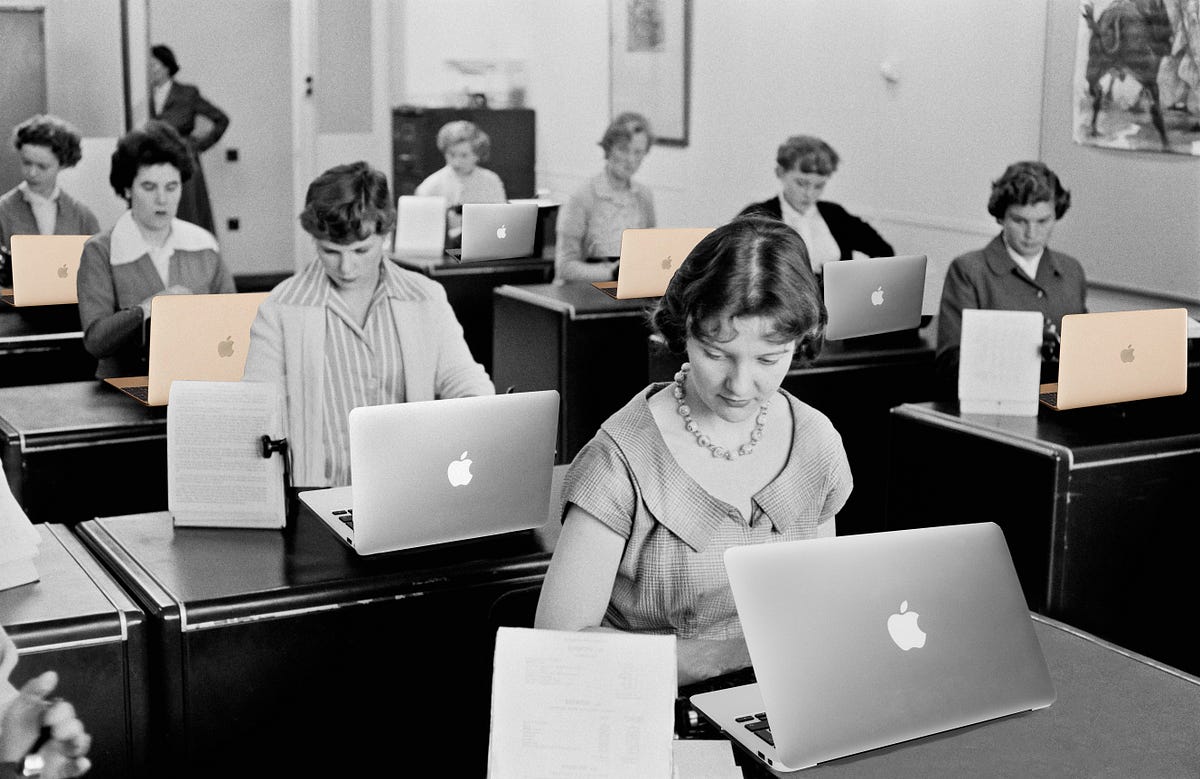
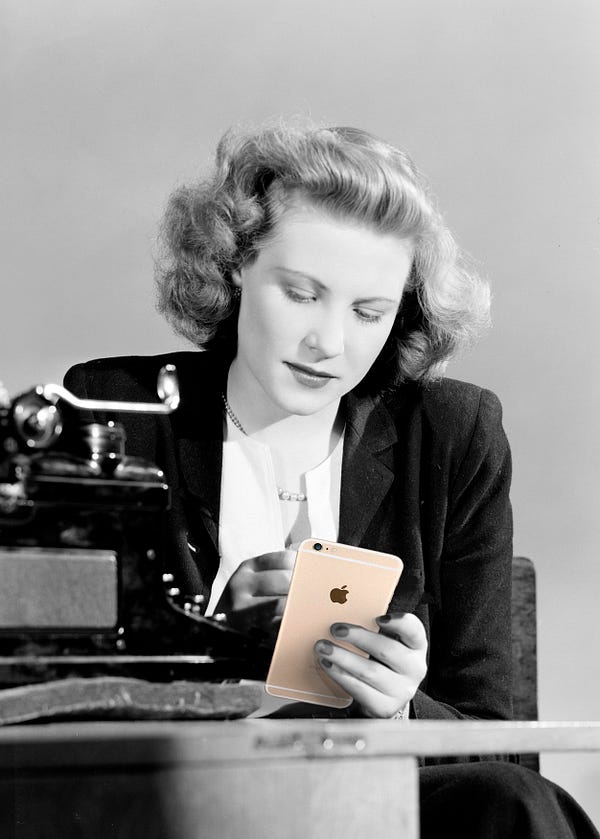
(Source photos, from top: Bert Hardy/Picture Post/Hulton Archive/Getty Images; SSPL/Getty Images)

Winning in the Boys Club - The First Female Coach in the NFL


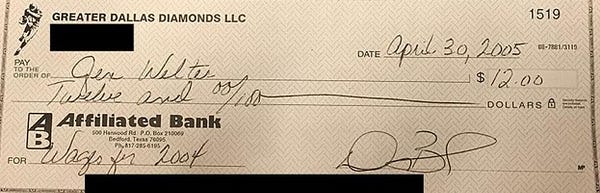
My gold medals are two of my greatest treasures. I won them as a member of team USA at the International Federation of American Football’s (IFAF) Women’s World Championship. Alongside the medals, I keep my first ever paycheck as a professional football player: $12 for an entire season. 
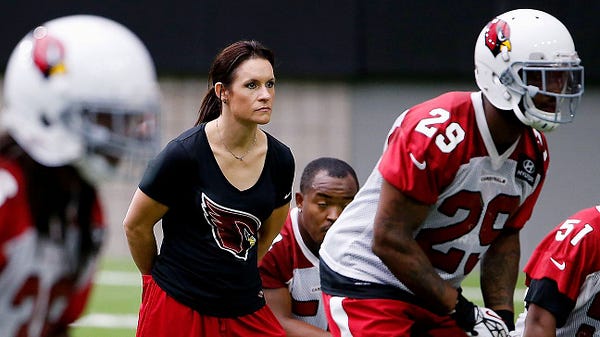
I had never dreamed any bigger than that. Being the first female coach in NFL history isn’t why I started playing football. Now, because of me, that’s a dream that other girls can grow up with. This is the inside story of how I broke down the barriers of tradition, history, and what was comfortable to play in a men’s professional league, then to coach in a men’s professional league, and finally to get hired as a coach by the Arizona Cardinals in 2015. 
The first check Welter received for professional football: $12 for an entire season
Too often, people assume that “breaking the glass ceiling” means overcoming the resistance of men. I have experienced the opposite. My male mentors are the ones that made my dreams a possibility. 
It all started in January 2014 when the Texas Revolution, a men’s Indoor Football League team, invited me to training camp. They weren’t just inviting me to watch — they were inviting me to train as a player and to take the field in their preseason games. I was considered one of the top female tackle-football players in the world at the time. Revolution GM and former Oakland Raiders wide receiver Tim Brown said it was an opportunity to showcase my talent as a female athlete. They considered me a long shot to actually make the team roster, but I still took the job. 
It was February 15, 2014 when I entered my first game. It was still preseason and we beat the North Texas Crunch, 64–30. I finished with three rushes for a loss of a yard, but it was still one of the best days of my life. I proved that I could get back up when I got hit. I stood back up and asked the Crunch player who tackled me, “Is that all you got?” 
Four days later, I was named to the 2014 regular season roster. I made the team and became the first woman to play running back in a men’s professional league. The stakes were too high at practice for me to be treated any more gently than the male athletes. Players were competing for their ability to stay on the team, and for their very livelihood, so they didn’t have the luxury to just step aside for the girl when I rushed through a gap. I took my hits play after play, lined back up and did it again, that’s football. 
Taking the field as a player was only the first step in my journey against the odds. The following year, on February 2015, I was introduced as the Revolution’s new linebackers and special teams coach. At first, I turned down the offer. “Jen, very few men are ever going to give you this opportunity,” the Revolution Head Coach Wendell Davis told me. “You’re taking this job.” 
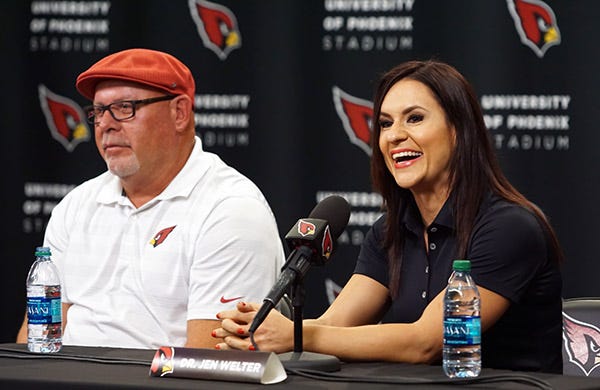
It wasn’t easy. At first, some of the guys on the Revolution did not think a woman could coach football. Though they had respected me as a player, many thought a woman coaching was a complete joke. But once I actually began coaching them, these same players changed their opinions entirely. My head coach at the time was former NFL player Devin Wyman and I’ll use his explanation of why those players started to take me seriously. I’m using his account because these are also the words he used when he first convinced Arizona Cardinals head coach Bruce Arians to give me a chance in the NFL. 
:: Follow every source on your favorite NFL teams in a personalized newsfeed. Download for free: chatsports.com/app :: 
 
“She thinks differently, but it’s really good to have that on your staff,” Arians has said. Photo credit: azcardinal.com 
Coach Wyman honored me by comparing me to one of the greatest coaches in history: Bill Parcells. He played for Parcells in 1996, and had seen firsthand what a legendary, championship coach was — and saw the same thing in me. Wyman also told Arians that I broke down film exactly the way Parcells did, creating smaller, more digestible chunks to help players understand. Once I displayed my deep knowledge of game tape and my vision on the field (as Wyman explained), respect as a coach followed instantly. 
Let me back up. Why was Coach Wyman calling up Bruce Arians on my behalf in the first place? It was because of a comment Coach Arians had made at the NFL Owners meeting that March. Arians said that he believed a woman could coach in the NFL if she could make players better — and that struck a chord with my head coach. So he called him up, and related what I just told you: how I won respect with my coaching prowess. At the end of the call, Arians asked him if I might be willing to join the Cardinals staff as a training camp intern. 
When Wyman told me about the call, I was in shock. It took a full day for me to even believe he was serious. I kept asking him, “Really? Coach Bruce Arians? I know you know a lot of people, but really?!” I was sure it would fall through. I even made Coach Wyman promise not to tell anyone on the team that I was being considered. I thought that if word got out, a storm of controversy would squash my dream. 
In late May, I was invited to Cardinals OTAs in person to meet the coaching staff and team. “I saw the passion and energy of the person I’m looking for,” Arians said of my visit. But he couldn’t offer me on the job quite yet. He pulled me aside. “This is the right staff, this is the right team, and you are definitely the right woman,” he told me. “I don’t know yet if I can make this happen. I have to get all the right yeses, but I want you to know that it’s in my heart to try.” 
After OTAs in May, I waited and waited. But I hadn’t heard had any contact with Cardinals, so I was ready to give up. But when the Revolution made it to the championship game, I used it as my reason to call Arians and let him know. “That’s great, Coach,” Arians replied. “You got a lot of work to do. Go ahead and win that thing. By the way, this internship is going to happen. I’ll give you details next week.” With those words, the chance of a lifetime was mine for the taking. With those words, Bruce Arians became the man who opened the door for women to coach in the NFL. 
 
Photo credit: BBC 
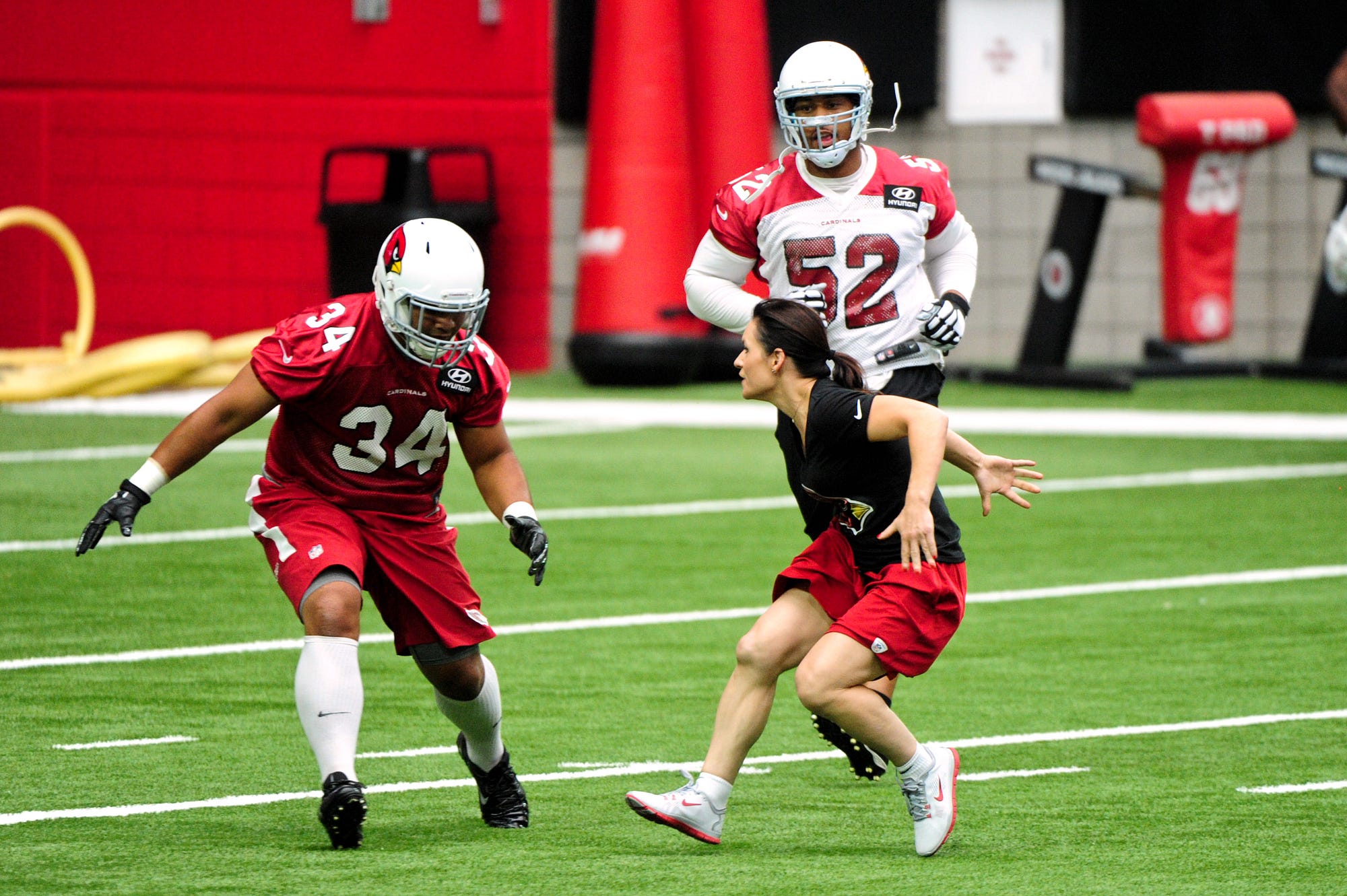
I joined the staff as one of seven interns brought on board that year, coaching inside linebackers under two-time Super Bowl champion Larry Foote. Larry is the ultimate player’s coach because he transitioned from being a team captain and leader on defense to being a coach in the space of just one season. He was incredibly smart and translated the plays so easily. Above all, he was practical, telling players exactly what they needed to do to excel — and they loved that. In that way, our approaches were extremely similar. We didn’t pull any punches. 
Our communication styles were a bit different, but we complemented each other. Larry is from Detroit, so he wouldn’t know how to sugarcoat something if he tried. I had a bit of a softer touch, so sometimes we played the good cop-bad cop roles. If I were still playing, it would be my dream to learn from someone like him. 
The pressure of training camp is unreal. Players are thrust together to compete for a roster spot, while also working to unite as a team. To fight off the fatigue and keep players awake, we had to keep the meeting rooms extremely cold — shocking their systems from 115-degree Arizona heat. They have a demanding schedule each day and their professional future is on the line. Family is often far away, and even if they are in town, time is severely limited. Players draw a lot from each other, but at the same time, there is a fear of getting too close. Out of the 90 men at training camp, at least 30 will be gone once the season starts. 
It truly felt like I had stepped into the reality show Survivor since every single minute was caught on tape, only we also had a playbook as thick as the Bible. The volume of the tape alone was daunting. My greatest surprise was just how much film we watch in the NFL. As a coach, you watch the film from every practice, and then review that film with your players in individual groups and then again in defensive meetings as a whole. 
The critics promised me that men in the NFL would never take coaching from a woman. Cardinals linebacker Kevin Minter, who I became extremely close with, told me he was scared the carefree vibe of the linebacker group might change with a woman present. But once I showed them that I was up for the jokes, for the swear words, and for the uncensored talk, we became family. I also treated them as people, not just performers. At work, we get too caught up in the number of tackles someone’s made or how many deals they’ve closed. Building real friendship and valuing the person behind those stats enhances performance. It also made it easy for my players to be themselves around me. 
What was it like to be a woman in a men’s locker room? That’s a question I get all the time, but it was a non-issue. Coaches rarely hangout in the locker room before or after games when players are changing. Of course, I went in at halftime or for scheduled meetings. But other than that, the team gathered in meeting rooms throughout the facility or huddled up on the field. So that scenario never really came up. 
Locker room aside, there were plenty of funny, awkward moments. I remember one of my players responded to an instruction with “yes, ma’am” instead of “yes, coach.” He realized instantly and apologized so profusely that I had to put him at ease. “I will never be mad at you for good home training,” I told him. “You can call me ma’am, you can call me doc, you can call me coach … Just don’t call me a ‘B’.” It was one of the more infamous moments during all of camp. 


Treat me like one of the guys, but it’s okay that I’m still a woman — that was the atmosphere I tried to foster. For example, I was walking beside my fellow coaching intern Rashied Davis, former Chicago Bear. I had tons of equipment with me. He turned to me and said, “I don’t care how tough you are, I’m still carrying your bag.” I handed it over with gratitude and we both laughed. 
The players were truly excited for me, and to be a part of this momentous step for women. “Coach, do you realize this is history?” “Coach, you are so tough, I can’t believe you played with guys!” “Coach, we watched your highlight reel, you were a beast off the edge.” It still makes me smile. 
I told them that whether their issues were about football or about life, if I could help them, I always would. I guess this is why we were all football on the field, and yet we would talk about life in the hallways. Some of my favorite moments started with “Coach, do you have a moment?” 
I knew I had gotten past any preconceptions and become a real insider when players wanted to introduce me to their families. I never realized how many of them already had a female coach in their lives — the moms, grandmothers, or aunts who raised them. Entire families devote their lives for an athlete to ascend to this level in their career. And for many of my players, a huge female presence in their lives had guided their path. One told me that he had never seen his mom cry until she met me, and I told her what an incredible man she created. “We’re proud of what you’re doing with our boys,” she said tearfully. 
I loved meeting the fathers, too. One shook my hand and said, “I didn’t know what to think with a woman as I coach.” “I didn’t either, Dad.” I replied and we both laughed. He went on, though. “I didn’t know what to think, but my son just loves you. So I guess what I’m trying to say is … thank you. 
We teach athletes never to admit fear and never to admit weakness, but that doesn’t mean they aren’t human. I knew going in that I was working with some of the best athletes in the world, but what impressed me most was how great they were as people. My time in training camp and OTA’s taught me that many people underestimate the caliber of men that are in the National Football League. 
In our first preseason game, I wrote notes to my players and left them in their lockers. I wrote memories from camp, words of encouragement, reflections on their best moments, and inside jokes. I never realized how powerful the response would be. 
As Cardinals linebacker Kevin Minter told the Associated Press, “She’s a stickler about fundamentals, but she knows a lot about making you better as a person, too — with the notes she left on your locker, the words of encouragement from what she sees on film. She was a real good person to feed off of.” 
I think that’s what coaching truly is: the ability to lift someone up and to change his or her life for the better. So many of my mentors have done the same for me, and that’s the only reason I’ve been able to blaze my trail and open these doors for other women. 
 
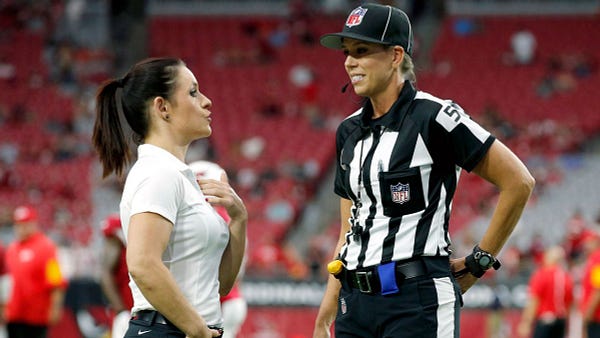
Welter with Sarah Thomas, the first female official in the NFL in 2015. Photo credit: Kickoff Coverage 
My coaching internship with the Cardinals ended on August 31, 2015. Even though I’m no longer with the team, I gained so much from my experience and was able to open the door for other women in the NFL. This past January, Buffalo Bills Head Coach Rex Ryan was considering hiring Kathryn Smith as a full-time coach. He placed a call to Bruce Arians to consult him on how it worked having a woman on staff. Not too long after, he hired Smith as their quality control and special teams coach — the first full-time position offered to a woman. I’m proud to be one chapter in the story of progress. 
These days, I’m launching NFL Play 60 in Canada. I get to coach children every day and show them that the dreams you once considered impossible really can come true.
by
 
Dr. J First Female Coach in the NFL, AZ CFollowingardinals. Boston College, MS Sport Psychology & PhD Capella. 14 years Women's Football. yes, anything is possible.

Apr 26, 2016

Men have taken away a woman’s right to simply say no to their advances. by Charlene Haparimwi

A woman has to be polite in her rejection, lest she gets harmed or even killed for saying no.
A woman has to say she has a boyfriend for a man to back off. Whether or not she’s lying doesn’t matter, what matters is the presence of a man, imaginary or not, is more valid than the woman presently standing in front of them.
A woman has to change train cars when she’s on a subway if she feels threatened, if she’s being followed, if a man shows himself to her inappropriately, or touches her inappropriately.
A woman has to cross the street, go in a different direction, hide in stores or completely change her normal route if she is being followed, watched or assaulted.
A woman has to carry pepper spray, mace, carry keys in her hand, not walk alone at night, not wear headphones, not walk in certain areas or on certain streets just to keep safe. And that is often still not enough.
A woman has to watch her drinks, her friend’s drinks, take friends to the bathroom with her, not take public transportation back alone or anything else for what is supposed to be a “fun night.”
A woman cannot just say fuck off to a man harassing her lest she get hurt in the process.
A woman only thinking of a man as a friend is apparently worse than a man only thinking of a woman as a sexual conquer or girlfriend. He is girlfriendzoning her.
A woman needs a reason every time to say no. She’s not interested in this man, she’s not interested in men at all, she doesn’t want to get hit on at the moment is not enough. Sometimes even those reasons will get her hurt or killed.
I’m tired of being polite to men who catcall and say vulgar things to me because I’m afraid of what they’ll do otherwise. I’m tired of having to talk about my boyfriend in order to have men leave me alone. I’m tired of having to purposely put in headphones and have resting bitch face walking down the street to scare off any unwanted harassment. I’m tired of not having ownership of my own body. I’m tired of being objectified. I’m tired of not being able to wear certain things or go certain places because of the men around me.

I’m tired of women getting killed for saying no.

Go to the profile of Charlene HaparimwiCharlene Haparimwi is a 20 year old DePaul University student studying Public Relations and Advertising, with two minors in Creative Writing and Peace, Justice and Conflict Studies. She has been published in Slant News, Hooligan Mag, Literary Juice, Femsplain, The Coffeelicious, and more. She is passionate about intersectional feminism, black rights, LGBT rights, and restorative justice. She is originally from Harare, Zimbabwe, lived in St. Louis for 13 years and currently resides in Chicago. Her Twitter and Instagram are @queencharlene95.
(Cover photo courtesy of: Mashable’s Bob Al-Green)

Charlene Haparimwi

Writer for @huffingtonpost & @hellogiggles. LGBT rights, women’s rights, black rights and peace movements. Twitter and Instagram: queencharlene95

Mar 15, 2016

Celebrate Women's History Month with 12 awesome things invented by women

March is the month in which we celebrate kickass women like Rosie the Riveter, the notorious RBG, and Ripley from the "Alien" franchise. It's the month in which we all watch "A League of Their Own" at least twice as many times as we watch it every other month (which, for me, is six times).
GIF from "A League of Their Own."
Of course, it wouldn't exactly be controversial to claim that many of women's achievements often go overlooked by their coworkers, clients, and even the media ... sometimes until years after the fact.
So with that in mind, I decided to ring in Women's History Month by taking a look back at some of the incredible, world-changing inventions that we owe to the fairer sex. Here are 12 of them.

1. The bulletproof Kevlar vest


Photo via iStock.
Yes, this otherworldly material that has saved the lives of countless law enforcement agents owes its invention to chemist Stephanie Kwolek, who developed it in 1964 while attempting to create a lighter, more durable material to use for car tires. Considered to be five times stronger than steel, Kevlar was patented in 1966 and is currently used in over 200 common applications.

2. The paper bag


GIF from "The Big Bang Theory."
It may be Papa who has a brand new bag according to James Brown, but in reality, Papa was only able to acquire said bag thanks to the efforts of Margaret Knight, who invented a machine capable of cutting, folding, and gluing the flat-bottomed paper bag in 1868 and later patented it in 1871. Those of us who bring lunches to work and/or suffer occasional panic attacks have never been the same.

3. The fire escape


Photo via iStock.
In an effort to combat the ever-growing number of fire-related deaths being caused by ever-growing apartment complexes, New York City passed a law in 1861 requiring all multi-floor buildings to be fitted with a pair of exterior stairs. Landlords resisted at first due to how much such a set-up cost, and it wasn't until 1887, when Anna Connelly patented the iron-railed fire bridge allowing residents trapped on higher floors to scale from one roof to another, that the future of building safety as we know it was forever changed.

4. The life raft


Photo by Roberto Schmidt/AFP/Getty Images.
Maria Beasley was something of engineering dynamo in her time, securing patents for everything from foot warmers to anti-derailment devices for trains between 1878 and 1898. While it was her barrel-making machine that earned her an unprecedented payday of over $20,000 a year, Bealey's life raft, which she patented in 1882, was perhaps her most significant contribution to human history. I mean, just think of all the brilliant, lifeboat-based comedy sketches we would have missed out on without it.

5. Signal flares for that life raft


Photo by Dmitry Kostyukov/AFP/Getty Images.
While not technically the pyro behind the flare's invention, it was the tireless efforts of Martha Coston that helped get the signal flare pushed into production. Working off a design found among her late husband's papers, Coston spent close to 10 years developing the system of flare signaling now recognized by the U.S. Navy, which became one of her first customers on the recommendation of former Capt. C.S. McCauley.

6. Computers, basically


GIF from "Napoleon Dynamite."
Not only were women programming computers long before "computer programmer" was even considered a job title, but it turns out that they've had a significant hand in damn-near every aspect of the computer since its birth.
Considered by many to be the world's first programmer, Ada Lovelace worked alongside "the father of the computer," Charles Babbage, to create the first computer algorithm in the early 1840s. Likewise, Navy admiral/computer scientist Dr. Grace Murray Hopper is credited with inventing one of the first high-level computer software programs (known later as COBOL) in 1959.

7. The medical syringe


Photo via iStock.
That thing that filled you with white-knuckled fear every time you had a doctor checkup as a kid? Thank Letitia Geer, who patented a modern one-handed syringe in 1899.

8. The Apgar score


Photo via iStock.
Better known as the most common method used to assess the health of a newborn baby, the Apgar score owes its name to Virginia Apgar, an obstetrical anesthesiologist who developed the test in 1952 while working at the Sloane Hospital for Women.

9. The solar-heated home

Photo via iStock.
A trailblazing biophysicist and inventor, Mária Telkes was one of the forerunners of the solar energy movement in 1940s — well, it was less of a "movement" and more of a "thing no one had even heard about." She created both the first thermoelectric (meaning "heat to electricity") power generator and refrigerator in 1947 and 1953, respectively, and in between designed the first 100% solar heating system for the Dover Sun House in Dover, Massachusetts, alongside architect Eleanor Raymond.

10. Stem cells

Photo by Spencer Platt/Getty Images.
Obviously, no person could ever be so bold as to make the claim of having invented stem cells, but Ann Tsukamoto was one of two people to receive a patent for a process to isolate human stem cells in 1991, which is about as close as you could get.

11. Chocolate chip cookies

GIF via "Sesame Street."
With all due respect to computers and solar power, those inventions are significantly lower on the list of Life's Greatest Comforts than chocolate chip cookies are — and in fact, so is everything else. Ruth Graves Wakefield knew this, which is why she invented the first chocolate chip cookie in the late 1930s.
How this woman's face is not carved into Mount Rushmore remains one of the world's greatest injustices. I mean, I can't even think of an invention greater than chocolate chip cookies...

12. Beer (yes, beer)

GIF via "The World's End"
While it will never be known who was the actual inventor of beer, historian and founder of the School of Booze Jane Peyton is one of many who argues that is was women. While conducting extensive researching into the origins of beer for her book, "School of Booze," Peyton revealed to The Telegraph in 2010 that "nearly 7,000 years ago in Mesopotamia and Sumeria, so important were [women's] skills that they were the only ones allowed to brew the drink or run any taverns."
It's a theory that seems to align with how the intoxicating beverage has been perceived over the centuries. Many ancient societies typically depicted beer as being a gift from a goddess — in Sumerian culture, it was Ninkasi; for the Egyptians, it was Tenenet and Nephthys; and in Zulu mythology, it was Nokhubulwane. The list goes on.

It is said that "behind every great man is a great woman," but when looking over this list of inventions, it feels like it might be time to update that maxim, no?

Let's give it a couple of tries:
"Behind every great man ... is a shadow of where a woman maybe used to stand until she decided to do her own thing."
"Behind every great man ... is an even greater woman holding a beer and a cookie THAT SHE INVENTED."
I kind of like that last one.

Mar 13, 2016

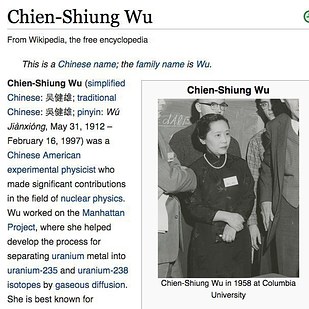
This Student Adds A Woman In Science To Wikipedia Every Time She’s Harassed Online


Emily Temple-Wood, a microbiology student at Loyola University Chicago, has come up with a unique way to combat the online harassment she faces as an advocate for women in science.
Keilana / Creative Commons / Via en.wikipedia.org

For every harassing email she gets, Temple-Wood has pledged to write one Wikipedia article on a woman in science.


She’s been a Wikipedia editor since she was 12 years old. Then, her motivation was to share information she found with the world.

But the online harassment she’s faced has given her an additional driving force. “My motivation is to channel the frustration I feel from being harassed into something productive,” she told BuzzFeed News.


Temple-Wood began the WikiProject Women Scientists in 2012 after discovering that female scientists weren’t adequately represented on the site.

Fuzheado / Creative Commons / Via commons.wikimedia.org

She came across a Wikipedia editathon that had happened for Ada Lovelace Day in 2012 and exposed the gender bias against women across Wikipedia’s science pages.

“I got pissed and wrote an article that night,” Temple-Wood said. “I literally sat in the hallway in the dorm until 2am writing the first women in science [Wikipedia] article.”
Former Wikimedia Foundation staff member Siko Bourtese told the Wikimedia blog about the impact of Temple-Wood’s work:

She’s created hundreds of articles about women scientists, including articles that address multiple gaps in Wikipedia—it’s really important that she’s not just writing about white women scientists, she’s also working to address underrepresentation of women of color in Wikipedia and looking at other points of intersectionality as well. And perhaps most importantly, because we’re much stronger collectively than alone, Emily has taught and inspired others to do the same … When I was a kid, I could count the number of women scientists I was aware of on one hand. But I know our daughters are going to have access to so much more free knowledge about scientists who look like them, thanks to Emily’s efforts, and that’s really powerful.

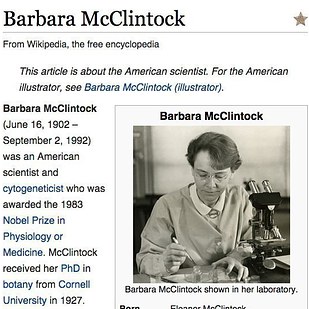
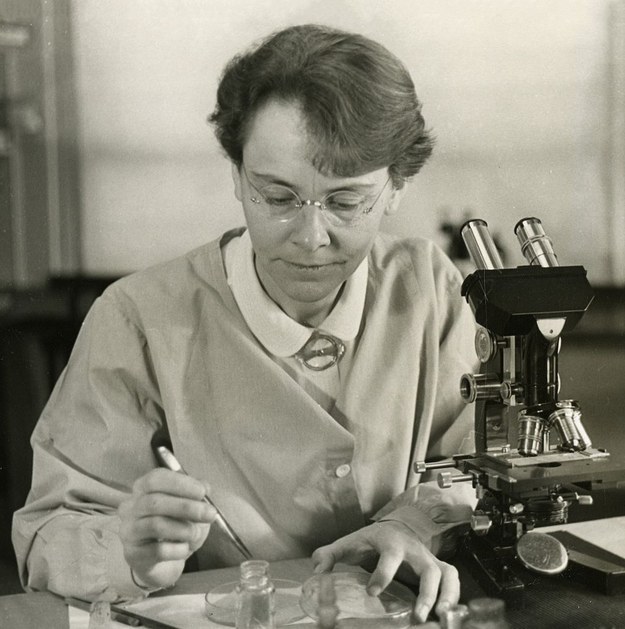
She told BuzzFeed News her personal favourite page is Barbara McClintock’s, describing her as “one of the greatest scientists of all time and an excellent alternative to Marie Curie”.


McClintock was an American cytogeneticist who was awarded the 1983 Nobel Prize in Physiology or Medicine.

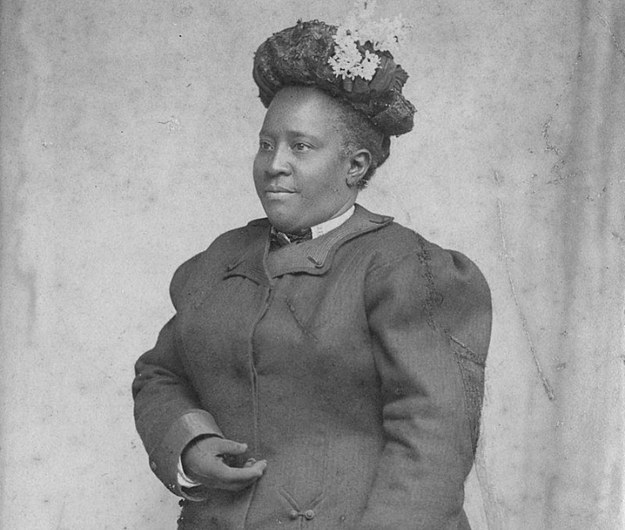
Other pages she’s created include Caroline Still Anderson, one of the first African-American women to become a doctor in the United States.

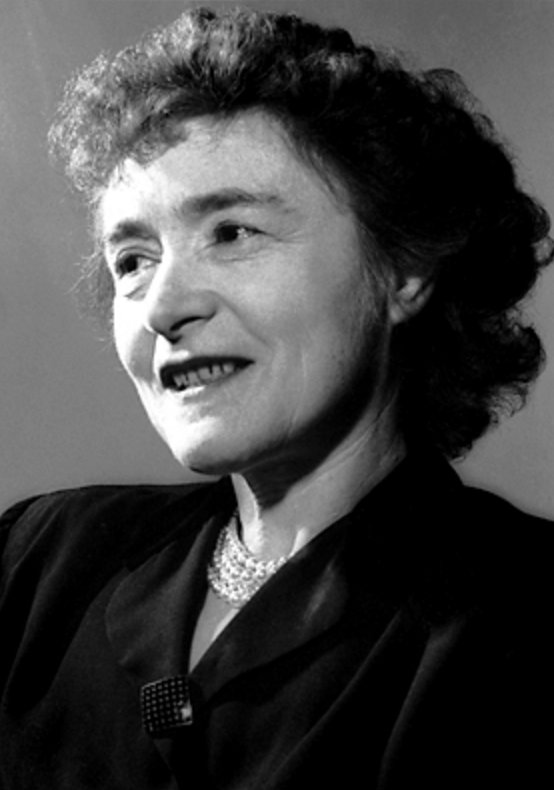
And Gerty Cori, who she calls “the best biochemist the world has ever seen” and was the first American woman to win a Nobel prize in science.

Find out more about WikiProject Women Scientists and a list of the biographies created by the project here.

by

Mar 9, 2016

Questions to Ask Yourself on International Women’s Day

  1. Am I listening more than I am speaking?
  2. Am I hearing the voices of women who are more marginalized than me, or those who have lived a different experience than I have, or am I only listening to other (educated, upper class, white, cis, straight) women?
  3. Am I internalizing their words and their experiences, and reflecting on how I have benefitted from the systematic oppression that others experience?
  4. When I am fighting for women, which women am I fighting for? Am I fighting for all women? Transgender women? Non-binary folks who are still subjected to patriarchal ideals of gender?
  5. When I am fighting for women, am I also fighting for a man’s right to exist outside traditional ideas of gender? For his right to cry in public, to raise children, to be tender, to tidy a house competently, to do emotional labor? For his right to paternal leave in every workplace in America?
  6. What privileges do I have? Am I educated? Am I white? If I needed money right now, would a family member help me? Would a bank help me?
  7. Do I have passing privileges? Do I pass as straight enough to not fear my safety? Can I pass in upper-class social situations enough to not be mocked? Could I pass as white enough for cops to value my life?
  8. Am I recognizing my privilege as a tool for social justice? Am I using a voice that society sees as smarter, safer, or more relatable to amplify the voices of others and call out injustice?
  9. Am I fighting for women’s autonomy, for their right to make the best choice for themselves? Am I fighting for the rights of sex workers? Am I fighting for women who choose to wear a hijab?
  10. Am I fighting for #BlackLivesMatter? Do I recognize the importance of BLM, and reject the tone policing rhetoric that states that we should only listen when it is convenient, and when the voices involved are polite and calm?
  11. Am I fighting for abortion, on demand, and without apology?
  12. Am I actively reframing my position within the abortion argument to include language that is inclusive to transgender men and non-binary people? Am I forcing this discussion beyond the outdated and easily changed “women’s right to choose” rhetoric?
  13. Am I teaching our sons and daughters about consent? 
    Am I encouraging my male friends to re-think consent and listen to women when they talk about sexual assault, and the pervasive ways that rape culture affects our every day life?
  14. Do I validate the experiences of others even if they are different from my own?
  15. Am I putting my money where my mouth is? Am I buying items emblazoned with the word “feminist” from companies who steal designs from women, furthering the economic divide?
  16. Am I curating festivals to include women, and listening to music performed by women, and valuing the role of female musicians including, and beyond, the roll of a front person? Am I encouraging women to own venues and book shows and make gig posters?
  17. Am I hiring women? Am I paying women the same as men in comparable positions, and eliminating the barriers that prevent women for demanding raises and promotions? Am I promoting people based on talent, and not on regressive ideals about what a “good” manager or leader should be? Am I deconstructing ideals about professionalism and leadership, recognizing how they are rooted in traditional masculinity and prevent hard working, deserving women and men from being promoted?
  18. Am I completely eliminating criticism of bodies of other women? Am I actively undoing the internalized notion that a fat body is an undesirable body, a body that doesn’t deserve respect? Am I ensuring that my ideas of a body-positive world include women beyond a size 24, include those who are disabled, include non-white bodies, include those with body hair, and include body shapes beyond the hour-glass ideal?
  19. Am I aware of how the multi-billion dollar beauty industry creates insecurities in order to profit off of women? Am I rejecting the notion that male attraction is the top form of flattery as I choose to apply too much blush?
  20. Am I recognizing how plus-size clothing made over-seas preys on disadvantaged women to manufacture garments, and that paying money into that industry perpetuates that oppression?
  21. Am I seeking information and knowledge of black women who were written out of history books? Am I sharing that knowledge and advocating for changes in curriculum? Am I telling my children the truth when the schools wont?
  22. Am I voting for politicians who fight for equal pay and equal representation? Who understand the ways the prison industrial complex, welfare and public assistance, minimum wage, access to affordable healthcare, access to public transportation, and maternal leave affect women, especially non-white women, often in a disproportionate way?
  23. Am I creating safe spaces for women to foster friendships and community? Am I celebrating the achievements of other women?
  24. Am I accepting of the grey areas and areas of perpetuality that the answers to these questions exist? Am I accepting of the lack of perfect right answers, and welcoming of an internal or external discussion that can propel us to achieve more?
  25. Am I holding myself accountable to be better for all women, for all people? Am I fighting for the justice that future generations deserve? Am I advocating for a future that ensures the safety and well-being of all, no matter their gender identity?
  26. Once again, am I listening more than I am speaking? Am I aware of when my voice is helpful or needed, and when it is silencing someone else?
  27. How am I doing these things right now?

Mar 8, 2016

The Legendary Queen of Sheba and Her Iconic Visit with King Solomon


Solomon and the Queen of Sheba, painting by Giovanni Demin (1789-1859)

Originating in the Bible, the Queen of Sheba is a figure featured in the stories of many cultures and religious groups. Although her exact homeland has not been agreed upon, she is known as a queen from the Red Sea region, and plays a role in legendary tales that have been retold numerous times through literature, film, television, and music. Most tales revolve around her meeting with the biblical King of Israel, Solomon, with variations on what occurred during that visit. In some tales she is tricked into sleeping with him, ultimately leading her to bear him a son. In other versions, she is tricked into revealing her hairy legs, which repulses Solomon. In other variations, she simply delivers spices to Solomon, uses riddles to test his wisdom, and then returns home.

The Queen of Sheba is well-known as a Biblical figure. Relatively little is written within the Bible about her origins. Her story focuses on her travels to Jerusalem. She is said to have arrived in Jerusalem with a camel bearing spices to give to Solomon. She arrived "with a very great retinue, with camels bearing spices, and very much gold, and precious stones" (I Kings 10:2). "Never again came such an abundance of spices" (10:10; II Chron. 9:1–9). She presented several riddles to Solomon, which he answered to her satisfaction. In the tale, Solomon taught Sheba about his god, Yahweh, and then they exchanged gifts. After that, the Queen returned to her home land. Some Ethiopians believe that this is how Christianity was originally brought to their area.

There is agreement among scholars that Sheba refers to the South Arabian kingdom of Saba, which is located in present-day Yemen. The Queen’s visit to Jerusalem may have been a trade visit, as it was common to trade spices by camel around the 9th and 10th centuries B.C.

In Jewish legend, the Queen of Sheba was the Queen of Egypt and Ethiopia. She was credited with bringing the first balsam tree to Israel. In one Jewish account, King Solomon was informed that Sheba was the only Kingdom that was not subject to him. This did not make him happy. He sent a letter to Sheba commanding that the Queen of Sheba come to him as one of his subjects. The Queen of Sheba agreed to visit Jerusalem, and sent many ships filled with gifts prior to her arrival. She also agreed to arrive within three years, although the trip typically took seven years. When she did arrive, she mistook Solomon’s glass floor for water, and lifted her dress, revealing her hairy legs, for which King Solomon reprimanded her. She asked him three questions to test his wisdom, and returned home. 


The Queen of Sheba meeting with Solomon (note: this is unlikely to be an accurate depiction of how she really looked, from a racial perspective). Public Domain

Muslims do not refer to the Queen of Sheba, but to the “queen of the south.” The story in the Quran is essentially the same as that followed by Christians and Jews, with some supplementations derived from the Jewish Midrash. The queen is named Bilkis. The tale says the demons of Solomon’s court were worried that Solomon might marry Bilkis. To prevent this, they started a rumor that Bilkis had hairy legs, leading Solomon to construct the glass floor for the sole purpose of tricking her into revealing her legs. However, in this version the Queen and Solomon did not have relations, as they did in the other versions. 

The Queen of Sheba, also known as Bilkis. Public Domain

In the Ethiopian Kebra Nagast (Glory of the Kings), the Queen is referred to as Makeda. While this version of her story included the trip to visit Solomon, and the son who they conceived together and she raised, it omitted the stories of the glass floor and her hairy legs. In this version of the legend, the Queen warned Solomon that he was not to touch her, because she was an unmarried woman. He agreed, so long as she agreed not to take anything of his while she stayed as his guest. She agreed. However, Solomon tricked her by ordering an extremely spicy meal to be served for dinner, and that a glass of water be placed near her bed as she slept. In the middle of the night she took the glass of water, and Solomon declared that she had broken her end of the agreement, and as such, he could break his end as well. They slept together, and after returning to her homeland, the Queen discovered she was pregnant. She gave birth to Solomon’s son, and named him Menelik. As he aged, Menelik expressed that he wished to see his father. He traveled to Israel to visit King Solomon, supposedly returning with the Ark of the Covenant, and the sacred container that contained the Ten Commandments. 


A figure rides upon horseback, thought to be the Queen of Sheba. Originally a wall painting in a church in Lalibela, Ethiopia, now in National Museum. Wikimedia, CC

With its many variations, the tales of the Queen of Sheba are frequently told to this day. In Ethiopia, it is believed that the son of the Queen of Sheba and Solomon, is from whom Ethiopian dynasty claims descent to this day. The tales are often used in modern-day literature, theater, film, and music. In these stories, she takes on many appearances, representing the different ways she is viewed by different societies. While many legends have the same basis, and there are many components of the Queen of Sheba’s story that are agreed-upon, there has been no physical evidence of her identity uncovered to date. Both Ethiopia and Yemen claim to be the homeland of the Queen of Sheba, but there is no archaeological evidence to support either stance. For now, she remains a legendary figure in the Bible, Quran, Jewish Aggadah, and Kebra Nagast. Regardless of the different versions of the stories that are told, the Queen of Sheba remains a figure that captivates people of different backgrounds, and from all different religions. As long as her story remains intriguing it will be retold, with newly arising variations on the legendary themes, and will serve as both inspiration and entertainment for many years to come. 

Actress Betty Blythe as the queen in The Queen of Sheba (1921) Public Domain

Featured image: Solomon and the Queen of Sheba, painting by Giovanni Demin (1789-1859). Public Domain

Sources


By M R Reese

Labels

Giveaway ( 3088 ) Excerpt ( 1336 ) blog tour ( 942 ) Book Blitz ( 864 ) Cover Reveal ( 543 ) Guest post ( 518 ) Teaser ( 347 ) Book blast ( 283 ) Interview ( 260 ) Culture ( 245 ) Books ( 242 ) Trailer ( 228 ) freebie ( 227 ) Art ( 226 ) Funny ( 225 ) History ( 219 ) Promotion ( 207 ) Science ( 202 ) Articles ( 181 ) free kindle ( 145 ) Literature ( 142 ) Release Day ( 131 ) Review ( 120 ) Photography ( 115 ) nature ( 113 ) kindle ( 112 ) Gender ( 105 ) Book tour ( 90 ) Authors ( 89 ) myth ( 77 ) new release ( 77 ) Coffee ( 76 ) newsletter ( 71 ) Children ( 70 ) Music ( 66 ) box set ( 60 ) Archaeological ( 59 ) illustration ( 56 ) food ( 50 ) spotlight ( 50 ) PLAYLIST ( 49 ) social ( 48 ) 0.99 sale ( 46 ) YA ( 45 ) contest ( 43 ) fantasy ( 43 ) Mythology ( 42 ) Grand Finale ( 41 ) sale ( 39 ) blog hop ( 37 ) words ( 37 ) Poetry ( 35 ) artist ( 34 ) Characters interviews ( 32 ) Game ( 32 ) syfy ( 32 ) language ( 30 ) quotes ( 30 ) recipe ( 30 ) Release Party ( 29 ) Expert ( 27 ) ads ( 21 ) mystery ( 21 ) Photos ( 20 ) reading ( 20 ) Romance ( 19 ) Animals ( 18 ) Design ( 18 ) Education ( 18 ) Street Photography ( 18 ) book highlight ( 18 ) facts ( 18 ) comics ( 17 ) health ( 17 ) writing ( 17 ) Folklore ( 16 ) Holidays ( 16 ) Movies ( 16 ) poem ( 15 ) Biology ( 13 ) top 10 ( 13 ) Book release ( 12 ) Maps ( 12 ) covers ( 12 ) Book trailers ( 11 ) Cash Giveaway ( 11 ) Giveaways ( 11 ) Twitter Blast ( 11 ) Valentine ( 11 ) Friday revel ( 10 ) Libraries ( 10 ) Paranormal ( 10 ) Release blitz ( 10 ) agriculture ( 10 ) events ( 10 ) sport ( 10 ) Characters cast ( 9 ) Publishing ( 9 ) Sneak Peek ( 9 ) dream cast ( 9 ) work ( 9 ) BOOK SIGNING ( 8 ) Steam-punk ( 8 ) astronomy ( 8 ) interviews ( 8 ) plants ( 8 ) technology ( 8 ) Free Book ( 7 ) Halloween ( 7 ) NA ( 7 ) Thanks Giving ( 7 ) blog ( 7 ) blog blast ( 7 ) economy ( 7 ) letters ( 7 ) street art ( 7 ) Christmas ( 6 ) Contemporary Romance ( 6 ) Genetic ( 6 ) Goodreads giveaway ( 6 ) This and That ( 6 ) YA RELEASES ( 6 ) news ( 6 ) short story ( 6 ) writing tools ( 6 ) Amazon. ( 5 ) Audio ( 5 ) Philosophy ( 5 ) Spring ( 5 ) YA Fantasy ( 5 ) hosting ( 5 ) jobs ( 5 ) mother day ( 5 ) top 5 ( 5 ) Black Friday ( 4 ) BookRave ( 4 ) Fun Facts ( 4 ) Grammar ( 4 ) Song ( 4 ) Sunday Read Recommendation ( 4 ) Weather ( 4 ) Web ( 4 ) cakes ( 4 ) deals ( 4 ) evolution ( 4 ) gift card ( 4 ) horror ( 4 ) lol ( 4 ) photographer ( 4 ) soundtrack ( 4 ) studies ( 4 ) video ( 4 ) Architecture ( 3 ) Book Swapping ( 3 ) Book tor ( 3 ) Cartoon ( 3 ) Characters ( 3 ) Computing ( 3 ) Dance ( 3 ) Easter ( 3 ) Erotica ( 3 ) Indian ( 3 ) Kindle Fire HDx Giveaway ( 3 ) St. Patrick's day ( 3 ) Suspense ( 3 ) TV series ( 3 ) Thriller ( 3 ) Translation ( 3 ) bookstore ( 3 ) chapters ( 3 ) chemistry ( 3 ) contemporary ( 3 ) ecology ( 3 ) fall ( 3 ) film director ( 3 ) guest review ( 3 ) hope ( 3 ) icon ( 3 ) launch day ( 3 ) math ( 3 ) story ( 3 ) summer ( 3 ) syfi ( 3 ) urban ( 3 ) winter ( 3 ) 10 Fun Facts ( 2 ) 10 things ( 2 ) 4th of july ( 2 ) Adventure ( 2 ) Audiobook ( 2 ) Awards ( 2 ) Blogger Appreciation ( 2 ) Book reveling ( 2 ) Bookstores ( 2 ) Characters bio ( 2 ) Clean Sweep ( 2 ) Cover wars ( 2 ) Crime ( 2 ) Debut Author Challenge ( 2 ) Dystopian ( 2 ) Family ( 2 ) Free Shipping ( 2 ) Fun ( 2 ) Gifts ( 2 ) Graphs. STAT ( 2 ) Hop International ( 2 ) Introduction ( 2 ) Literature awards ( 2 ) Nostalgic ( 2 ) Ocean ( 2 ) Psychological ( 2 ) Psychological Thriller ( 2 ) Reading Contest ( 2 ) Release week ( 2 ) Selfies ( 2 ) Summer Reading ( 2 ) Summery of the year ( 2 ) Tablets ( 2 ) Tea ( 2 ) Titles ( 2 ) add ( 2 ) art Articles ( 2 ) birds ( 2 ) book bash ( 2 ) book contest ( 2 ) bread ( 2 ) cell & molecular biology ( 2 ) children’s literature ( 2 ) climate change ( 2 ) codes ( 2 ) discussion ( 2 ) dragons ( 2 ) ebooks ( 2 ) epic ( 2 ) extreme ( 2 ) facebook ( 2 ) facebook Blast ( 2 ) games & gadgets. test ( 2 ) ilustration ( 2 ) immunology ( 2 ) incredible ( 2 ) internet ( 2 ) labels ( 2 ) lists ( 2 ) lunch blitz ( 2 ) martial ( 2 ) min-interview ( 2 ) monsters ( 2 ) physics ( 2 ) poets ( 2 ) sea ( 2 ) tips ( 2 ) tv ( 2 ) water ( 2 ) wolf ( 2 ) 5 Fun Facts ( 1 ) 5 Rapid Fire Round ( 1 ) A vote ( 1 ) Action ( 1 ) Adult ( 1 ) Adult Historical Fantasy ( 1 ) Adult fiction ( 1 ) African-American Lit ( 1 ) Amazing ( 1 ) Amazon ( 1 ) Amazon.Tech ( 1 ) Announcement ( 1 ) Apology ( 1 ) April ( 1 ) Atlit Yam ( 1 ) B-day ( 1 ) Badass heroes ( 1 ) Baking ( 1 ) Bibliophile ( 1 ) Black & White ( 1 ) Blogoversary ( 1 ) Book Hop ( 1 ) Bookfest ( 1 ) Booklikes ( 1 ) Bravery ( 1 ) Bundles ( 1 ) Catalog ( 1 ) Concepts ( 1 ) Critique ( 1 ) Cut Scene ( 1 ) DVD ( 1 ) Did you know ( 1 ) Discovery ( 1 ) Disney ( 1 ) Donation Campaign ( 1 ) Earth Day ( 1 ) Etymology ( 1 ) Extravaganza ( 1 ) FAQ ( 1 ) Falafel Day ( 1 ) Favorite Reads ( 1 ) Folklure ( 1 ) Gadgets ( 1 ) Garden ( 1 ) Geography ( 1 ) Greating ( 1 ) Happy New Year. greatings ( 1 ) Heroes ( 1 ) High-Rise Buildings ( 1 ) Highlights ( 1 ) Holocaust ( 1 ) Infographic ( 1 ) Inspiration ( 1 ) International ( 1 ) Japan ( 1 ) Jazz ( 1 ) Kindness ( 1 ) Linguists ( 1 ) Literary Fiction ( 1 ) Maleficent ( 1 ) Meet the author ( 1 ) Misconceptions ( 1 ) Multicultural ( 1 ) New Adult ( 1 ) New Adult fiction ( 1 ) New Series Releases ( 1 ) New Year ( 1 ) Offers ( 1 ) PRE-RELEASE ( 1 ) Parental ( 1 ) Passover ( 1 ) Personal message ( 1 ) Picture Revision ( 1 ) Piracy ( 1 ) Pirates ( 1 ) Preview ( 1 ) Print Design ( 1 ) Psychology ( 1 ) QA ( 1 ) Query Contest ( 1 ) Quet ( 1 ) Quiz ( 1 ) Quize ( 1 ) Random Facts ( 1 ) Rapid Fire Round ( 1 ) Recommends ( 1 ) References ( 1 ) Religion ( 1 ) Reveal ( 1 ) Rhymes ( 1 ) Romantic Suspense ( 1 ) Scavenger Hunt ( 1 ) Scots ( 1 ) Sleeping Beauty ( 1 ) Sparkiversary ( 1 ) Target ( 1 ) Tax day ( 1 ) Tour ( 1 ) Tour Highlight ( 1 ) Tourney ( 1 ) Trivia ( 1 ) Typography ( 1 ) Unbelievable ( 1 ) Urban Fantasy ( 1 ) Vintage ( 1 ) Virtual Book Tour ( 1 ) Visa ( 1 ) WWII ( 1 ) Waiting on Wednesday ( 1 ) Western Historical Romance ( 1 ) What I'm reading ( 1 ) Women ( 1 ) Women’s Fiction ( 1 ) Women’s Lit ( 1 ) YA nonfiction ( 1 ) academic ( 1 ) alternative medical ( 1 ) angry robot ( 1 ) anima ( 1 ) author blog ( 1 ) available ( 1 ) book hunt ( 1 ) book industry ( 1 ) book sketch ( 1 ) book swag ( 1 ) brain ( 1 ) calligraphy ( 1 ) ceremony ( 1 ) challenge ( 1 ) clips ( 1 ) clocks ( 1 ) confidence ( 1 ) convention ( 1 ) crazy ( 1 ) creative ( 1 ) cupping ( 1 ) daimonds ( 1 ) diet ( 1 ) digital copy ( 1 ) discount ( 1 ) drugs ( 1 ) east ( 1 ) editing ( 1 ) essays ( 1 ) fairy tales ( 1 ) fashion ( 1 ) fiction ( 1 ) fool day ( 1 ) genre ( 1 ) gift ( 1 ) global warming ( 1 ) gov ( 1 ) green ( 1 ) greeting ( 1 ) guns ( 1 ) harvest ( 1 ) help ( 1 ) ideas ( 1 ) indi ( 1 ) infectious disease ( 1 ) info ( 1 ) insects ( 1 ) intro for audio ( 1 ) introducing ( 1 ) labor day ( 1 ) lego ( 1 ) make up ( 1 ) manga ( 1 ) meaning ( 1 ) message ( 1 ) money ( 1 ) monthly ( 1 ) mystical ( 1 ) names ( 1 ) names.culture ( 1 ) new cover ( 1 ) note ( 1 ) olympic ( 1 ) organic ( 1 ) out takes ( 1 ) outage ( 1 ) packing ( 1 ) palentology ( 1 ) party ( 1 ) pepco ( 1 ) physiology ( 1 ) pk ( 1 ) protein ( 1 ) protein folding×¥ ( 1 ) protest ( 1 ) public transportation ( 1 ) pulp fiction ( 1 ) rare ( 1 ) recommendation ( 1 ) rescued ( 1 ) retail ( 1 ) reveal tour ( 1 ) revel party ( 1 ) shopping ( 1 ) solutions ( 1 ) songs tracks ( 1 ) support ( 1 ) surfing ( 1 ) survival ( 1 ) swords ( 1 ) tags ( 1 ) theater ( 1 ) title reveal ( 1 ) top 12 ( 1 ) trees ( 1 ) update ( 1 ) visual ( 1 ) winner of giveaway ( 1 ) wo ( 1 )