Showing posts with label social. Show all posts

May 3, 2016

A guide to empathetic hiring processes by Karolina Szczur


During over ten years in the tech industry I went through the hiring process at small startups, mid-sized agencies and well-funded corporations at least a dozen times. I’ve seen colleagues struggling when interviewing and being under tremendous amount of stress and so was I.
At the beginning of my career I assumed that seeking employment simply cannot be a pleasant journey—it’s one of those situations when you grit your teeth and push forward, looking forward to (hopefully) exciting times ahead when being already hired.
There’s a lot of talk on company values, equal opportunity, diversity and transparency in hiring. Unfortunately it seems like even companies that are publicly known for exemplary ethics and culture make the same mistakes. During last couple months of heavy interviewing I’ve personally experienced unacceptably unprofessional slips and widespread lack of empathy. Sometimes mishandling was obviously a part of not-so-great culture but often recruitment was simply an afterthought.

The dynamics of hiring

Employers looking for filling the gaps in human resources are naturally in a privileged position, holding major advantage over the applicants. They hold the power to decide who’s going to be most valuable to their goals and needs, forgetting there’s an actual human on the other side of the line.
The hiring scale is tipped in employers favour. The fact that finding a great fit isn’t a single-sided operation and means living up to your values even before new employee joining sadly slips unnoticed.
Nowadays in the tech industry more senior, experienced candidates, feel comfortable and empowered to not to take on recruitment processes that seem unfair, too long or lacking in transparency. Even though, that’s still a very privileged position to be in.
Changing these dynamics is a hard problem to solve, but we definitely can improve and make hiring processes more humane, as they should be in the first place. Having had said that, let’s dive into what the common missteps are and how to avoid them.

Define clear expectations and process

It’s a common problem to struggle with defining what skills are needed and what type of people would make a great addition to a given team. There are several reasons why that is happening:
  • job ads are written based off other companies’ postings, which might relate to a similar role, but reside within entirely different context — this leads to ads that over-emphasise common buzzwords/patterns and misrepresent real needs
  • individuals working in given roles aren’t involved in defining what’s necessary to get the work done,
  • career openings rely on specific technology not necessarily willingness to learn, collaboration skills and other character traits that are more important, especially long term.
Building teams and products strongly relies on clarity in understanding the necessities, context and future goals. Expectations have to be transparent and customised for each use case (organisation) and even more importantly base off character traits a little bit more than learnable technologies.
Doing that alongside with describing the hiring process in detail, in the open, will filter out candidates, who’d realise it’s not a good fit early on and by proxy show respect to everyone’s time.

Keep job postings up-to-date

Startups are especially prone to exponential, rapid growth but it’s no excuse for keeping up ads for positions that have been filled long time ago. In all cases it’s a waste of candidates time, and oftentimes, on larger scale, weeks waiting for an answer simply saying “we’re not hiring right now” or never receiving one at all.
There are multiple solutions, the easiest one being accepting accountability for weekly or bi-weekly quick check-up whether everything’s up to the minute.

Over-communicate, especially when it’s hard

Usually there’s a fair bit of back and forth when interviewing, unfortunately the communication lapses when it’s crucial. Delayed in reviewing a code test? Notify the applicant. Can’t make a decision to hire when you promised to? Notify the applicant immediately. Employers often fail to acknowledge these breakdowns in communication are a major stress cause to future team members.
Being upfront about the state of the process is even more important when the company decides not to proceed. We’re dealing with two cases:
  • obvious mismatch between the opening and candidate’s skills on applying initially,
  • rejection further in the process.
Ideally in both cases you’d be given reasons why it’s not a good fit, but looking realistically at number of applicants in some places and available bandwidth simple email saying “Unfortunately, we can’t proceed” is better than silence. While over-communication is key, over-promising lets people down and sets them up with expectations that are far from reality (ever got one of those emails saying “check back in couple months”? We all know how that ends up going.)
Over-communication sheds additional light and empowers to make the decisions important to careers and make them quickly.

Use inclusive language

In the male-dominated tech industry often job ads are written using exclusionary language sub, or consciously, perpetuating sexism. When composing a career posting make sure not to make any gender assumptions.
Moreover, don’t facilitate unrealistic expectations by referring to people with “ninja”, “guru” or “wizard”. That approach has been dubbed a dark pattern long time ago but keeps resurfacing. In professional settings, we’re dealing with people, not mythical creatures. Additionally, that language is alienating for less senior developers or designers.

Gear up for better company culture

These are only a few pointers to multidimensional process that hiring is, but I strongly believe, from both the position of employer and employee, that taking these steps leads towards more empathetic approach.
Have any tips on how empathetic hiring is implemented at your organisation or stumbled upon great examples elsewhere? Comment on the post or tweet with #empathetichiring.

Why is hiring broken? It starts at the whiteboard. by Quincy Larson


Open source extraordinaire Sahat Yalkabov has given up his search for a front end developer job after a series of technical interviews that he described to me as a “humiliating and dehumanizing process.”
Various recruiters lined up interviews for him at six different companies over the past few months. Each of his interviews revolved around scrawling algorithms on a whiteboard, in front of other developers, who stood by to render judgement on his fitness for the job.
And after each interview, he received a brisk email informing him of the company’s decision not to proceed with his candidacy, without any further explanation.
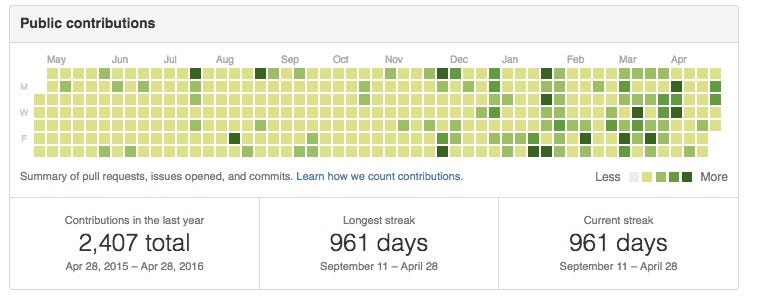
Sahat isn’t exactly an outsider. He has a computer science degree, has worked as a developer at Yahoo, and is among the most prolific open source contributors.
Sahat’s open source contribution activity on GitHub.
At a time when big tech companies are scrambling to find capable developers, why is he having so much trouble getting job offers?
The answer lies in part in with how big tech companies interview developers.
You might assume that in this high tech industry, interviewers use fancy tools to analyze the quality of code samples, or look at how widely a candidate’s code was included as a dependency in a package ecosystem like npm. That’s how an academic researcher’s work would be judged — by how many other academics cite them.
Unfortunately, interviewing practices at big tech companies aren’t that scientific. The decision of whether to hire a developer usually comes down to the candidate walking up to a whiteboard and regurgitating algorithms that haven’t changed since the 1970s, like a (classically) trained monkey.
Sahat is not alone in his frustration with the whiteboard-centric technical interview process used by most major software companies. Virtually every developer I’ve talked with agrees that one’s ability to write algorithms from memory on a whiteboard has almost nothing to do with real day-to-day developer work.

How whiteboard interviews work

The most common tasks meted out at the whiteboard are recalling algorithms and writing them bug-free on the whiteboard.
There’s usually an element of time pressure. If you don’t remember the algorithm or never learned it (i.e. never had a use for it), your interviewer may push you to guess your way into a working implementation.
Your interviewer will probably ask about time complexity, seeing if you can reduce the time it takes to run your algorithm from say O(n log(n)) to O(n).
And remember that this is a whiteboard — not a code editor. You can’t actually run the code to see if it works, let alone benchmark it. So your interviewer serves as judge, jury and (literally) executioner of your code.
The good news is you can prepare for whiteboard interviews, just like you can cram for a college entrance exam. And there’s a cottage industry of books and websites aimed specifically at helping you ace the whiteboard interview process.
Whiteboard interview questions generally come from a predictable pool of around 200 questions, the solutions of which are all available in Cracking the Code Interview. This book is the closest thing to a whiteboard interview playbook. Its author wrote it based off of her experience interviewing developers for Google, Amazon, Microsoft, and Apple.
Of course, your interviewer is under no obligation to ask you one of those questions you so diligently prepared for. If you’re unlucky, they could ask you to write out an algorithm you’ve never heard of before. This is the essence of the “algorithm question lottery.”
Developers will often defend whiteboard interviews as meritocratic. Anyone who wants to spend months of their life toward committing algorithms to memory can go and get that job at Google.
And a majority of these algorithms are already touched on as part of a computer science undergraduate program.
So what’s the problem?

The case against whiteboard interviews

The problem is that writing algorithms on a whiteboard has almost nothing to do with modern software development.
In real life, you would rarely just whip up an off-the-cuff algorithm from memory in the middle of a coding session. You are almost always going to use an existing library, which has its own test suite, and has survived the scrutiny of other developers.
The only world where you would actually need to be able to recall an algorithm would be a post-apocalyptic one, where the hard drives of all the computers connected to the internet were fried, and all copies of foundational academic papers and computer science textbooks had been reduced to ashes.
Whiteboard interviewing is a discrete skill, much like being able to remember Pi to a thousand decimal places. And students of programming are spending a disproportionate amount of their time mastering this skill instead of practicing real software development by building projects, maintaining legacy code, or contributing to open source.
This ultimately reduces the quality of entry-level hires, as it becomes difficult for the average interviewer to figure out who’s good at developing software, and who’s merely good at whiteboard interviewing.
It also freezes out many of the people who are under-represented in the software development field. If you’re busy working and raising kids, you want to spend as much of your scarce time as possible learning to code — not performing rote memorization that won’t matter once you start your job.
Even if you could afford to pay for a cram school (and some will garnish your future wages instead of asking for cash up front), you would still need to allocate time from your busy life to attend.
Whiteboard interviews also punish more experienced developers who are too busy doing real software development to drop everything and cram for a month. They also punish people who don’t have a computer science degree, or who finished theirs so long ago that they’ve forgotten most of these (rarely needed) algorithms.
Whiteboard interviews favor fresh graduates from theory-heavy computer science programs. But it’s hard to believe that those are the people who will perform best in the highly collaborative, practical 21st century developer workplace.

So why do we do whiteboard interviews?

Whiteboard interviews are akin to a hazing ritual — a rite of passage that one must endure before joining an organization — because everyone else there did. “I went through a battery of whiteboard interviews when I got here, so why shouldn’t this person?”
Supporters of the whiteboard interview will argue that it tests one’s ability to solve problems under pressure, or that it tests fundamental competence.
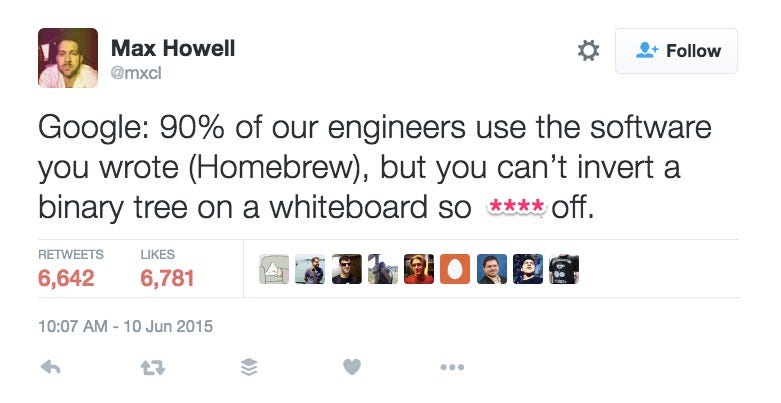
Whiteboard interviews provide an interviewer a defensible reason for passing on a candidate that their gut tells them they don’t like. Instead of attributing a no-hire decision to a poor “culture fit”, the interviewer can tell themselves and their superiors that “she just didn’t know how to invert a binary tree.”
It also provides the interviewer with an opportunity to feel smart and validate that “they’ve still got it” and that they aren’t themselves an imposter, by critically examining the work of an outsider who wants in.
Because of these forces, whiteboard interviews may stick around for a long time, like a circle of retribution — an ordeal inflicted upon one generation of developers by the previous, that will in turn be inflicted upon the next.

How can a good developer cope with whiteboard interviews?

There are only two good options here (other than to give up and go farm goats).
Option 1: Accept it and cram.
Every responsible academic program is encouraging new developers to learn these algorithms. Dozens of the algorithms in Free Code Camp’s curriculum come directly from common whiteboard interview questions.
Many of our students have told me that their prior experience with these specific algorithm questions was critical in landing their first developer jobs.
We have also created a lot of videos focused on time complexity and data structures, and are working on a system for conducting live mock coding interviews through our platform.
Option 2: Avoid companies that do whiteboard interviewing
Already, many experienced developers will flat out refuse interviews that involve whiteboards. Many of these developers are so good that they can often afford to be more selective.
Four Square has publicly ditched whiteboard interviews in favor of take-home assignments.
We were concerned that [the whiteboard interview] process filtered out many other great engineers for reasons other than their abilities. Some possible reasons include variation between interviewers, candidate nervousness, or the unnaturalness of whiteboard coding generally.
In doing so, Four Square has gotten rid of the random false negatives that can result from the “algorithm question lottery.”
Pivotal Labs is famous for their pair-programming-centric interview. You come in to their office in the morning and pair all day with a one of their developers. One of our students went through their interview process, loved it, and accepted a job there.
Whatever you do, don’t give up and go farm goats. Regardless of the stubborn hiring practices of big tech companies, the world needs a lot more good developers! So keep fighting the good fight.

Thanks for reading my article! If you found it helpful, recommend it to your friends on Medium by clicking the green heart bel
Go to the profile of Quincy Larson

Quincy Larson

Teacher at FreeCodeCamp.com

May 2, 2016

Why one woman stole 50 million academic papers — and made them all free to read


Many academic journals are extremely expensive. Want to read just one article? That could cost you around $30. The best way to access academic papers is through universities or libraries. But those institutions can pay millions of dollars a year to subscribe to a comprehensive collection.
Alexandra Elbakyan has had enough.
Elbakyan is a Russia-based neuroscientist turned academic Robin Hood. In 2011 she founded the website Sci-Hub, which has grown to host some 50 million academic papers — Elbakyan claims this is nearly all the paywalled scientific knowledge that exists in the world. These papers are free for anyone to view and download.
For students and researchers around the globe who can't afford academic journals, Elbakyan is a hero. For academic publishers that have historically been shielded from competition, she's a villain.
Either way, what she's doing is most definitely illegal.
Last year, leading journal publisher Elsevier took action against Sci-Hub, claiming it violated US copyright laws and the Computer Fraud and Abuse Act, which prohibits the fraudulent access of computer systems. In October, a New York district court ordered that the site be taken down. Elbakyan was unfazed. Soon after, in November Sci-Hub reemerged with a new overseas domain.
This story is bigger than a single court ruling. It's a new front in the academic publishing wars. What's at stake is the question of who has access to scientific knowledge: wealthy institutions, or anyone with an internet connection?
If Sci-Hub wins, the age of academic paywalls may effectively be over.

How Sci-Hub breaks the paywall

 Sci-hub
Elbakyan's personal story is like many others. When she was a student, she needed access to research papers. She didn't have that access. She also didn't have the money to download dozens of papers one by one.
Elbakyan explained her predicament in a letter to the New York court that ruled against her:
When I was a student in Kazakhstan university, I did not have access to any research papers. These papers I needed for my research project. Payment of 32 dollars is just insane when you need to skim or read tens or hundreds of these papers to do research. I obtained these papers by pirating them. Later I found there are lots and lots of researchers (not even students, but university researchers) just like me, especially in developing countries.
In creating Sci-Hub, Elbakyan basically mechanized something that already occurs: password sharing.
Most university libraries have online portals for their students and faculty. Enter these portals with a university password, and voilà — all the world's scientific knowledge is at your fingertips.
Before Sci-Hub, Elbakyan simply asked fellow researchers with access to those portals to fetch articles for her. Sci-Hub streamlines this process. When a Sci-Hub user requests an article, the site will try to log in to a university portal, using passwords that were reportedly donated, and grab the article.  (In a news story published in Science on April 28, Elbakyan cautiously denied claims that the login credentials were obtained via phishing attacks. "I cannot confirm the exact source of the credentials," she told Science, "but can confirm that I did not send any phishing emails myself.")
Once that's done, Sci-Hub will make a copy of the paper for its servers. That way, Sci-Hub won't have to go through a portal the next time someone needs a paper.
"The goal is to collect all research papers ever published, and make them free," Elbakyan told the website Torrent Freak last June.
And with 50 million papers, she's getting close. Science reports that only 4.3 percent of Sci-Hub's monthly download requests are for articles not already in the database.

How popular is Sci-Hub?

Popular!
Science recently conducted an analysis of Sci-Hub's web traffic (with the cooperation of Elbakyan). It found that 3 million unique IP addresses downloaded a total of 28 million documents in a six-month period between September and March 2016. And the number of users could actually be even higher "because thousands of people on a university campus can share the same IP address," according to Science.
Many of these users came from the United States. But a great many others came from poorer nations like Tunisia and India where the biggest hurdle to accessing scientific information may high journal costs.
This map, produced by Science, shows where in the world the downloads are coming from.


Via Science
In the United States, Sci-Hub users seem to be clustered around academic hot-spots, such as East Lansing, Michigan, where Michigan State University is located.
This suggest students and researchers are using Sci-Hub despite having journal access. It's easy to understand why. University libraries have complicated (and sometimes multiple) catalog programs to deliver scientific papers to students and staff. Sci-Hub offers a singular, simple-to-use portal.

Via Science

Is this legal?

No.
Publishers like Elsevier own the copyright to the articles, plain and simple. Elbakyan allegedly took the copyrighted material and distributed it without permission of the owner. That's illegal. This would be like if I photocopied The Hunger Games and handed the copies out in the street.
Elbakyan doesn't deny this. Instead, she's arguing that the copyrights are wrong to begin with. "We advocate for cancellation of intellectual property, or copyright laws, for scientific and educational resources," the Sci-Hub website states.
Elbakyan (and a large community of like-minded people) sees several problems with the current academic journal publishing model:
  1. Paywalls keep publicly funded research out of the public's reach.
  2. While publishers own the copyrights, they didn't create the content. Researchers typically do not receive any royalties from the money their work generates.
  3. This model only exists because academic journals confer prestige on authors. Authors willingly give up rights to their own research because they believe it will help their careers.

How did academic journals get so expensive?

For its part, Elsevier argued to the court that its paywalls "protect the delicate ecosystem which supports scientific research worldwide." And it's true that publishers add value, namely in facilitating peer review to ensure the published research meets rigorous standards.
"Journals have real costs, even though they don’t pay authors or reviewers, as they help ensure accuracy, consistency, and clarity in scientific communication," Science editor-in-chief Marcia McNutt writes in an editorial in which she describes her "love-hate" feelings on Sci-Hub. McNutt worries (perhaps rightly so) that non-profit science publishers will be harmed by continued pirating.
Yet others argue that the costs across the industry have grown out of control — and now exceed what's needed to support research.
In 2012, Harvard University said the growing cost of journal subscriptions was an "untenable situation" for the school's library, which shelled out $3.5 million a year for them.
"Prices for online content from two providers have increased by about 145% over the past six years, which far exceeds not only the consumer price index, but also the higher education and the library price indices," an internal Harvard memo read.
 Harvard
A Harvard researcher crunched the numbers: The cost of academic journals is rising much faster than the consumer price index.
It's not just Harvard struggling with these costs. An analysis from the University of South Florida found that "American research libraries spent 227% more for their journal collections in 2002 than in 1986. The CPI increased 57% during the same period."
The frustrating irony is that universities have to pay these sky-high prices despite the fact they are the institutions funding the research in the journals. Similarly, taxpayers spend $140 billion every year supporting research they can't easily access.
Publishers say the costs are necessary to ensure the quality of the research. But a 2005 analysis of Elsevier's business model by Deutsche Bank claims that profits are what the publishers are really after. "If the process really were as complex, costly and value-added as the publishers protest that it is, 40 percent [profit] margins wouldn't be available," Deutsche Bank wrote.
So how did these journals get so expensive?
Universities have no choice but to pay the high fees. Their students and faculties need access to research. On top of that, the majority of academic journals are published by just a handful of companies. This creates a market that greatly favors the publishers.
Or as Scientific American explains:
It's kind of like the way that HBO can control its subscription price. If you want to watch Game of Thrones, you have to subscribe to HBO. You may get it via Time Warner or Direct TV, but HBO can still set the price. The major difference here is that unlike TV shows for entertainment purposes, some scholarly content can be considered vital to the educational and research mission of a college, making it difficult to say NO to.

Sci-Hub will be incredibly difficult to take down

Sci-Hub's continued existence will pose a challenge for the science publishing business. Libraries won't immediately start canceling subscriptions and encouraging their students to pirate papers.
But as history shows, once a source of media becomes freely accessible to masses — like Napster did for music in the 1990s and 2000s — it can trigger a massive restructuring of the underlying industry. Now it's easy to purchase single tracks of music for little money or stream huge catalogues of it for just a few dollars a month. Perhaps continued pirating will put that same pressure on academic publishing.
Internet pirates have been extremely hard to take down, especially if they operate internationally. Sci-Hub follows in the footsteps of other pirating websites, such as the Pirate Bay — a portal for movies, music, and other entertainment — which has cleverly avoided shutdown for years, despite significant international legal action.
When the New York court issued its injunction against Sci-Hub in October, it banned the domain "www.sci-hub.org." But just days later, Sci-Hub was back on the web, under the new domain "sci-hub.io."
"The new domain will be hard for a US-based lawsuit, like Elsevier’s from last year, to shut down," Quartz explains. "The US only has jurisdiction over registrars based in the US, such as .com, .net, and .org."
(Contrast this with what happened to internet activist Aaron Swartz, who in 2010 and 2011 downloaded 450,000 journal articles using MIT's network. Swartz was a US citizen operating on US soil, so it was easier for him to be arrested and charged with a crime.)
Sci-Hub may be able to fool legal systems the world over by continually changing servers or distributing them across many continents and on many service providers. And though the court order made Sci-Hub temporarily unavailable on the mainstream internet, it was up and running on Tor, an encrypted, totally anonymous network. As Kaveh Waddell points out in the Atlantic, it took an enormous amount of effort for the government to bring down the Silk Road, a Tor network that sold drugs. It’s "unlikely the new Sci-Hub website would attract the same amount of negative attention," he writes.
By all accounts, Elbakyan has resolved to keep the project going. "We are definitely not going to stop spreading the knowledge," she told Nature in

The frustrated science student behind Sci-Hub


Scientific community


Alexandra Elbakyan, Sci-Hub founder.
APNEET JOLLY/FLICKR
By John Bohannon


Beyond being the founder of Sci-Hub, the world’s largest pirate site for academic papers, and risking arrest as a result, Alexandra Elbakyan is a typical science graduate student: idealistic, hard-working, and relatively poor. In 1988, when Elbakyan was born in Kazakhstan, the Soviet Union was just beginning to crumble. Books about dinosaurs and evolution fascinated her early on. “I also remember reading Soviet science books that provided scientific explanations for miraculous events thought previously to be produced by gods or magic.” She was hooked.
At university in the Kazakh capital, she discovered a knack for computer hacking. It appealed to her because “unlike higher programming languages that are created by people and are volatile,” making and breaking computer security systems requires a deeper knowledge of mathematics and the primitive “assembly language” that computers use to move information.
Journal paywalls are an example of something that works in the reverse direction, making communication less open and efficient.


Alexandra Elbakyan
Related content:
Like so many of Kazakhstan’s brightest, Elbakyan left the country to pursue her dreams. First she worked in Moscow in computer security for a year, and then she used the earnings to launch herself to the University of Freiburg in Germany in 2010, where she joined a brain-computer interface project. She was lured by the possibility that such an interface could one day translate the thought content from one mind and upload it to another. But the work fell short of her dreams. “The lab activity was spiritless,” she says. “There was no feeling of pursuing a higher goal.”
Elbakyan did find a community of like-minded researchers in transhumanism, a lofty field that encompasses not just neuroscience and computer technology but also philosophy and even speculative fiction about the future of humanity. She discovered a transhumanism conference in the United States and set her heart on attending, but she struggled to get a U.S. visa. She was rejected the first time and only barely made it to the conference. With the remainder of her summer visa, she did a research internship at Georgia Institute of Technology in Atlanta. When she got back to Kazakhstan, frustration with the barriers that scientists face would soon lead her to create Sci-Hub—an awe-inspiring act of altruism or a massive criminal enterprise, depending on whom you ask.
Publisher paywalls are the bane of scientists and students in Kazakhstan, she says, and the existing solution was cumbersome: Post a request on Twitter to #IcanhazPDF with your email address. Eventually, a generous researcher at some university with access to the journal will send you the paper.
What was needed, she decided, was a system that allowed that paper to be shared—with absolutely everyone. She had the computer skills—and contacts with other pirate websites—to make that happen, and so Sci-Hub was born. Elbakyan sees the site as a natural extension of her dream of helping humans share good ideas. “Journal paywalls are an example of something that works in the reverse direction,” she says, “making communication less open and efficient.”
Running a pirate site and being sued for what is likely to be millions of dollars in damages hasn’t stopped Elbakyan from pursuing an academic career. Her neuroscience research is on hold, but she has enrolled in a history of science master’s program at a “small private university” in an undisclosed location. Appropriately enough, her thesis focuses on scientific communication. “I perceive Sci-Hub as a practical side of my research.”

Sci-Hub activity over 6 months

Apr 26, 2016

Men have taken away a woman’s right to simply say no to their advances. by Charlene Haparimwi

A woman has to be polite in her rejection, lest she gets harmed or even killed for saying no.
A woman has to say she has a boyfriend for a man to back off. Whether or not she’s lying doesn’t matter, what matters is the presence of a man, imaginary or not, is more valid than the woman presently standing in front of them.
A woman has to change train cars when she’s on a subway if she feels threatened, if she’s being followed, if a man shows himself to her inappropriately, or touches her inappropriately.
A woman has to cross the street, go in a different direction, hide in stores or completely change her normal route if she is being followed, watched or assaulted.
A woman has to carry pepper spray, mace, carry keys in her hand, not walk alone at night, not wear headphones, not walk in certain areas or on certain streets just to keep safe. And that is often still not enough.
A woman has to watch her drinks, her friend’s drinks, take friends to the bathroom with her, not take public transportation back alone or anything else for what is supposed to be a “fun night.”
A woman cannot just say fuck off to a man harassing her lest she get hurt in the process.
A woman only thinking of a man as a friend is apparently worse than a man only thinking of a woman as a sexual conquer or girlfriend. He is girlfriendzoning her.
A woman needs a reason every time to say no. She’s not interested in this man, she’s not interested in men at all, she doesn’t want to get hit on at the moment is not enough. Sometimes even those reasons will get her hurt or killed.
I’m tired of being polite to men who catcall and say vulgar things to me because I’m afraid of what they’ll do otherwise. I’m tired of having to talk about my boyfriend in order to have men leave me alone. I’m tired of having to purposely put in headphones and have resting bitch face walking down the street to scare off any unwanted harassment. I’m tired of not having ownership of my own body. I’m tired of being objectified. I’m tired of not being able to wear certain things or go certain places because of the men around me.

I’m tired of women getting killed for saying no.

Go to the profile of Charlene HaparimwiCharlene Haparimwi is a 20 year old DePaul University student studying Public Relations and Advertising, with two minors in Creative Writing and Peace, Justice and Conflict Studies. She has been published in Slant News, Hooligan Mag, Literary Juice, Femsplain, The Coffeelicious, and more. She is passionate about intersectional feminism, black rights, LGBT rights, and restorative justice. She is originally from Harare, Zimbabwe, lived in St. Louis for 13 years and currently resides in Chicago. Her Twitter and Instagram are @queencharlene95.
(Cover photo courtesy of: Mashable’s Bob Al-Green)

Charlene Haparimwi

Writer for @huffingtonpost & @hellogiggles. LGBT rights, women’s rights, black rights and peace movements. Twitter and Instagram: queencharlene95

Apr 24, 2016

Titles are Toxic By rands

You have a job and it has a name. A name of convenience. It exists so that when someone asks, “What do you do?” you can simply say, “I am a software engineer” rather than saying, “Well, there are these things called computers and computers run software and humans write software and I am one of those humans”.
Chances are, you also have a title. It was given to you when you first arrived at your fine company and you probably didn’t think about it. You argued for more salary or more stock, but the title was just there — Sr. Software Engineer 2. You didn’t think about where the title came from or the fact that it defined your compensation and promotion path for the duration of your stay with the company.
You didn’t think a lot about title because you didn’t really have a choice. The decision to create titles happened long before you were there, but you still need to understand why titles are toxic.

On the Origin of Titles

When a company is small, everyone does a little bit of everything, so titles make no sense. My first title at Netscape was “Bitsifter”. Sure, there were some titles, but they were titles of convenience so external parties could apply their antiquated title frameworks to folks on our team during meetings. “Oh, I see, you’re the VP of Product… how very impressive.”
The unspoken agreement was that these titles were necessary to map to a dimwitted external reality where someone would look at a business card and apply an immediate judgment on ability based on title. It’s absurd when you think about it — the fact that I’d hand you a business card that read “VP” and you’d leap to the immediate assumption: “Since his title is VP, he must be important. I should be talking to him”. I understand this is how a lot of the world works, but it’s precisely this type of reasoning that makes titles toxic. They didn’t start out toxic. They started out as a means to give folks a path towards growth.

The Leadership Path

When your company gets a little larger, when the team has been on board for more than a few years, you need to give folks a growth path. There are two paths that need definition. I’m going to define these relative to software engineering, but my gut feeling is that these paths are similar for many types of jobs.
The first track created is the lead or management track, and this shows up first organically out of necessity because there are too many of you. At 25 people you could keep everyone on the same page because each person was able to maintain state with each other person. The leadership track shows up so that communication and decisions can be sensibly organized.
This is a major development for a growing company because this might be the first title arriving. Lead or manager, whatever you call it, the question is the same: is it a job or a title? A job is a well-defined thing that has a clear and easy to understand set of responsibilities. A title often has neither.
A good way to explain this is to imagine the poor use of titles in Toxic Title Douchebag World. In this imaginary world, the first five hires after the founders have given themselves impressive sounding titles. VP of Business Development or Director of Advanced Technology. If you’re employee #34 and someone is walking around the building calling themselves the SVP of Platform Engineering, you might be in Toxic Title Douchebag World.
I’m not suggesting that this is not an accomplished person. I’m not saying that they don’t have a wealth of experience or fantastic ideas, but never in my life have I ever stared at a fancy title and immediately understood the person’s value. It took time. I spent time with those people — we debated, we discussed, we disagreed — and only then did I decide: “This guy… he really knows his stuff. I have much to learn.” In Toxic Title Douchebag World, titles are designed to document the value of an individual sans proof. They are designed to create an unnecessary social hierarchy based on ego.
When that first title shows up for your first leader, ask yourself: does this title reflect a job I consider to be real and of obvious value? If the answer is anything other than a resounding yes, your titles might be toxic.

The People Path

Let’s say you’ve avoided Toxic Title Douchebag World when the leadership titles landed. Let’s make the big assumption that everyone sees leadership jobs as equivalent to any other jobs. Congratulations. There’s more opportunity for toxicity forthcoming.
The second growth path that needs to be defined is harder than the leadership path because of the inherent difficulty in defining the jobs. The forcing function for leadership was driven by a need to improve efficiency, communication, and accountability. The forcing function for the People Path is growth.
You likely didn’t define the Leadership Path out of a need to grow your people; you did it to scale your company. The fact that this new job is seen as a promotion is a happy byproduct of the job’s existence. Problem is, the majority of your company is never going to be managers, but they want to grow, too.
This is where a critical mistake is usually made. The folks who successfully landed the lead title think, “Well, when we needed leaders we called them leads, so why don’t we create new titles for folks to give them the same sense of promotion and advancement.”
No no no no and no. To understand how this breaks down, let’s head back to Toxic Title Douchebag World.
In this world, our SVP of Talent looks at his 119 employes and 17 leads and thinks, “Well, the folks who are the most cranky are the engineers who have been here the longest, so I’ll do what I did at my former company — I’ll create titles: Associate Engineer, Engineer, Senior Engineer, Staff Engineer, and Architect.”
By themselves, these titles are not completely toxic. It’s the process by which the SVP of Talent assigns these titles. Here are a few samples of his increasingly flawed reasoning:
  • He creates a stack ranking of employees based on years of tenure and last year’s performance rating.
  • He draws lines on this list to create groups. Where does he draws these lines? Well, it’s based on his mood.
  • With this group done, he passes it on to the leads who he thinks will have good opinions about the groups, but in reality will mostly share his opinion without question.
If you don’t have blinding teeth-grinding rage after reading those three bullets, I’ll put you over the edge. This isn’t really Toxic Title Douchebag World: this is your world. This grim, poorly defined decision process has heralded the arrival of a lot of title systems that you’re living with right now.
Now, those who designed and deployed titles don’t intend to do harm. They are, hopefully, intending to build a rational system for growth, but what they don’t account for is that…

You are a Beautiful Snowflake

How do you compare two engineers with equivalent years of experience? Comparing their years on the job is an easy empirical comparison and it’s not a crazy assumption that someone with more years on the job has more refined skills. But can you quantitatively measure those skills? No.
Phil and Felix both have four years of experience. Both have worked on the same team and the same project, but Phil works so much better with people, whereas Felix is happier hiding in the shadows and working on well sequestered projects. Felix is world-class at measuring performance, whereas it appears Phil doesn’t really know how to add. However, Phil is a steady, leveling voice during times of crisis where your impression is that Felix wouldn’t mind if it all burned to the ground.
You need both of these guys, but there is no one title which describes both of them. Phil’s title should be Humble Math-Addled Keeper of the Peace whereas Felix would be The Dark Lord of Performance and Snark. Their jobs are clearly as engineers, but defining a single title is a slippery exercise in comparing two things that are incomparable.
The main problem with systems of titles is that people are erratic, chaotic messes who learn at different paces and in different ways. They can be good at or terrible at completely different things, even while doing more or less the same job. A title has no business attempting to capture the seemingly infinite ways by which individuals evolve. They are imprecise frameworks used to measure the masses. To allow leadership to bucket individuals into convenient chunks so they can award compensation and measure seniority while also serving as labels that are somehow expected to give us an idea about expected ability. This is an impossibly tall order and at the root of title toxicity.
When Felix learns that he’s a Senior Engineer and Phil is a Staff Engineer, he loses his shit. Why? Because he perceives his value as performance engineer extraordinaire as significantly more valuable than Phil’s value as a guy who just gets along with people. Titles place an absolute professional value on individuals, where the reality is that you are a collection of skills of varying ability. Some are your super power, some are your Achilles heels, and none are clearly defined by a title.

R.I.P. Business Cards, Resumes, and Titles

Business cards are dead. Yes, I feel bad when I’m at a conference and someone hands me their gorgeous business card and looks expectantly for mine. Sorry, I don’t have one. Well, I do. You’re looking at it right now. It doesn’t fit in your wallet, but it saves a little bit of a tree and has vastly more information than a business card.
Resumes, in their current form, I hope, are not far behind. It’s convenient to have a brief overview of someone’s career when we sit down to interview, but more often than not, when I’m interviewing you, I’m searching Google for more substance. Do you have any sort of digital footprint? A weblog? A GitHub repository? It’s these types of artifacts that give me the beginning of insight into who you are. It’s by no means a complete picture, but it’s far more revealing than a bunch of tweets stitched together in a resume.
Titles, I believe, are an artifact of the same age that gave us business cards and resumes. They came from a time when information was scarce. When there was no other way to discover who you were other than what you shared via a resume. Where the title of Senior Software Engineer was intended to define your entire career to date.
This is one of those frustrating articles where I gnash my teeth furiously about a problem, but don’t offer a concrete solution because I haven’t solved for this problem and I’m wondering if anyone else has. I believe there is a glimmer of a good idea regarding gauging and annoucing ability in ideas like Open Badges but the burden of progress is a two-way street.
For a leader of humans, it’s your responsibility to push your folks into uncomfortable situations where they’ll learn, document, and recognize their accomplishments, and help them recover from the failures as quickly as possible.
For the individual, it’s about continually finding new jobs. In my career, I’ve been a student, a QA engineer, an engineer, a manager, and a writer. Each job is a path I’ve chosen. I’ve had much support along the way, but, more importantly, I’ve never been content to be complacent, nor ever believed there weren’t more jobs to be discovered, and always knowing that I’m more than a title.

Apr 10, 2016

We’ve Got Your Back - Bikers Against Child Abuse stand up for young victims


Courtesy Image

Two weeks ago I didn’t know that Bikers Against Child Abuse (BACA) was a thing, but I instantly loved the concept. I contacted the President of the Alaska chapter and arranged to meet them last Wednesday when he and several other members of the chapter were attending the last rehearsal of Stalking the Bogeyman at UAA. It’s a play based on the true story written by Press contributing editor David Holthouse about the plan he almost carried out to kill the man who raped him when he was seven years old. Before the April 7 performance of the play, representatives from BACA were to make a short presentation about what it is they do for abused kids, so they were attending the rehearsal for practice.

BACA receives referrals from parents or guardians, police or other agencies (like the Office of Children’s Services, or S.T.A.R. here in Anchorage) if a child who has reported abuse remains in fear in their environment. An initial ride is scheduled to meet the child somewhere they feel comfortable, with as many members of the chapter as possible showing up on motorcycles, in full regalia. The child is given their own vest with the BACA patch attached and allowed to choose their own road name, becoming an honorary part of the family. After that, the child gets the phone numbers of the two nearest BACA members, and can call on them at any time he or she feels scared. If asked, they’ll show up. They can also provide an escort, do regular ride-bys, attend court and parole hearings with the child, or stand guard outside the child’s home as long as he or she feels frightened. In some circumstances, this can mean staying outside through the night to make sure the child feels safe enough to sleep.

I showed up at the rehearsal and saw a dozen bikers in full leathers bearing the BACA patch on their backs. Having no idea what the chapter President looked like, I took a deep breath, approached the crowd of bikers and opened with the words, “Excuse me, is there someone here that goes by the name … uh, McDreamy?” All BACA members use their road names in order to help protect the anonymity of everyone involved.

Half a dozen hands pointed at a guy near the front of the line. I walked up and introduced myself, then turned to look at the bikers standing around us. Of course, because Alaska is such a small town, I knew one of them. Her vest said her road name was “Dreamcatcher.” She had been head of security at my very first job, where we’d become friends. She is an Amazon of a woman, and tough. Not the kind of person you would pick to rob on a subway. How serendipitous that she should appear out of my past on that evening.

When the doors opened, we settled into two rows on the right side of the theater; McDreamy on my right and Dreamcatcher on my left. I was not looking forward to the play. Within just a few minutes though, I realized exactly what it is that BACA has to offer. I didn’t want to be seeing what I was seeing, but sitting with that crowd of tough guys and gals around me, it was OK. I had backup.

The play was in part designed to start a conversation that Alaska especially—consistently among the highest in rates of child abuse in the country—needs to have. To facilitate that process, there was an after-performance discussion as a chance for the actors to decompress and for us to see them as regular human beings again, and for all of us to dissolve the illusion we’d just been a part of.

Courtesy Image

People asked questions and made comments on the performances put on by the actors. Soon though, someone sitting on the opposite side of the theater asked what others were wondering; why there were a dozen bikers in attendance.

McDreamy got up to stand in front of the set and explain BACA; that they exist to give empowerment and choice back to a child who’s had those things robbed from them. Immediately people chimed in saying how grateful they were to hear that BACA was around and how desperately our community needs their help. The last comment came from a lady sitting in the first row. She turned in her seat and repeated those sentiments, then finished with, “Where were you when my daughter needed you?”

I felt the room freeze while everyone absorbed what that meant. “We’re here now,” came from Dreamcatcher next to me. The painful tension disappeared. What was left felt steady and certain. It would be OK.

Sunday I sat with McDreamy, their child liaison officer Fun Size, and a gentleman whose title I assume is something like chief intimidator—Papa Bear, to learn more about BACA.

If you were contacted by a parent and they were interested in bringing you into their child’s life, what’s the summary you’d give them to explain BACA?

McDreamy: I’d say that we’re here to empower their child, to be there for him or her, but only if they ask us to be part of this kid’s life and they want us involved. We’re not here to go after the person that hurt the kid, first and foremost. From there we’d just try to answer any questions or concerns they may have.

What concerns do you typically hear?

Fun Size: Most of the parents that reach out to us are so desperate for our help they don’t really have many. But sometimes they ask if we’ll be carrying firearms, and that answer depends on what they’re comfortable with. If a firearm or a knife could be a trigger for a kid, we make sure not to have them on us.

Tell me about the process for a newly referred kid. McDreamy mentioned the night of the play that you, as the child liaison, are the only person who knows what happened to that child.

FS: That’s correct, it’s for that child’s protection. I ask a series of questions about the case; I let them share as much as they want to. I need their case number; it has to have been reported for us to take the case. I need to know if the perpetrator in jail, if they live nearby, if the child or the family is being harassed by the perpetrator or his/her family, if there will be court proceedings, what the kid’s triggers are, what scares them, what are their fears, how do they express that fear.

You’ve mentioned triggers a couple of times. I am guessing that can make or break a meeting with a child.

FS: Yes. Triggers can be anything from the type of cologne someone is wearing, whether or not they smoke cigarettes, how someone has their hair cut, wearing a baseball hat, looking like him [she gestures at Papa Bear] or looking like him, clean cut [gesturing at McDreamy], the type of voice someone has, wearing sunglasses, if you spit when you talk, songs, smells, almost anything. Depending on the type of abuse it could be, maybe they’re not comfortable with men. In those cases our brothers will still ride out, but they will not approach the child. They just hang back to protect and support that child and be the obstacle, but they will not approach that child unless the child initiates the interaction.

Papa Bear: To me, to watch a child go from when you’re first meeting with them and they’re standing far away from you and not wanting anything to do with you, not even looking at you, but by the end of our visit them wanting to embrace you, to sit there chattering your ear off, not wanting you to leave, that’s so rewarding. In most of the situations, by the time we leave that’s what’s happening. They feel secure, happy and they want us to come back soon. That’s what makes it worth it to me.

Courtesy Image

I was not looking forward to being at that play at all. David is someone I know, and that made it even harder to watch. But I noticed that with you guys being there and all sitting around me, I just felt better.

MD: You were sitting right in the middle of us and to kind of put it in perspective for you. Imagine instead being in a courtroom and facing the perpetrator that had hurt you. And think of how you felt with us around you. That’s what we do for those kids.

In a story about another BACA chapter that I read, they mentioned one of the rules is that you cannot cry, cannot get emotional in front of the kids. It seems like you guys run into a lot of sad, really scary situations. How do you handle that?

MD: Debriefing, destressing after each ride is something we always do. Go on a ride, get something to eat, stand around and talk about it—just something. As you heard in the talk after the play, those kids frequently cannot leave their situation. So when we meet a kid, we don’t know exactly what happened, but we know something happened and we see how it affects that kid, and that in turn affects us. But we cannot express that around the kids. He might look pretty intimidating now [gesturing at Papa Bear] but imagine what he looks like with tears in his eyes. It defeats the purpose. We’re here to let that kid know that they don’t have to be scared of anything, period. There’s no need for them to be afraid.

PB: It’s about breaking those chains of abuse. It’s about stepping in and letting that child know that what happened to them wasn’t right and there are people out there who stand with them and will help them.

MD: One of the things that needs to happen—it’s what David did and this play is doing—is bringing to light these situations. Kids even at the younger ages need to know what is OK and what is not OK coming from adults in their lives. People in this world need to know that this shit goes on. A close person in my life growing up had this happen to them in their household, and they tried to speak up and no one would believe them. Perpetrators are good at what they do. They’re good at intimidating. They seem to have split personalities. They can be awesome around other people but behind closed doors are truly horrible. More people need to be aware of what to look for.

FS: The most important thing we do is to give them back choice. We let them talk about themselves, we let them choose whether or not they’re interested in being a part of our family. We do not make them no accept us matter how much we think they need us. They do not have to welcome us, it’s their choice. They choose what patch goes on their vest, what their road name is going to be. They get to choose if we visit again to introduce them to all the brothers and sisters. They choose what we do during our visits. Do we jump rope or play soccer or …

MD: Let them color our hair pink.

FS: [Smiling] That one was awesome. That could have been one of our greatest success stories. When we first arrived, she had put a “Hi, Welcome” sign up in the house for us because she was afraid to talk to us and that was the best she could do. We came in and stood around and gave her a chance to talk. Then the guys went to do a walk around the house and us girls took her out to look at the motorcycles, and when it was time for us to wrap things up, she chose to ask the guys to stay outside while the girls came back in. Which means that she felt comfortable to ask for what she needed.

MD: This particular child did not want to be around men at all at the beginning. And we went from that, to her being comfortable running around playing soccer with men, to physically putting her hands on men to color their hair and beards pink.

What’s surprising me most since meeting you guys is that you’re so ... busy.

PB: We haven’t even started yet. We have barely scratched the surface. That’s the sad thing. Once the word gets out about who we are and what we do, we’re not going to have nearly enough people. The statistics here in Alaska are so overwhelming, between neglect to sexual abuse to physical abuse—it’s insane. We’re riding every weekend. I didn’t even get my fishing rod out last year. Lifelong Alaskan and I didn’t get to go fishing once.

Courtesy Image


You guys are in a unique position in that people are often inherently scared of you, and that what makes you so effective.

PB: Yep. What’s scarier than a group of bikers?

MD: That’s part of where we came from. The founder of our organization grew up around bikes and clubs as a kid and remembered what it did for him when he was being bullied. Later in life he became a Child Play Therapist and saw what was happening to the kids he worked with in between the time he was with them and the times the cops could be there. He’d see those kids again after a week and they’d have regressed substantially. So he thought about his experience with bikers and he started what we are now. We fill the gap between therapy and home life and the cops not being able to be there all the time. A restraining order is just a piece of paper to someone who isn’t a law abiding citizen already. If the cops can’t be there right away, and that kid needs us, we can sit on a house 24/7 for a day, two days, for a week—whatever it takes.

How frequently does that happen, that you’re staying overnight somewhere?

MD: Not that frequently because generally the perpetrator stops coming around once they see us, so it’s not all the time but it has happened, and it can happen, and we have to be prepared for that from the minute we get the call. In the Lower 48 they had a day and night stay for 28 days in a row. They were in a place where they had a huge chapter that we don’t have here. We do have some brothers and sisters in Kenai that can come up if they’re needed, but if we put out the call I guarantee folks from the Lower 48 would be using their airline miles to get up here.

PB: It’s strength in numbers. They might be able to go through me, but they will not get through the 20 people behind me.


For more information about Bikers Against Child Abuse, you can visit their webpage at http://alaska.bacaworld.org/. If you know a child who’s suffered abuse and could benefit from some very tough older brothers and sisters, you can reach B.A.C.A at 907-885-4357. If you’d like to donate to donate to the cause, you can do so here http://bacaworld.org/merchandise/


Labels

Giveaway ( 3088 ) Excerpt ( 1336 ) blog tour ( 942 ) Book Blitz ( 864 ) Cover Reveal ( 543 ) Guest post ( 518 ) Teaser ( 347 ) Book blast ( 283 ) Interview ( 260 ) Culture ( 245 ) Books ( 242 ) Trailer ( 228 ) freebie ( 227 ) Art ( 226 ) Funny ( 225 ) History ( 219 ) Promotion ( 207 ) Science ( 202 ) Articles ( 181 ) free kindle ( 145 ) Literature ( 142 ) Release Day ( 131 ) Review ( 120 ) Photography ( 115 ) nature ( 113 ) kindle ( 112 ) Gender ( 105 ) Book tour ( 90 ) Authors ( 89 ) myth ( 77 ) new release ( 77 ) Coffee ( 76 ) newsletter ( 71 ) Children ( 70 ) Music ( 66 ) box set ( 60 ) Archaeological ( 59 ) illustration ( 56 ) food ( 50 ) spotlight ( 50 ) PLAYLIST ( 49 ) social ( 48 ) 0.99 sale ( 46 ) YA ( 45 ) contest ( 43 ) fantasy ( 43 ) Mythology ( 42 ) Grand Finale ( 41 ) sale ( 39 ) blog hop ( 37 ) words ( 37 ) Poetry ( 35 ) artist ( 34 ) Characters interviews ( 32 ) Game ( 32 ) syfy ( 32 ) language ( 30 ) quotes ( 30 ) recipe ( 30 ) Release Party ( 29 ) Expert ( 27 ) ads ( 21 ) mystery ( 21 ) Photos ( 20 ) reading ( 20 ) Romance ( 19 ) Animals ( 18 ) Design ( 18 ) Education ( 18 ) Street Photography ( 18 ) book highlight ( 18 ) facts ( 18 ) comics ( 17 ) health ( 17 ) writing ( 17 ) Folklore ( 16 ) Holidays ( 16 ) Movies ( 16 ) poem ( 15 ) Biology ( 13 ) top 10 ( 13 ) Book release ( 12 ) Maps ( 12 ) covers ( 12 ) Book trailers ( 11 ) Cash Giveaway ( 11 ) Giveaways ( 11 ) Twitter Blast ( 11 ) Valentine ( 11 ) Friday revel ( 10 ) Libraries ( 10 ) Paranormal ( 10 ) Release blitz ( 10 ) agriculture ( 10 ) events ( 10 ) sport ( 10 ) Characters cast ( 9 ) Publishing ( 9 ) Sneak Peek ( 9 ) dream cast ( 9 ) work ( 9 ) BOOK SIGNING ( 8 ) Steam-punk ( 8 ) astronomy ( 8 ) interviews ( 8 ) plants ( 8 ) technology ( 8 ) Free Book ( 7 ) Halloween ( 7 ) NA ( 7 ) Thanks Giving ( 7 ) blog ( 7 ) blog blast ( 7 ) economy ( 7 ) letters ( 7 ) street art ( 7 ) Christmas ( 6 ) Contemporary Romance ( 6 ) Genetic ( 6 ) Goodreads giveaway ( 6 ) This and That ( 6 ) YA RELEASES ( 6 ) news ( 6 ) short story ( 6 ) writing tools ( 6 ) Amazon. ( 5 ) Audio ( 5 ) Philosophy ( 5 ) Spring ( 5 ) YA Fantasy ( 5 ) hosting ( 5 ) jobs ( 5 ) mother day ( 5 ) top 5 ( 5 ) Black Friday ( 4 ) BookRave ( 4 ) Fun Facts ( 4 ) Grammar ( 4 ) Song ( 4 ) Sunday Read Recommendation ( 4 ) Weather ( 4 ) Web ( 4 ) cakes ( 4 ) deals ( 4 ) evolution ( 4 ) gift card ( 4 ) horror ( 4 ) lol ( 4 ) photographer ( 4 ) soundtrack ( 4 ) studies ( 4 ) video ( 4 ) Architecture ( 3 ) Book Swapping ( 3 ) Book tor ( 3 ) Cartoon ( 3 ) Characters ( 3 ) Computing ( 3 ) Dance ( 3 ) Easter ( 3 ) Erotica ( 3 ) Indian ( 3 ) Kindle Fire HDx Giveaway ( 3 ) St. Patrick's day ( 3 ) Suspense ( 3 ) TV series ( 3 ) Thriller ( 3 ) Translation ( 3 ) bookstore ( 3 ) chapters ( 3 ) chemistry ( 3 ) contemporary ( 3 ) ecology ( 3 ) fall ( 3 ) film director ( 3 ) guest review ( 3 ) hope ( 3 ) icon ( 3 ) launch day ( 3 ) math ( 3 ) story ( 3 ) summer ( 3 ) syfi ( 3 ) urban ( 3 ) winter ( 3 ) 10 Fun Facts ( 2 ) 10 things ( 2 ) 4th of july ( 2 ) Adventure ( 2 ) Audiobook ( 2 ) Awards ( 2 ) Blogger Appreciation ( 2 ) Book reveling ( 2 ) Bookstores ( 2 ) Characters bio ( 2 ) Clean Sweep ( 2 ) Cover wars ( 2 ) Crime ( 2 ) Debut Author Challenge ( 2 ) Dystopian ( 2 ) Family ( 2 ) Free Shipping ( 2 ) Fun ( 2 ) Gifts ( 2 ) Graphs. STAT ( 2 ) Hop International ( 2 ) Introduction ( 2 ) Literature awards ( 2 ) Nostalgic ( 2 ) Ocean ( 2 ) Psychological ( 2 ) Psychological Thriller ( 2 ) Reading Contest ( 2 ) Release week ( 2 ) Selfies ( 2 ) Summer Reading ( 2 ) Summery of the year ( 2 ) Tablets ( 2 ) Tea ( 2 ) Titles ( 2 ) add ( 2 ) art Articles ( 2 ) birds ( 2 ) book bash ( 2 ) book contest ( 2 ) bread ( 2 ) cell & molecular biology ( 2 ) children’s literature ( 2 ) climate change ( 2 ) codes ( 2 ) discussion ( 2 ) dragons ( 2 ) ebooks ( 2 ) epic ( 2 ) extreme ( 2 ) facebook ( 2 ) facebook Blast ( 2 ) games & gadgets. test ( 2 ) ilustration ( 2 ) immunology ( 2 ) incredible ( 2 ) internet ( 2 ) labels ( 2 ) lists ( 2 ) lunch blitz ( 2 ) martial ( 2 ) min-interview ( 2 ) monsters ( 2 ) physics ( 2 ) poets ( 2 ) sea ( 2 ) tips ( 2 ) tv ( 2 ) water ( 2 ) wolf ( 2 ) 5 Fun Facts ( 1 ) 5 Rapid Fire Round ( 1 ) A vote ( 1 ) Action ( 1 ) Adult ( 1 ) Adult Historical Fantasy ( 1 ) Adult fiction ( 1 ) African-American Lit ( 1 ) Amazing ( 1 ) Amazon ( 1 ) Amazon.Tech ( 1 ) Announcement ( 1 ) Apology ( 1 ) April ( 1 ) Atlit Yam ( 1 ) B-day ( 1 ) Badass heroes ( 1 ) Baking ( 1 ) Bibliophile ( 1 ) Black & White ( 1 ) Blogoversary ( 1 ) Book Hop ( 1 ) Bookfest ( 1 ) Booklikes ( 1 ) Bravery ( 1 ) Bundles ( 1 ) Catalog ( 1 ) Concepts ( 1 ) Critique ( 1 ) Cut Scene ( 1 ) DVD ( 1 ) Did you know ( 1 ) Discovery ( 1 ) Disney ( 1 ) Donation Campaign ( 1 ) Earth Day ( 1 ) Etymology ( 1 ) Extravaganza ( 1 ) FAQ ( 1 ) Falafel Day ( 1 ) Favorite Reads ( 1 ) Folklure ( 1 ) Gadgets ( 1 ) Garden ( 1 ) Geography ( 1 ) Greating ( 1 ) Happy New Year. greatings ( 1 ) Heroes ( 1 ) High-Rise Buildings ( 1 ) Highlights ( 1 ) Holocaust ( 1 ) Infographic ( 1 ) Inspiration ( 1 ) International ( 1 ) Japan ( 1 ) Jazz ( 1 ) Kindness ( 1 ) Linguists ( 1 ) Literary Fiction ( 1 ) Maleficent ( 1 ) Meet the author ( 1 ) Misconceptions ( 1 ) Multicultural ( 1 ) New Adult ( 1 ) New Adult fiction ( 1 ) New Series Releases ( 1 ) New Year ( 1 ) Offers ( 1 ) PRE-RELEASE ( 1 ) Parental ( 1 ) Passover ( 1 ) Personal message ( 1 ) Picture Revision ( 1 ) Piracy ( 1 ) Pirates ( 1 ) Preview ( 1 ) Print Design ( 1 ) Psychology ( 1 ) QA ( 1 ) Query Contest ( 1 ) Quet ( 1 ) Quiz ( 1 ) Quize ( 1 ) Random Facts ( 1 ) Rapid Fire Round ( 1 ) Recommends ( 1 ) References ( 1 ) Religion ( 1 ) Reveal ( 1 ) Rhymes ( 1 ) Romantic Suspense ( 1 ) Scavenger Hunt ( 1 ) Scots ( 1 ) Sleeping Beauty ( 1 ) Sparkiversary ( 1 ) Target ( 1 ) Tax day ( 1 ) Tour ( 1 ) Tour Highlight ( 1 ) Tourney ( 1 ) Trivia ( 1 ) Typography ( 1 ) Unbelievable ( 1 ) Urban Fantasy ( 1 ) Vintage ( 1 ) Virtual Book Tour ( 1 ) Visa ( 1 ) WWII ( 1 ) Waiting on Wednesday ( 1 ) Western Historical Romance ( 1 ) What I'm reading ( 1 ) Women ( 1 ) Women’s Fiction ( 1 ) Women’s Lit ( 1 ) YA nonfiction ( 1 ) academic ( 1 ) alternative medical ( 1 ) angry robot ( 1 ) anima ( 1 ) author blog ( 1 ) available ( 1 ) book hunt ( 1 ) book industry ( 1 ) book sketch ( 1 ) book swag ( 1 ) brain ( 1 ) calligraphy ( 1 ) ceremony ( 1 ) challenge ( 1 ) clips ( 1 ) clocks ( 1 ) confidence ( 1 ) convention ( 1 ) crazy ( 1 ) creative ( 1 ) cupping ( 1 ) daimonds ( 1 ) diet ( 1 ) digital copy ( 1 ) discount ( 1 ) drugs ( 1 ) east ( 1 ) editing ( 1 ) essays ( 1 ) fairy tales ( 1 ) fashion ( 1 ) fiction ( 1 ) fool day ( 1 ) genre ( 1 ) gift ( 1 ) global warming ( 1 ) gov ( 1 ) green ( 1 ) greeting ( 1 ) guns ( 1 ) harvest ( 1 ) help ( 1 ) ideas ( 1 ) indi ( 1 ) infectious disease ( 1 ) info ( 1 ) insects ( 1 ) intro for audio ( 1 ) introducing ( 1 ) labor day ( 1 ) lego ( 1 ) make up ( 1 ) manga ( 1 ) meaning ( 1 ) message ( 1 ) money ( 1 ) monthly ( 1 ) mystical ( 1 ) names ( 1 ) names.culture ( 1 ) new cover ( 1 ) note ( 1 ) olympic ( 1 ) organic ( 1 ) out takes ( 1 ) outage ( 1 ) packing ( 1 ) palentology ( 1 ) party ( 1 ) pepco ( 1 ) physiology ( 1 ) pk ( 1 ) protein ( 1 ) protein folding×¥ ( 1 ) protest ( 1 ) public transportation ( 1 ) pulp fiction ( 1 ) rare ( 1 ) recommendation ( 1 ) rescued ( 1 ) retail ( 1 ) reveal tour ( 1 ) revel party ( 1 ) shopping ( 1 ) solutions ( 1 ) songs tracks ( 1 ) support ( 1 ) surfing ( 1 ) survival ( 1 ) swords ( 1 ) tags ( 1 ) theater ( 1 ) title reveal ( 1 ) top 12 ( 1 ) trees ( 1 ) update ( 1 ) visual ( 1 ) winner of giveaway ( 1 ) wo ( 1 )