Jul 11, 2016

The Future of Browser History by Patryk Adaś


I am really unsatisfied with the current state of Browser History. I think that this is the most underestimated feature of every modern web browser. Let’s take the most popular browser as an example. 
Before we talk about browsers history, we need to understand how we tend to browse nowadays. 
Sometimes I want to know how to convert 1 foot to centimeters.
Sometimes, on the other hand, I want to know why and how things happen. 
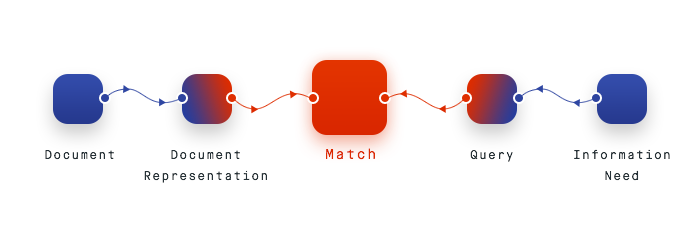
For the second kind of search, the standard pattern of match retrieval does not really cut it.

Problem

I can search for the term in Google, but I’m not going to get a single result that answers my question. Rather, I’m going to get a lot of results, and all of those results will have bits and pieces of information that are relevant to me.
Then I’m going to go exploring through the internet, collecting lots of tabs along the way. Some of those tabs will be duds, so I close them.
Some of those tabs will be relevant and will have twenty more links, so I open them all, and in this way I keep crawling.

Tabs, tabs, tabs

Then after a while I have a cloud of pages in my head that I visited and the answer is more or less complete. 

But if I try to revisit this later, it’s impossible. I can remember what I found, but it wasn’t a linear progression, therefore my browser history is useless. 
Despite living in a data-driven society, as more and more databases are brought online, the complex and varied information available to be discovered is dependent on how well we can search. 
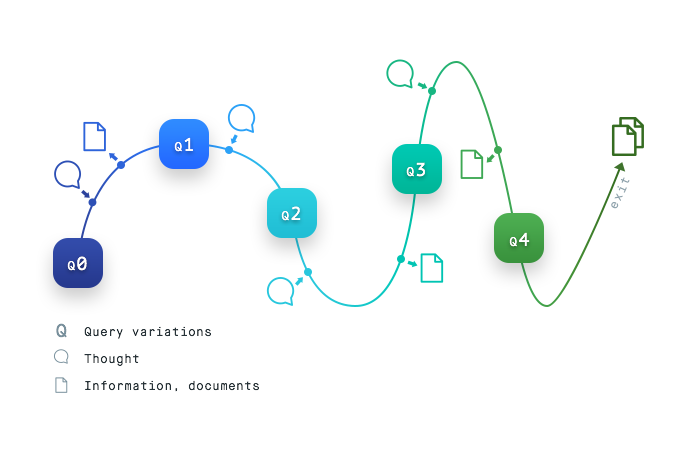
In formal ways, we have transitioned from the Classic Retrieval Model, to what is called, Berrypicking Search.

Classic Retrieval Model

The query is satisfied not by a single final retrieved set, but by a series of selections of individual references and bits of information at each stage of the ever-modifying search. 
In other words, we do not usually search for something that leads to a single result that answers our question, rather we search for terms and then explore the internet, connecting bits and pieces of the answer as we read through the web of tabs that our search starts for us.

Berrypicking Search

Our search needs, and in turn our browser history, are not being met with single query anymore. We move through a variety of sources with every new piece of information giving us new ideas and directions to follow. Without us ever knowing it, our search queries are constantly fluctuating. 
 

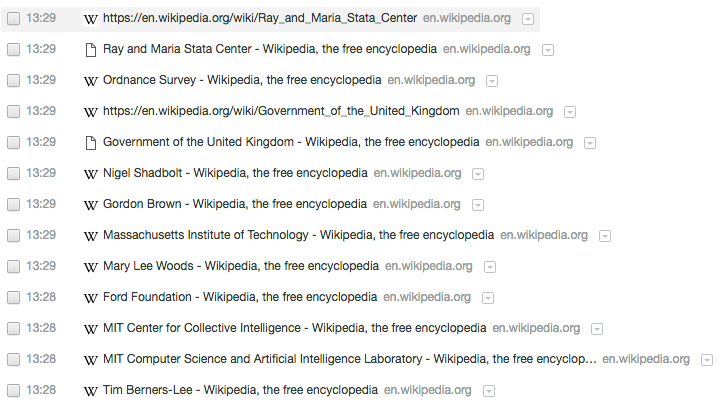
Current Google Chrome History

Unfortunately, our current solution to finding a not-bookmarked webpage, is to retrace own steps through different links. 
It demands that users have enough information to decipher the desired page from all others by recognizing headers, obscure URLs or timestamps. 
Our browser’s history should reflect our behaviour in the internet and help us understand the process behind it. It is crucial to actually understand and question the way we use the Internet, and without the suitable tools, it is not possible.

Solution

I find answer in maps.

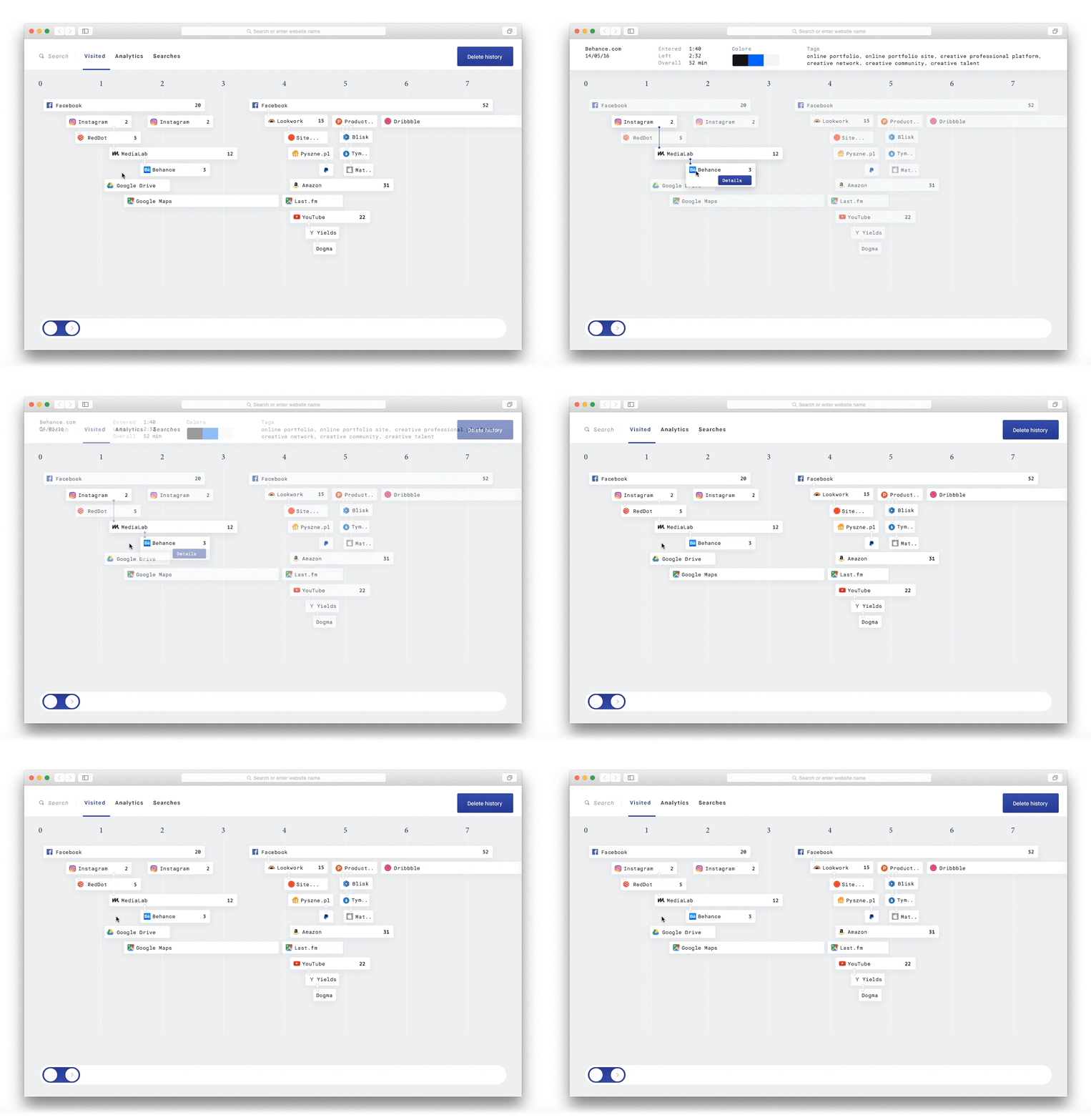
Main Page

:hover
On top there is a timeline, positions are still displayed chronologically, but users can also see connections. 
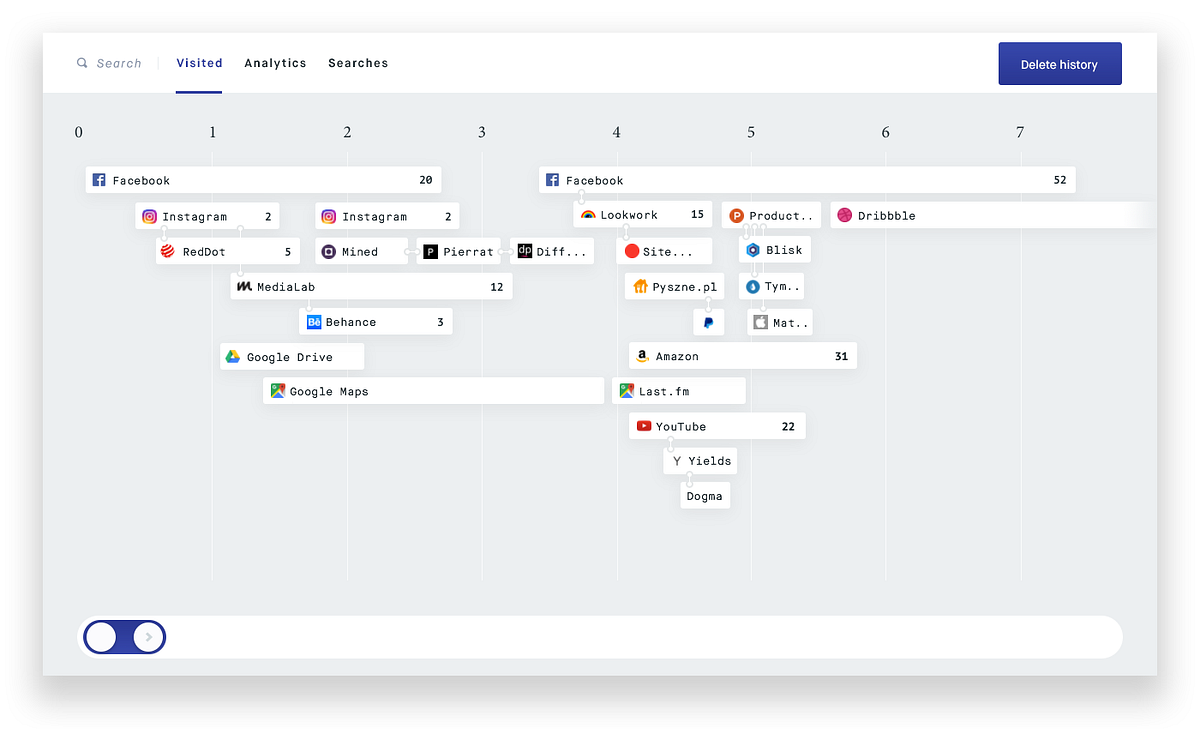
Not only is this a different approach to browsing our own content, it is now possible to see patterns of my search queries and behaviors. In this way, our browser history does not only perform a retrieval function, but also writes a narrative. 

I will finally understand why I ended up reading about the influence of plants on soil properties, when I started with texas bbq query. 

With this method, I am able to see at a glance how different pieces of information are connected, how they relate to each other and how I formed conclusions. I see how I actually cognized things that are relevant. It is not only about the goal, but also about the journey. 

In the proposed interface, with a simple hover action I receive essential pieces of information. I am able to understand my thought process and points of interest. It is also easier to actually remember the page thanks to particular color schemes and meta sections. 
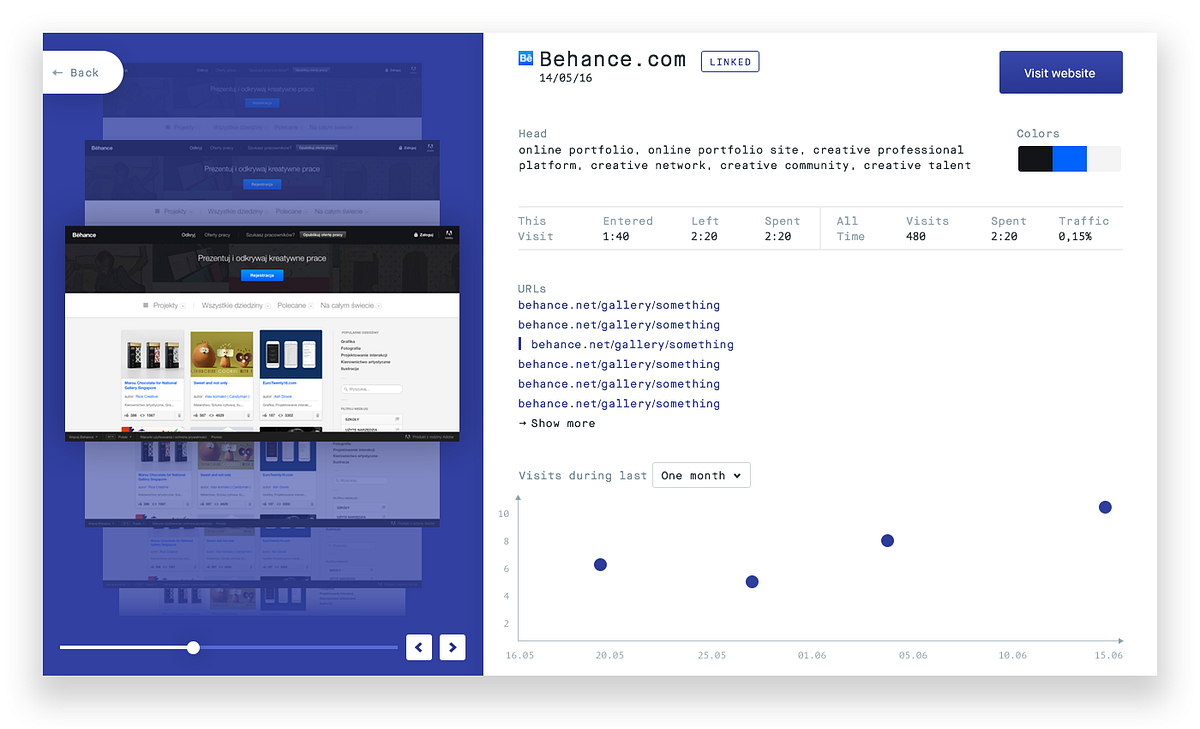


Single page 


Let’s say I already found what I was looking for and I’m satisfied with my information retrieval process. 


How many times have I visited this website? How much time have I spent using it? When did I see something interesting? How often do I visit it? How does my generated traffic look like, from perspective of particular page? 



Delete dropdown

Search 
Google is one of the best search engines available and yet, in Browser History there is not even a place for autosuggestion. How come? 
I’d love to search by topic, dates, colors.

Searches

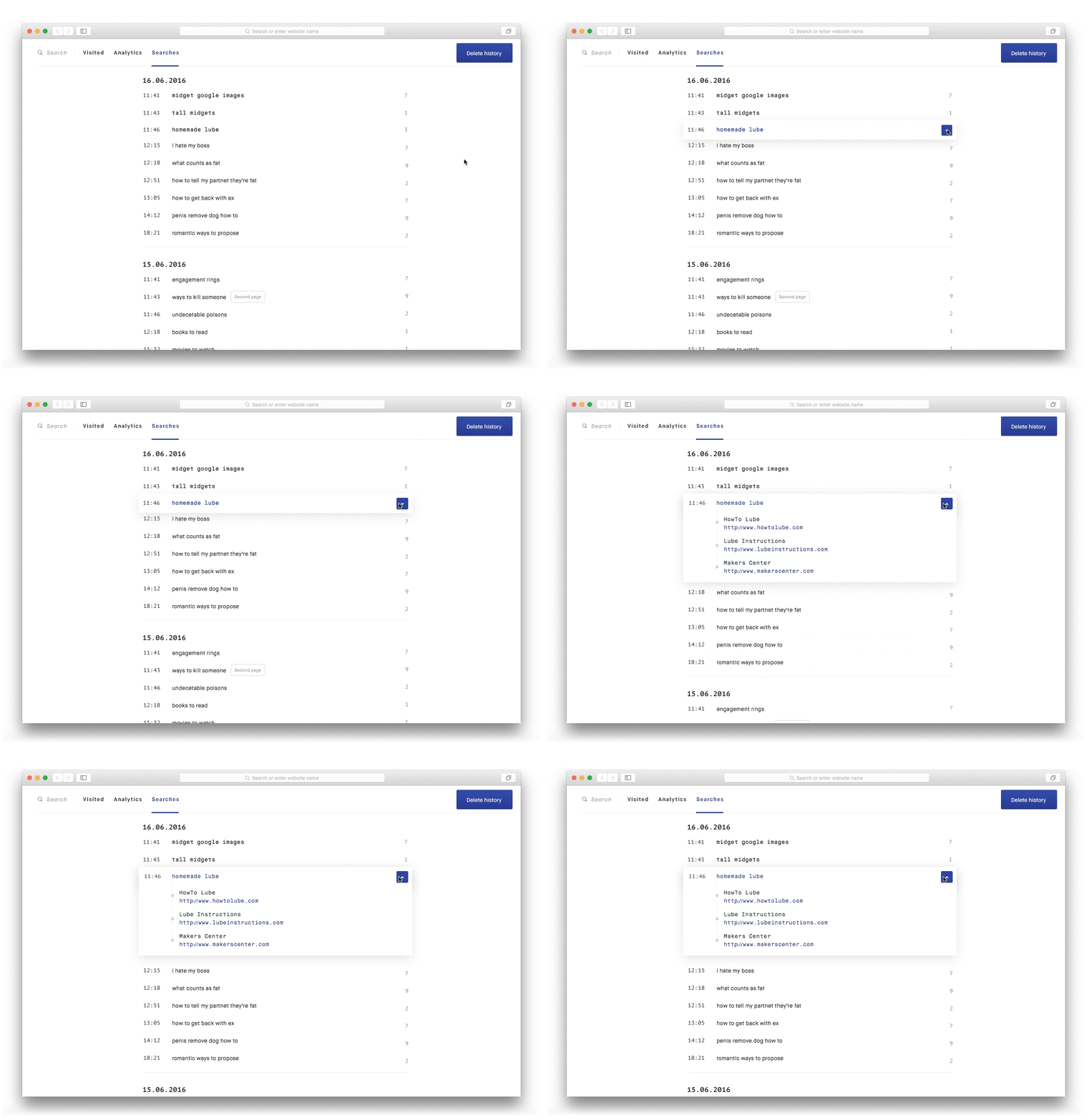
In order to re-create our experience or to just see the overall topics of our interests I think it is highly useful, to provide users with a list of past searches. Once you click a particular search result, it expands with visited links based on that very query and would redirect you to the map with the highlighted path.
Analytics 
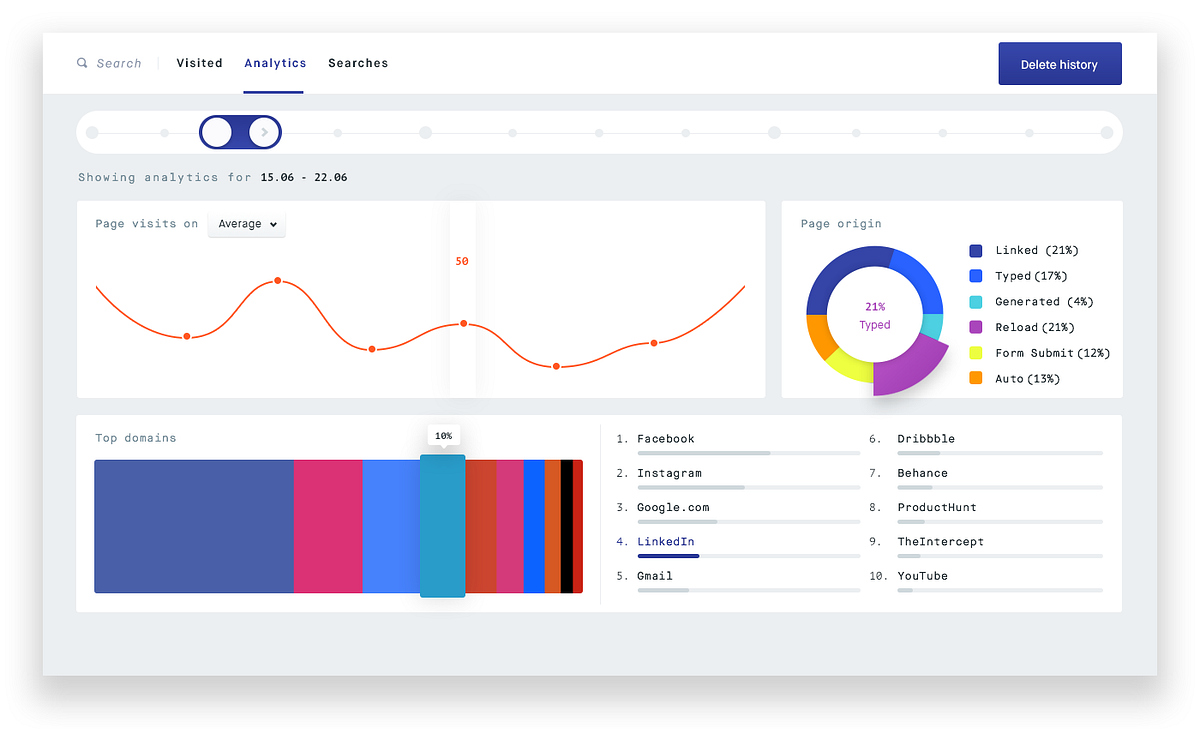
Currently, I am really missing the analytics screen. It is crucial to be able to understand one’s own behavior, especially as there is no distinction between offline and online anymore. Filter Bubble shows that information we see is selective, we become separated from information that disagrees with our viewpoint. Users are more and more comforted in their own domain, we have stopped questioning. 
I want to see how much time I spend browsing Internet, how I collect information and how I form my views. 
We live in times when understanding your browse behaviors and search patterns is becoming crucial in cognitivism process. 


The Mysterious Fairy Flag of Clan MacLeod and its Legendary Protective Powers

The Dunvegan Cup, Fairy Flag, and Sir Rory Mor's Horn are heirlooms of the MacLeods of Dunvegan. This photo was taken sometime before 1927.
Top image: The Dunvegan Cup, Fairy Flag, and Sir Rory Mor's Horn are heirlooms of the MacLeods of Dunvegan. This photo was taken sometime before 1927. (Public Domain) 
The Fairy Flag is one of the treasures kept by the chief of Clan MacLeod, a Highland Scottish clan associated with the Isle of Skye. Today, the flag resides in Dunvegan Castle, the seat of the clan’s chief, on the Isle of Skye, and has been described as “rather tattered, made of faded brown silk and carefully darned in places”. Although the flag does not look like much, it is believed to possess mystical powers, and several stories have been told about how this magical object has protected Clan MacLeod over the centuries. 
There are two main stories that have been traditionally told about the origin of the fairy flag. The first of these links the flag to the Crusades, thus indicating that the flag came from somewhere in the East. The second one, by comparison, involves fairies, and places events surrounding the flag’s appearance on the Isle of Skye itself. 
It has been determined that the fabric of the Fairy Flag is silk from the Middle East (more specifically, Syria or Rhodes). This lends some credence to the story that the flag has its origin in the East. Nevertheless, this object has been dated to between the 4th and 7th centuries AD, at least 400 years before the First Crusade. Still, it may be possible that the Fairy Flag was already treated as a relic by the time of the First Crusade, and only found its way to the British Isles following this military campaign.

Crusades Flag

The Crusades version of the Fairy Flag story begins with Harald Sigurdsson, known also as Harald Hardrada, the King of Norway who ruled from 1046 to 1066. Prior to becoming the King of Norway, Harald had served as captain of the Varangian Guards in the court of the Byzantine Emperor at Constantinople. One of the treasures he brought back to Norway was the Fairy Flag, which was then known as Landoda, or ‘Land Ravager’. The king believed that the flag made him undefeatable in battle, and when Harald embarked on his campaign to conquer England, he took the flag along with him. 
The Norse army was ambushed by the English, and it seems that Harald did not have the opportunity to unfurl his magical flag. Harald’s army defeated at the Battle of Stamford Bridge, and the king lost his life as a result of an arrow that pierced his throat. It is said that one of Harald’s soldiers who survived the battle, Godred Crovan, managed to rescue the flag, and brought it to the Kingdom of Mann and the Isles, where he found refuge with its king, Godred Sigtryggsson, who was also his kinsman. Godfred established himself as the King of Mann in 1079, and the MacLeods are said to claim descent from him. 
Harald at the battle of Stamford Bridge. (Public Domain)

Fairy Clan

The other main story suggests that the Fairy Flag was not obtained from the East, but given to the clan by a fairy. The fourth chief of the clan, Iain Ciar, is said to have been a highly attractive young man. Although many women were attracted to him, he had fancied none of them. One night, the chief is said to have stumbled upon a fairy dwelling, where he saw a fairy princess. The two fell in love instantly, and the princess requested that she be allowed to marry the chief.
The fairy king, however, rejected her request, explaining that unlike fairies, humans will grow old and die, and that grief was inevitable for her. A compromise was reached, and the princess was allowed to be with the chief for a year and a day, after which she would need to return to her people. During this period, the princess gave birth to a son. Eventually, the time came when the princes had to return. Before leaving, she made her husband promise that he would never leave the child alone, and never allow him to cry, and that would be too much for her to bear. 
The Fairy Flag (Public Domain) and Dunvegan Castle on the Isle of Skye in the mist, August 2007. (CC BY-SA 3.0
In the weeks after his wife’s departure, the chief kept his promise, though he was depressed. His friends decided to throw him a party in an attempt to cheer him up. As the celebrations were going on, the chief’s spirits began to revive. The merry music and noise from the banquet hall were so loud, that the baby’s nurse decided to leave the nursery to have a peek at the revelry. The baby woke up, and began to cry, though the nurse did not hear him. 
The fairy princess heard her child’s cries, and appeared beside him. She took him up, wrapped him in a fairy shawl, and sang to him, thus putting him back to sleep. It was at this point that the chief / nurse entered the nursery. The lullaby was heard, but the person singing it could not be seen. Years later, the child grew up, and told his father what had happened. The shawl became the Fairy Flag, and is believed to be a talisman that protected the clan. 
Princess singing lullabies, Illustration by H.J. Ford, 1921 (carolynemerick.com
If the clan were to find themselves in great danger, all they needed to do was to unfurl the flag and wave it three times. Doing so would bring the fairy legions to their aid. This, however, could only be used three times, after which it would return to where it came from, taking the flag waver with it. The flag is said to have been used twice already, the first when they were vastly outnumbered by their enemies, the MacDonalds, when the latter invaded their lands. When the Fairy Flag was used, the tide of battle turned, and the MacLeods were saved from destruction.

 
Iona Abbey: The effigy on the floor in the center may mark the location of the burials of several MacLeod chiefs and one flag bearer.
The second time the Fairy Flag was used was when a plague was killing off the clan’s cattle, and the MacLeods were dying of starvation. When the flag was used, the cattle was said to have come back to life. The flag was almost used for the third time during the Second World War, as the clan’s chief, Dame Flora MacLeod offered to wave the flag from the Cliffs of Dover should the Germans attempt to invade Great Britain, but fortunately Clan MacLeod did not need to call upon the magic of the flag and so, according to legend, the MacLeods can call upon the legendary flag one last time. 
Dame Flora MacLeod of MacLeod of Dunvegan Castle, a castle belonging to the clan MacLeod Annotation (CC BY-SA 3.0 nl)

References

Jul 10, 2016

Negotiating with Death: Special Agreements for the Afterlife Around the World

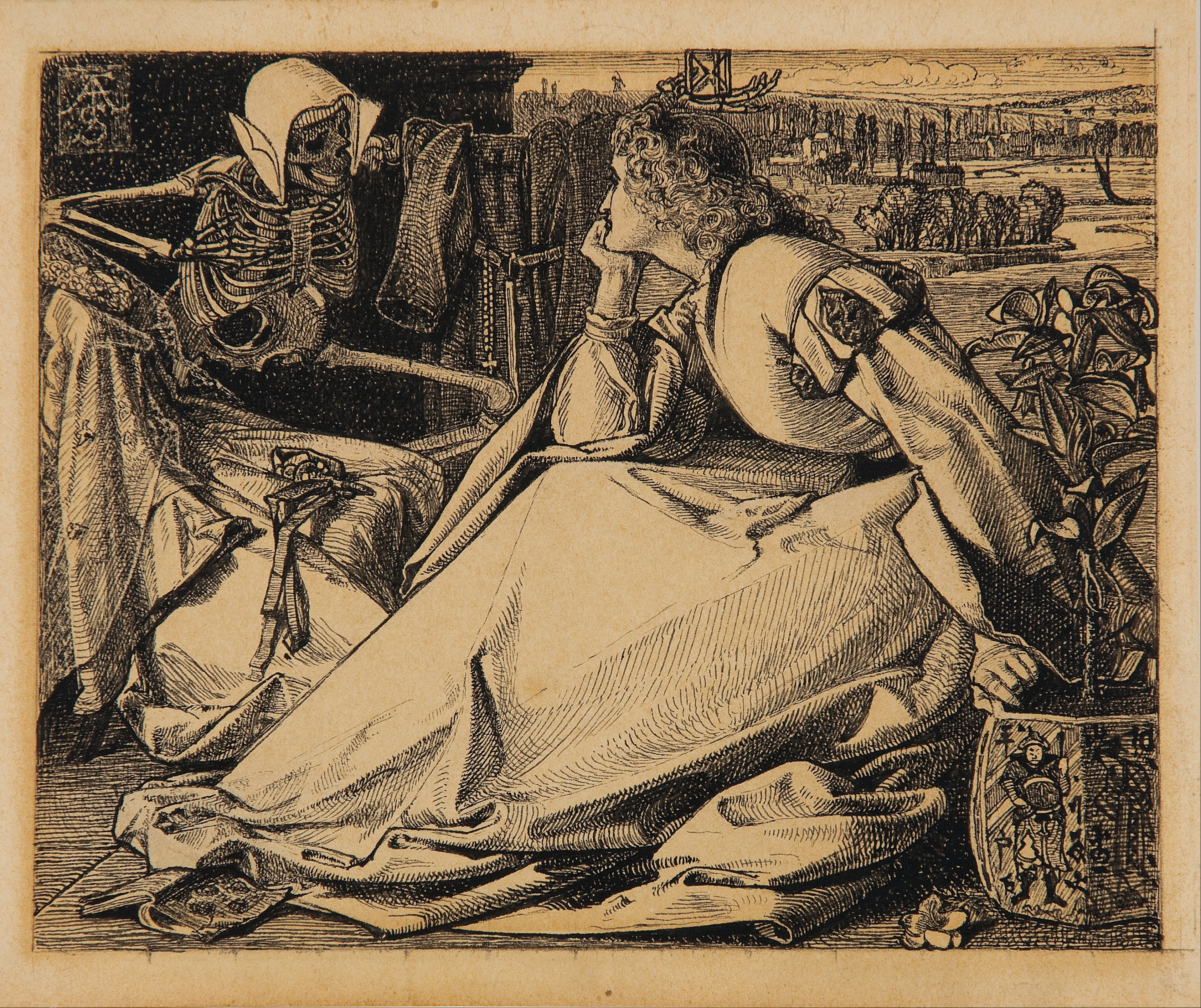
Until her death (1862) by Frederick A. Sandys.
Top Image: Until her death (1862) by Frederick A. Sandys. Source: Public Domain 
Death as an entity appears in many cultures across the globe. In the West, this entity is known as the Grim Reaper. In Japan, Death is represented by Shinigami, the Gods of Death. A lesser-known element of stories involving Death is the part about those who negotiate with the Grim Reaper. This is their story. 

Death and the Crow

There is an old legend about crows. It is said that these birds can help the spirits of the dead travel safely to the afterlife. The same belief has been connected to eagles. However, it is also said that crows can help give a person a second chance at life by negotiating with Death and by preventing it from severing life from a person’s body. This would allow the individual to complete one last urgent task. In this sense, the crow is one of those negotiators who can talk Death out of claiming a person’s life…at least for a time. 
Crow on a Branch (1873-1877) by Kawanabe Kyōsai. Brooklyn Museum. (Public Domain)

The Flaming Winged Serpent

In Japan, onmyouji were a type of wizard monks. They used to invoke Shikigami (ceremonial deities) in order to help them achieve their tasks. One such Shikigami was Touda or Tousha, the flaming winged serpent. Touda was said to be the only Shikigami capable of killing (in fact, completely erasing from existence) a Shinigami, a God of Death. 

Prolonging Human Life

“Compendium Medicus” (“Hippocratis, Medicorum”) was printed in Byzantine, but the 1588 edition was prohibited by the Church. The text dealt with how medicine should fight in order to prolong human life. It ended with a chapter on human structure, concluding that the human body is stronger than what was known at that time. The main conclusion rested in the fact that human beings had the tendency to become immortal. 
Animal or demon blowing horn, perhaps allegory of disease. In Hippocrates' Aphorismi. (c. 1300) (Public Domain
In many cases of apparent near death experiences, the people who have returned from the other side claimed that they had heard a voice telling them that their time had not yet come and, as a result, their souls were sent back into their bodies. These voices or the entities to whom they belong could be another type of negotiators with Death. 
Also, the shadow is said to protect the individual to whom it belongs. In this sense, the shadow can oppose the Grim Reaper when it comes and refuse to surrender the individual’s soul to Death. Only when the shadow gives its permission can the Grim Reaper sever the person’s ties to life. 
Other legends and stories start from the fact that Death comes for all those who have life and concludes that this aspect is unfair. Such legends speak about regular mortals who have come to this conclusion and who have decided to oppose the Grim Reaper in order to remain alive. 
Death as a skeleton carrying a scythe. (Public Domain)

A Norse Negotiator

In Norse mythology, the trickster god Loki caused the death of the god Balder. When Frigga saw that her beloved son had died, she asked that someone go to Helheim to appear before Hel and bargain for the return of Balder. 
Hemrod volunteered to perform the act and Odin lent him Sleipnir, so that he would quickly reach the realm of the goddess Hel. In the meanwhile, the gods said their farewell to Balder and prepared for the funeral rites. Balder’s wife, Nanna, bent over her husband’s body on the funeral pyre and decided to join him in death as her heart was broken and she could, under no circumstance, be apart from him. 
Balder und Nanna (1882) by Wägner, Wilhelm. (Public Domain
After ten nights of riding on Sleipnir’s back, Hemrod crossed over River Gjoll. There, Modgud inquired the reason for his coming and, once he explained and made sure that both Balder and Nanna had crossed over the bridge before him, Hemrod continued his journey until he reached the large gate. He made Sleipnir jump over the high gate and, once they landed safely on the other side, they carried on until they finally arrived at Hel’s great hall.

When he entered the hall, Hemrod found Balder and Nanna sitting on a couch, both caught up in their sadness. Even though Hemrod told Balder that he had come to take him home, Balder replied that he knew he had to stay in Helheim until the last day. However, he did ask Hemrod to take Nanna back to Asgard, but she immediately refused, once again not wanting to be parted from her beloved husband. In the end, Hemrod presented himself before Hel and asked her to release Balder. 
Her response explained that she would allow the god of light to return to Asgard should all things in creation shed tears for him. With this encouraging answer, Hemrod returned to the realm of the Aesir. Once the gods assembled, Hemrod gave Odin the ring Draupnir (which Balder had sent back). Then he presented Frigga with an embroidered carpet which Nanna had sent for her and gave a ring to Fulla.
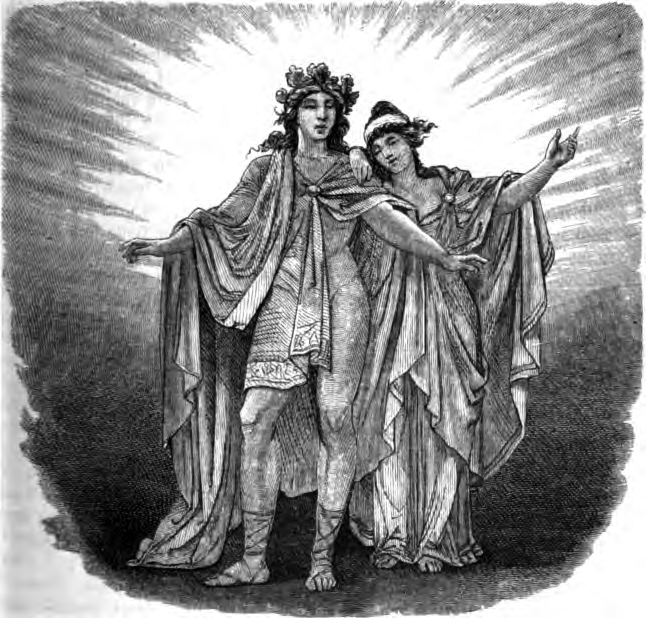
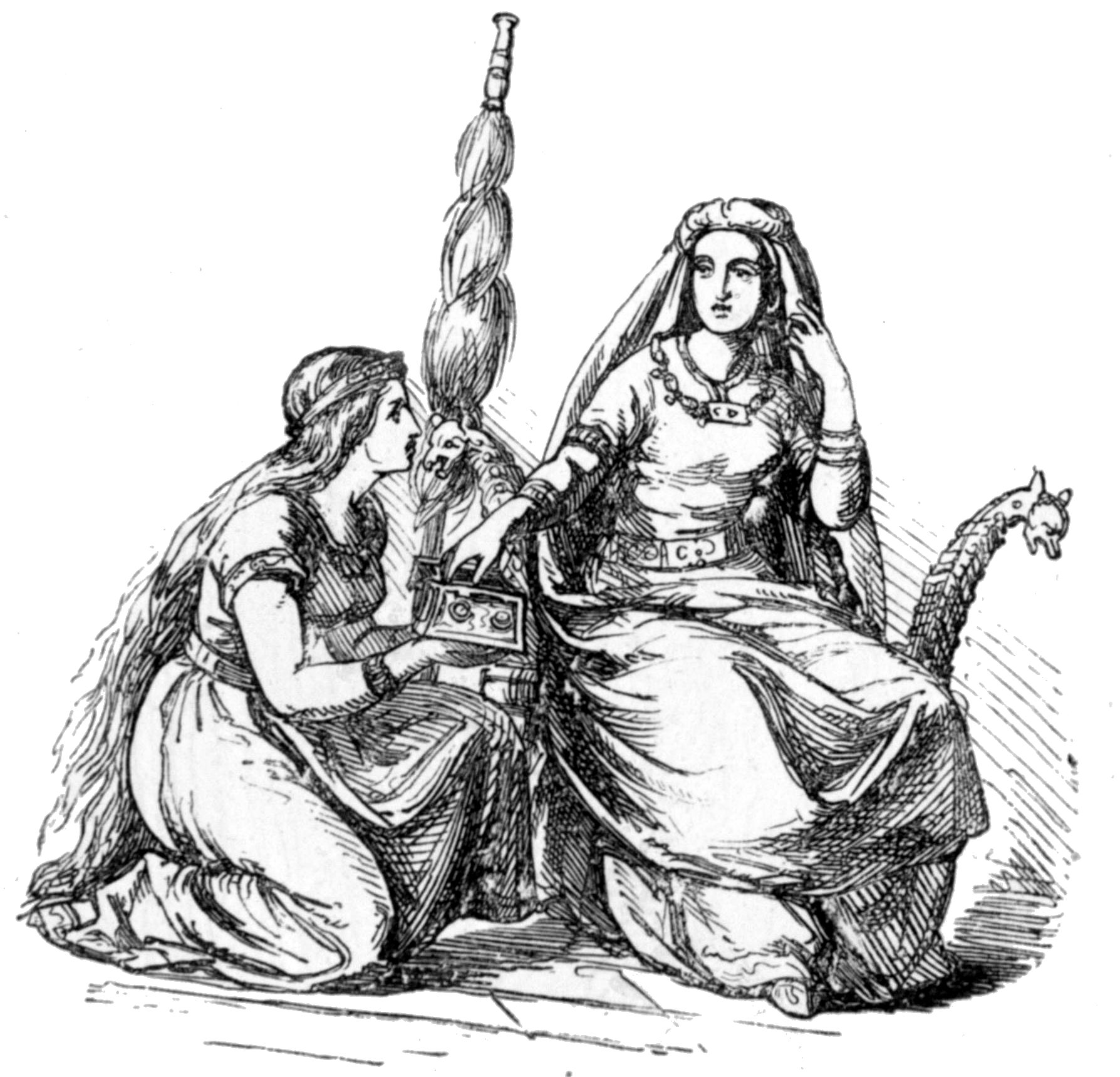
Frigg and one of her handmaids, presumably Fulla. (1865) Ludwig Pietsch. (Public Domain
After Hemrod told them about the condition for Balder’s release, the gods sent heralds to all the corners of the world to ask everything in creation to weep for the god of light. They all wept for Balder, and upon their return to Asgard, the heralds noticed the giantess Thok crouching inside a cave by the edge of the road. The giantess was said to have been Loki in disguise. The messengers approached her and asked her to shed a tear for Balder. 

Failure Due to Trickery

To their dismay, she mocked them and refused, while turning her back on them and going back into the darkness of the cave. Thok had told the heralds that, for all she cared, the goddess Hel could keep Balder forever, and with this message they sadly returned to the abode of the gods. 
Upon their arrival, the messengers imparted the upsetting news, and the Aesir understood that they would no longer behold Balder in Asgard. Legend further has it that Odin whispered something, one single word, into his dead son’s ear while his body laid on the funeral pyre. It is not known exactly what the word was. Still, many suggest that what Odin uttered was: “Resurrection!”. 
‘Odin's last words to Baldr’ (1908) (Public Domain)

References:

  • Valda Roric – “Wonders of History and Mythology”
  • Valda Roric – “From History to Mystery”
  • Valda Roric – “Loki – The Trickster Unleashed”
  • Valda Roric – “Loki – The Trickster Redeemed and the Secret of the Runes”

Baba Yaga, The Confounding Crone of Slavic Folklore

Baba Yaga
Featured image: The Baba Yaga, flying through the air with her
terrified captive. Illustration, 1917.Public Domain 
Baba Yaga is considered one of the most intriguing characters from Slavic mythology. As ambiguous as she is hideous, Baba Yaga has been described by scholars as an anomaly, both a maternal, mother-nature figure and an evil villain who enjoys eating those who fail to complete her tasks. Though the origins of her name are as unclear as her purpose tends to be, it is believed thatbaba means something akin to “old woman” or “grandmother”, while yaga has conflicting theories of meaning ranging from “snake” to “wicked.” Regardless, even Baba Yaga’s name emphasizes the strangeness of her person, making her an interesting character to decipher. 
The most common portrayal of Baba Yaga is as either one old woman or a trio of old sisters, all of whom are depicted as skinny, with iron teeth, and noses so long that they touch the ceiling when they sleep. 
Baba Yaga is commonly illustrated as riding around on a mortar rather than a broom, wielding a pestle as both a flying aid and a wand. Tales involving her usually take place at her hut. It is found deep in the woods, standing on magical chicken legs, with a rooster's head on top. Legend says her hut is surrounded by a fence made of human bones.

Inside her hut, heroes usually encounter her stretching across her cooking stove, the enormous stove itself reaching from one side of the hut to the other, subtly emphasizing her size and magic. The stove is another common detail in tales of the Baba Yaga as the punishment for the failure of certain tasks is a fate of being cooked and eaten. Despite an ambitious appetite, however, Baba Yaga is always portrayed as skinny and bony, with her own epithet of “the bony one”. 
.
Sculpture depicting the gnarly-faced character of Baba Yaga. Public Domain 
The characterization of Baba Yaga is where much of the uncertainty surrounding her comes from. She varies between acting as a benefactor and a villain, either helping the hero of the Slavic myth or hindering him or her. Though it appears she never goes after anyone unprovoked—that is to say, without the person at least coming to the door of her hut—she appears to follow little or few morals. Nevertheless, whatever promise she makes to the hero after his completion of her tasks, she keeps. 
Most of the prominent stories about Baba Yaga are not about her directly but about heroes who encounter her. 
In one story, “Vasilisa the Beautiful”, Vasilisa is a Cinderella type character with a magical doll, whose mother died and father remarried a horrible woman with equally unkind daughters. When Vasilisa's father goes away for a trip, the new stepmother sells their house and moves her and the three girls to a cottage in the woods, giving the daughters impossible tasks to complete by candlelight. It is when Vasilisa ventures out of the house at the demand of her stepsisters to find more light that she encounters Baba Yaga, who presents numerous difficult chores to Vasilisa in exchange for a fire to take back to her household. With the aid of the doll, Vasilisa completes all the tasks and is given a fire in a skull lantern which incinerates her horrible new family upon her return home. Inevitably, Vasilisa's story ends on a happy note, with her wedding the tsar of Russia, but it is Baba Yaga’s role in her tale that is most intriguing. 
The heroine Vasilisa outside of the hut of Baba Yaga as depicted by Ivan Bilibin (1902). Public Domain 
Baba Yaga acts both an obstacle for Vasilisa as well as a savior, as without the lantern Vasilisa would never have been free of her cruel stepfamily. However, the way in which Baba Yaga frees her is terrible, revealing her as an unmoral, dangerous woman. Unlike the fairy godmother from the original Cinderella story, Baba Yaga appears more like the wicked stepmother who allows her daughter to cut off her foot so it will fit in the glass slipper. Baba Yaga goes to extraordinary lengths to free Vasilisa, instigating three painful deaths—as well as causing Vasilisa much grief before letting her leave the hut—rather than merely helping Vasilisa escape her stepfamily.

Baba Yaga of Russian fairy tales depicted on post card. Illustration circa 1917. Public Domain 
Baba Yaga is also cast as a Mother Earth figure, having an influence on the natural world through three of her servants as witnessed by Vasilisa. Twice Vasilisa sees three riders—the first white, the second red, and the third black. Upon asking who they were, Baba Yaga replies that they are Day, the sun, and Night, respectively, each controlled by her, each a servant of hers. In this instance, the reader can see the span of Baba Yaga's power, further implying that she could have used much gentler means in the dismissal of Vasilisa's family but chose not to. 
Another story of Baba Yaga involves peasant children, again the victims of a cruel stepmother. 
In the tale, the children are sent to Baba Yaga to be rid of, but they manage to escape the witch’s hut through the help of all the animals, plants, and objects Baba Yaga neglects. A black cat helps them plan their escape because they feed him when the witch doesn’t; a gate closes Baba Yaga off from them because she never tends it; and even the trees of the forest attempt to stand in her path because of similar mistreatment. Thus, the children return home in one piece, Baba Yaga forfeiting her search when it grows too difficult. Again, this tale ends happily, with the stepmother thrown out and the father protecting his children, and again, Baba Yaga’s role is one of an obstacle. She might otherwise have not bothered the children if they had not bothered her first. 
Thus, despite being considered a deity akin to Mother Nature, the natural world turns on her because of their suffering at her hands. Again, this evidences why scholars still find her so difficult to place in any one category and why she ranges many. 
It is because of the elusive nature of her character that Baba Yaga remains such an intriguing mythical individual, and continues to be discussed and researched by scholars. She adds a level of mystery and uncertainty to each of the tales she takes part in, as the reader is uncertain until her final action whether her intentions will be villainous or redemptive. Though this dilemma of whether she is good or evil is only one of many considerations, it lays the basis for her analysis throughout Slavic literature. 
Illustration of a hag-like, long-nosed Baba Yaga of Slavic legend. 1911. Public Domain 

Bibiography

  • Afanasev, Aleksander. Russian Fairy Tales (Pantheon Books: New York, 1976.)
  • de Blumenthal, Verra Xenophontovna Kalamatiano. Folk Tales From the Russian (BiblioBazaar, South Carolina, 2009.)
  • Illes, Judika. Encyclopedia of Spirits: The Ultimate Guide to the Magic of Fairies, Genies, Demons, Ghosts, Gods & Goddesses (New York: HarperOne, 2009.)
  • Johns, Andreas. Baba Yaga: The Ambiguous Mother and Witch of the Russian Folktale. (2004.)
  • Wheeler, Post. Russian Wonder Tales. (New York: The Century Company, 1912.)
  • Russian Fairy Tales. trans. Norbert Guterman. (Pantheon Books, FIND, 1973.)
By Ryan Stone

Jul 4, 2016

Why We Shouldn't Label GMO Foods


THE CROPS ARE COMPLETELY SAFE TO EAT. OTICKI/SHUTTERSTOCK

The safety of genetically modified food is an unnecessarily controversial subject. Despite countless studies finding no adverse health effects, leading to a comprehensive report from independent scientists finding no difference between GMOs and conventionally bred crops, and the FDA clearing GMO salmon for sale, the push back continues. This often culminates in the demand to label all food containing GMOs so that the consumer can chose whether to eat it or not. But is this necessary?
Attempts to pass legislation to force companies to do this has been popular in many states, and in Vermont, this is due to come into law on July 1. Rather than produce separate packaging for one state, many manufactures have simply resigned themselves to putting GMO labelling on all products.
But that may not be necessary any more. The Senate may be about to put a stop to the explicit labelling in a compromise with manufacturers, instead requiring products containing GMO foods to have a QR code, which consumers can then scan with a smartphone.
Obviously, for those who are against GMO foods being in our diet, due to the misguided notion that they are somehow bad for our health or simply because they are uncomfortable with the monopoly of large agricultural businesses, this will be seen as a major setback. Yet there is plenty of evidence to suggest that the idea of labelling GMO foods is wrong in the first place.
Mirco Vacca/Shutterstock

The point is that all food, to some degree or another, has been genetically modified. The wild ancestors of grains such as barley, for example, produce extremely small yield, and so have been selectively bred over thousands of years to produce larger amounts of grain. More recently with the discovery of DNA and techniques to manipulate this, scientists have been tweaking and altering the genetic code of crops for decades, making them shorter or more resistant to drought. Now, more advanced techniques enable the more precise editing of genes to directly target specific genes.
In fact, it is estimated that some 70 percent of processed food in America contains GMO ingredients. Once again, it is important to reiterate that there is nothing, zero, nada to suggest that genetically modified crops are harmful to human health or the environment. The labelling of GMOs, therefore, only acts to reinforce this erroneous notion of “Frankenfoods” that is perpetuated by certain groups. This in turn harms an industry that has done an incredible amount of good.
It is true that the majority of Americans believe that food containing GMO should be labeled. In fact, one survey found that “a large majority (82 %) support mandatory labels on GMOs,” yet the same study also found something more curious. It revealed that when asked, there was almost the same support from the public (80 percent) that there should be mandatory labels on food containing DNA. This suggests that the general public may not know enough to be making these decision in a fully informed manner.
GMO maize has been developed that is short in height, meaning it is less likely to collapse under the weight of the corn. igor.stevanovic/Shutterstock

While wanting to know what is in the food that you eat isn’t necessarily a bad thing at all, the blanket labelling of foods which contain GMOs is essentially useless, some argue, as it tells the consumer almost nothing about the specific modification that has been done to the crops, and thus about their safety. All it does is fan the flames of “chemophobia,” or the irrational fear that all chemicals in food are by their very nature bad.
And the point is, the stigma that would become attached to GMO labeled foods could have further consequences. In 1997 GMO labelling became compulsory in the European Union, leading to many major brands removing GMO foods from their products. You might cheers at this as a good things and a sign that it could work in the US. But it also meant that as the crops required more water and more pesticides, among other things, and so food prices have also risen and for no health benefits whatsoever. Not only that, but it also drives a stigma to a technology that has benefited millions, if not billions of people in the developing world, and prevented countless famines.
You only have to look at the work of Norman Borlaug to see the benefits of GMO crops. Credited as the man who has saved the most number of lives (at least 1 billion), Borlaug started the Green Revolution that saw the spread of dwarf wheat to the developing world. This meant it was more resistant to drought, stood up to higher winds, and was less likely to collapse under the weight of the grain, leading to massive harvests and the prevention of famines across Africa and Asia.
With US law ruling that food should only be labelled as GMO if “there is a material difference – such as a different nutritional profile – between the GE product and its non-GE counterpart,” then it seems that there is little legal backing to the wide-scale labelling and next to no scientific backing.

by josh-davis

Labels

Giveaway ( 3088 ) Excerpt ( 1336 ) blog tour ( 942 ) Book Blitz ( 864 ) Cover Reveal ( 543 ) Guest post ( 518 ) Teaser ( 347 ) Book blast ( 283 ) Interview ( 260 ) Culture ( 245 ) Books ( 242 ) Trailer ( 228 ) freebie ( 227 ) Art ( 226 ) Funny ( 225 ) History ( 219 ) Promotion ( 207 ) Science ( 202 ) Articles ( 181 ) free kindle ( 145 ) Literature ( 142 ) Release Day ( 131 ) Review ( 120 ) Photography ( 115 ) nature ( 113 ) kindle ( 112 ) Gender ( 105 ) Book tour ( 90 ) Authors ( 89 ) myth ( 77 ) new release ( 77 ) Coffee ( 76 ) newsletter ( 71 ) Children ( 70 ) Music ( 66 ) box set ( 60 ) Archaeological ( 59 ) illustration ( 56 ) food ( 50 ) spotlight ( 50 ) PLAYLIST ( 49 ) social ( 48 ) 0.99 sale ( 46 ) YA ( 45 ) contest ( 43 ) fantasy ( 43 ) Mythology ( 42 ) Grand Finale ( 41 ) sale ( 39 ) blog hop ( 37 ) words ( 37 ) Poetry ( 35 ) artist ( 34 ) Characters interviews ( 32 ) Game ( 32 ) syfy ( 32 ) language ( 30 ) quotes ( 30 ) recipe ( 30 ) Release Party ( 29 ) Expert ( 27 ) ads ( 21 ) mystery ( 21 ) Photos ( 20 ) reading ( 20 ) Romance ( 19 ) Animals ( 18 ) Design ( 18 ) Education ( 18 ) Street Photography ( 18 ) book highlight ( 18 ) facts ( 18 ) comics ( 17 ) health ( 17 ) writing ( 17 ) Folklore ( 16 ) Holidays ( 16 ) Movies ( 16 ) poem ( 15 ) Biology ( 13 ) top 10 ( 13 ) Book release ( 12 ) Maps ( 12 ) covers ( 12 ) Book trailers ( 11 ) Cash Giveaway ( 11 ) Giveaways ( 11 ) Twitter Blast ( 11 ) Valentine ( 11 ) Friday revel ( 10 ) Libraries ( 10 ) Paranormal ( 10 ) Release blitz ( 10 ) agriculture ( 10 ) events ( 10 ) sport ( 10 ) Characters cast ( 9 ) Publishing ( 9 ) Sneak Peek ( 9 ) dream cast ( 9 ) work ( 9 ) BOOK SIGNING ( 8 ) Steam-punk ( 8 ) astronomy ( 8 ) interviews ( 8 ) plants ( 8 ) technology ( 8 ) Free Book ( 7 ) Halloween ( 7 ) NA ( 7 ) Thanks Giving ( 7 ) blog ( 7 ) blog blast ( 7 ) economy ( 7 ) letters ( 7 ) street art ( 7 ) Christmas ( 6 ) Contemporary Romance ( 6 ) Genetic ( 6 ) Goodreads giveaway ( 6 ) This and That ( 6 ) YA RELEASES ( 6 ) news ( 6 ) short story ( 6 ) writing tools ( 6 ) Amazon. ( 5 ) Audio ( 5 ) Philosophy ( 5 ) Spring ( 5 ) YA Fantasy ( 5 ) hosting ( 5 ) jobs ( 5 ) mother day ( 5 ) top 5 ( 5 ) Black Friday ( 4 ) BookRave ( 4 ) Fun Facts ( 4 ) Grammar ( 4 ) Song ( 4 ) Sunday Read Recommendation ( 4 ) Weather ( 4 ) Web ( 4 ) cakes ( 4 ) deals ( 4 ) evolution ( 4 ) gift card ( 4 ) horror ( 4 ) lol ( 4 ) photographer ( 4 ) soundtrack ( 4 ) studies ( 4 ) video ( 4 ) Architecture ( 3 ) Book Swapping ( 3 ) Book tor ( 3 ) Cartoon ( 3 ) Characters ( 3 ) Computing ( 3 ) Dance ( 3 ) Easter ( 3 ) Erotica ( 3 ) Indian ( 3 ) Kindle Fire HDx Giveaway ( 3 ) St. Patrick's day ( 3 ) Suspense ( 3 ) TV series ( 3 ) Thriller ( 3 ) Translation ( 3 ) bookstore ( 3 ) chapters ( 3 ) chemistry ( 3 ) contemporary ( 3 ) ecology ( 3 ) fall ( 3 ) film director ( 3 ) guest review ( 3 ) hope ( 3 ) icon ( 3 ) launch day ( 3 ) math ( 3 ) story ( 3 ) summer ( 3 ) syfi ( 3 ) urban ( 3 ) winter ( 3 ) 10 Fun Facts ( 2 ) 10 things ( 2 ) 4th of july ( 2 ) Adventure ( 2 ) Audiobook ( 2 ) Awards ( 2 ) Blogger Appreciation ( 2 ) Book reveling ( 2 ) Bookstores ( 2 ) Characters bio ( 2 ) Clean Sweep ( 2 ) Cover wars ( 2 ) Crime ( 2 ) Debut Author Challenge ( 2 ) Dystopian ( 2 ) Family ( 2 ) Free Shipping ( 2 ) Fun ( 2 ) Gifts ( 2 ) Graphs. STAT ( 2 ) Hop International ( 2 ) Introduction ( 2 ) Literature awards ( 2 ) Nostalgic ( 2 ) Ocean ( 2 ) Psychological ( 2 ) Psychological Thriller ( 2 ) Reading Contest ( 2 ) Release week ( 2 ) Selfies ( 2 ) Summer Reading ( 2 ) Summery of the year ( 2 ) Tablets ( 2 ) Tea ( 2 ) Titles ( 2 ) add ( 2 ) art Articles ( 2 ) birds ( 2 ) book bash ( 2 ) book contest ( 2 ) bread ( 2 ) cell & molecular biology ( 2 ) children’s literature ( 2 ) climate change ( 2 ) codes ( 2 ) discussion ( 2 ) dragons ( 2 ) ebooks ( 2 ) epic ( 2 ) extreme ( 2 ) facebook ( 2 ) facebook Blast ( 2 ) games & gadgets. test ( 2 ) ilustration ( 2 ) immunology ( 2 ) incredible ( 2 ) internet ( 2 ) labels ( 2 ) lists ( 2 ) lunch blitz ( 2 ) martial ( 2 ) min-interview ( 2 ) monsters ( 2 ) physics ( 2 ) poets ( 2 ) sea ( 2 ) tips ( 2 ) tv ( 2 ) water ( 2 ) wolf ( 2 ) 5 Fun Facts ( 1 ) 5 Rapid Fire Round ( 1 ) A vote ( 1 ) Action ( 1 ) Adult ( 1 ) Adult Historical Fantasy ( 1 ) Adult fiction ( 1 ) African-American Lit ( 1 ) Amazing ( 1 ) Amazon ( 1 ) Amazon.Tech ( 1 ) Announcement ( 1 ) Apology ( 1 ) April ( 1 ) Atlit Yam ( 1 ) B-day ( 1 ) Badass heroes ( 1 ) Baking ( 1 ) Bibliophile ( 1 ) Black & White ( 1 ) Blogoversary ( 1 ) Book Hop ( 1 ) Bookfest ( 1 ) Booklikes ( 1 ) Bravery ( 1 ) Bundles ( 1 ) Catalog ( 1 ) Concepts ( 1 ) Critique ( 1 ) Cut Scene ( 1 ) DVD ( 1 ) Did you know ( 1 ) Discovery ( 1 ) Disney ( 1 ) Donation Campaign ( 1 ) Earth Day ( 1 ) Etymology ( 1 ) Extravaganza ( 1 ) FAQ ( 1 ) Falafel Day ( 1 ) Favorite Reads ( 1 ) Folklure ( 1 ) Gadgets ( 1 ) Garden ( 1 ) Geography ( 1 ) Greating ( 1 ) Happy New Year. greatings ( 1 ) Heroes ( 1 ) High-Rise Buildings ( 1 ) Highlights ( 1 ) Holocaust ( 1 ) Infographic ( 1 ) Inspiration ( 1 ) International ( 1 ) Japan ( 1 ) Jazz ( 1 ) Kindness ( 1 ) Linguists ( 1 ) Literary Fiction ( 1 ) Maleficent ( 1 ) Meet the author ( 1 ) Misconceptions ( 1 ) Multicultural ( 1 ) New Adult ( 1 ) New Adult fiction ( 1 ) New Series Releases ( 1 ) New Year ( 1 ) Offers ( 1 ) PRE-RELEASE ( 1 ) Parental ( 1 ) Passover ( 1 ) Personal message ( 1 ) Picture Revision ( 1 ) Piracy ( 1 ) Pirates ( 1 ) Preview ( 1 ) Print Design ( 1 ) Psychology ( 1 ) QA ( 1 ) Query Contest ( 1 ) Quet ( 1 ) Quiz ( 1 ) Quize ( 1 ) Random Facts ( 1 ) Rapid Fire Round ( 1 ) Recommends ( 1 ) References ( 1 ) Religion ( 1 ) Reveal ( 1 ) Rhymes ( 1 ) Romantic Suspense ( 1 ) Scavenger Hunt ( 1 ) Scots ( 1 ) Sleeping Beauty ( 1 ) Sparkiversary ( 1 ) Target ( 1 ) Tax day ( 1 ) Tour ( 1 ) Tour Highlight ( 1 ) Tourney ( 1 ) Trivia ( 1 ) Typography ( 1 ) Unbelievable ( 1 ) Urban Fantasy ( 1 ) Vintage ( 1 ) Virtual Book Tour ( 1 ) Visa ( 1 ) WWII ( 1 ) Waiting on Wednesday ( 1 ) Western Historical Romance ( 1 ) What I'm reading ( 1 ) Women ( 1 ) Women’s Fiction ( 1 ) Women’s Lit ( 1 ) YA nonfiction ( 1 ) academic ( 1 ) alternative medical ( 1 ) angry robot ( 1 ) anima ( 1 ) author blog ( 1 ) available ( 1 ) book hunt ( 1 ) book industry ( 1 ) book sketch ( 1 ) book swag ( 1 ) brain ( 1 ) calligraphy ( 1 ) ceremony ( 1 ) challenge ( 1 ) clips ( 1 ) clocks ( 1 ) confidence ( 1 ) convention ( 1 ) crazy ( 1 ) creative ( 1 ) cupping ( 1 ) daimonds ( 1 ) diet ( 1 ) digital copy ( 1 ) discount ( 1 ) drugs ( 1 ) east ( 1 ) editing ( 1 ) essays ( 1 ) fairy tales ( 1 ) fashion ( 1 ) fiction ( 1 ) fool day ( 1 ) genre ( 1 ) gift ( 1 ) global warming ( 1 ) gov ( 1 ) green ( 1 ) greeting ( 1 ) guns ( 1 ) harvest ( 1 ) help ( 1 ) ideas ( 1 ) indi ( 1 ) infectious disease ( 1 ) info ( 1 ) insects ( 1 ) intro for audio ( 1 ) introducing ( 1 ) labor day ( 1 ) lego ( 1 ) make up ( 1 ) manga ( 1 ) meaning ( 1 ) message ( 1 ) money ( 1 ) monthly ( 1 ) mystical ( 1 ) names ( 1 ) names.culture ( 1 ) new cover ( 1 ) note ( 1 ) olympic ( 1 ) organic ( 1 ) out takes ( 1 ) outage ( 1 ) packing ( 1 ) palentology ( 1 ) party ( 1 ) pepco ( 1 ) physiology ( 1 ) pk ( 1 ) protein ( 1 ) protein foldingץ ( 1 ) protest ( 1 ) public transportation ( 1 ) pulp fiction ( 1 ) rare ( 1 ) recommendation ( 1 ) rescued ( 1 ) retail ( 1 ) reveal tour ( 1 ) revel party ( 1 ) shopping ( 1 ) solutions ( 1 ) songs tracks ( 1 ) support ( 1 ) surfing ( 1 ) survival ( 1 ) swords ( 1 ) tags ( 1 ) theater ( 1 ) title reveal ( 1 ) top 12 ( 1 ) trees ( 1 ) update ( 1 ) visual ( 1 ) winner of giveaway ( 1 ) wo ( 1 )